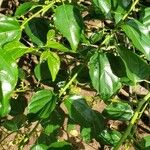
Colubrina asiatica
Wild coffee · Beach berrybush · Indian snakewood · Asian Nakedwood · Hoop-withe
Description
Source: leafsnapColubrina asiatica, commonly known as Asian snakewood or beach cherry, is a small tree or shrub belonging to the family Rhamnaceae. Native to tropical and subtropical regions of Asia, Africa, and Australia, this plant can grow up to 10 meters in height and boasts a dense crown of glossy green leaves. The leaves of Colubrina asiatica are simple, alternate, and ovate with serrated margins. The plant produces small white flowers from late winter through early spring, which are followed by small red berries that ripen during the summer. For centuries, Colubrina asiatica has been valued for its medicinal properties, particularly its anti-inflammatory benefits. Additionally, it is popular as an ornamental plant due to its attractive foliage and colorful berries. The plant thrives in well-drained soils and prefers full sun exposure, although it can also tolerate partial shade. While Colubrina asiatica is drought-tolerant, regular watering is essential during its initial growth period. In summary, Colubrina asiatica is a versatile plant with both medicinal properties and ornamental value, making it an excellent addition to any garden or landscape design project.
Care Guide
💧 Water Every 7 days
Originating from coastal regions, the Asian nakedwood thrives with minimal moisture, needing water only every 2 to 3 weeks. This drought-tolerant species adapts well to warmer climates and seasonal rainfall patterns, which influence its growth cycles and water uptake efficiency.
☀️ Light Full sun
Originating from bright, sun-drenched habitats, Asian nakedwood is a tropical woody species that flourishes in full sun yet can tolerate partial sun. It commonly occurs in open, well-lit locations with little shade.
What are the sunlight requirements for Asian nakedwood (Colubrina asiatica)?
Asian nakedwood requires full sun, defined as over 6 hours of sunlight, to thrive but can also tolerate partial sun, about 3-6 hours of sunlight. This tropical woody plant is native to bright, sun-drenched environments and often grows in open, well-lit areas with minimal shade. When selecting a location for your Asian nakedwood, it's crucial to observe how sunlight moves through your garden and choose spots that provide a balance of light and shade, ensuring the plant's happiness.
How can artificial lighting be used for indoor Asian nakedwood plants?
Indoor Asian nakedwood plants require adequate lighting for optimal growth, especially when natural sunlight is insufficient, such as in winter or in less sunny spaces. Artificial lights, like LEDs that provide specific wavelengths of light needed by plants, offer a solution by promoting faster, healthier growth. For full sun plants, 30-50W/sq ft of artificial light is needed, 20-30W/sq ft for partial sun plants, and 10-20W/sq ft for full shade plants. The light source should be placed 12-36 inches above the plant to mimic natural sunlight, and most plants need 8-12 hours of light per day.
What symptoms indicate insufficient light for indoor Asian nakedwood?
Symptoms of insufficient light for indoor Asian nakedwood include small, new leaves growing smaller than previous ones, leggy or sparse growth with elongated spaces between leaves or stems, faster leaf drop to conserve resources, slower or no new growth as the plant enters survival mode, lighter-colored new leaves indicating a lack of chlorophyll and nutrients, chlorosis leading to leaves losing their green color and turning yellow, sunscald with pale or necrotic areas on plant tissue, leaf curling as a defense mechanism to minimize water loss, wilting due to increased water loss from overexposure to sunlight leading to drooping leaves and stems, and leaf scorching characterized by brown, dry, and crispy leaf edges due to excessive sunlight.
What are the solutions for adapting Asian nakedwood to its light environment?
To adapt Asian nakedwood to its light environment, gradually move plants to receive at least 6 hours of direct sunlight daily for outdoor care, and use a south-facing window or keep a desk or ceiling lamp on for at least 8 hours daily for indoor care. If the plant is too large or not easily movable, consider using professional grow lights. For outdoor plants, ensure a gradual adaptation to avoid sunburn. Parts of the plant that have suffered from insufficient sunlight may not recover, but new growth will be healthy. If plants are in the ground and sunlight is obstructed, consider pruning surrounding trees or transplanting the plant to a sunnier location during its dormant period for better light exposure.
🌡️ Temperature 20–37.8°C
Asian nakedwood comes from habitats where temperatures generally range from 68 to 100 °F (20 to 38 ℃). Therefore it grows best in warm conditions and may struggle in very cold environments. Adjustments may be needed during cooler seasons.
What is the ideal temperature range for Asian nakedwood?
Asian nakedwood is native to environments where temperatures typically range from 68 to 100 °F (20 to 38 °C), which indicates its preference for warm conditions. This plant is very heat-loving and can struggle in very cold settings, making adjustments necessary for cooler seasons. During the autumn, it's recommended to bring the plant indoors if it's being grown outside, ensuring it's placed near a bright window while keeping a safe distance from heaters. To support its growth, maintaining indoor temperatures above 20°C during the winter is beneficial, as any exposure to temperatures near or below 0°C can be detrimental to the plant.
How does low temperature affect Asian nakedwood and what are the solutions?
Asian nakedwood prefers warm temperatures and does not tolerate low temperatures well, thriving best when the temperature remains above 20°C. In winter, it's important to keep the plant's surroundings warmer than 0°C. Exposure to temperatures below -5°C may cause the leaves to lighten in color, and following frost damage, leaves gradually turn brown or black, showing symptoms of wilting and drooping. To mitigate such damage, trim off the frost-damaged parts and immediately move the plant to a warm environment indoors. Placing it near a south-facing window can ensure ample sunlight, but it's crucial to avoid placing the plant near heaters or air conditioning vents, which can cause excessive dryness in the air.
How does high temperature affect Asian nakedwood and what are the solutions?
During the summer months, it's advisable to keep Asian nakedwood in conditions where temperatures don't surpass 38°C to prevent heat stress. When the temperature exceeds 43°C, the plant may exhibit signs of stress such as a lightening of leaf color and increased susceptibility to sunburn. To care for a plant that's suffering from high-temperature stress, trim away the sunburned and dried-up portions. Then, move the plant to a spot where it can be shielded from the intense midday and afternoon sun. Ensuring the plant is watered in the morning and evening can help keep the soil adequately moist, further mitigating the effects of high temperatures.
💨 Humidity
🪴 Soil 6-7
🌱 Fertilizer
Fertilizing is essential for care of Asian nakedwood. Regular feeding during the active growing season preserves the energy required for its showy leaves and aids overall growth. If fertilization is neglected, leaves can become unhealthy, the plant’s ornamental appeal can decline, and growth may be stunted or weak and prone to breaking.
🪴 Pot & Repot
✂️ Pruning
Asian nakedwood is a hardy shrub characterized by its glossy dark green leaves and small yellow-green flowers. To maintain its health, prune the shrub from early to late winter. Pruning helps remove dead branches and improves airflow, promoting healthy growth and preventing pest infestations. Always use clean tools during the process to avoid infections and support vigorous regrowth.
🌿 Propagating
🐛 Diseases & pets
☠️ Toxicity
Characteristics
- Plant Type
- Tree, Vine, Shrub
- Life Cycle
- Perennial
- Genus
- Colubrina
- Family
- Rhamnaceae
- Hardiness Zone
- 9-11
- Mature Height
- 9.14 m
- Mature Spread
- 2.44 m
- Leaf Color
- Forest Green, Dark Green
- Leaf Type
- Evergreen
- Flower Color
- Yellow, Green
- Flower Size
- 0.51 cm
- Bloom Time
- Late spring, Summer, Early fall, Mid fall
- Planting Time
- Spring, Summer, Autumn
- Harvest Time
- Late summer, Fall, Early winter, Mid winter
- Native Area
- Sri Lanka, India, Malaysia, Vanuatu, Philippines, Madagascar, Laos, Fiji, Kenya, Tanzania, China, Solomon Islands, Indonesia, Cambodia, Vietnam, Mozambique, Myanmar, Papua New Guinea, Singapore, Thailand