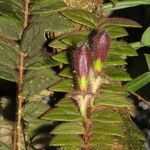
Columnea gloriosa
Goldfish plant
Description
Source: leafsnapColumnea gloriosa is commonly known as the goldfish plant (a name it shares with a number of other species), because of the fish shaped flowers it produces. It falls into the genus Columnea. Also known as a cousin to African violets. This plant is in the family Gesneriaceae. Some authorities have it as a synonym of Columnea microcalyx. Origins are from Central and South America and the Caribbean.
Care Guide
💧 Water
The goldfish plant, native to tropical rainforests, thrives in moist environments with consistent humidity. To maintain healthy soil, it should be watered regularly, about twice a week, to keep it evenly damp. This plant is ideally suited for indoor settings that mimic its natural habitat, such as terrariums or well-lit bathrooms.
☀️ Light Partial sun
Goldfish plant is native to habitats like forest understories and rocky locations, where it grows in natural shade. It prefers partial sun but can tolerate full sun or deep shade, demonstrating its adaptable, hardy nature.
What are the sunlight requirements for a Goldfish plant?
The Goldfish plant, or Columnea gloriosa, thrives in varying sunlight conditions. For ideal growth, it requires partial sun, meaning about 3-6 hours of sunlight daily. If the area is in full shade, which is defined as receiving less than 3 hours of sunlight, it still can manage, but this is the minimum it should get. It's important to observe how sunlight moves through your garden throughout the day to find the best spot that offers a balance of light and shade suitable for your plants. This careful observation ensures the plants' happiness and health.
🌡️ Temperature 20–37.8°C
The goldfish plant comes from tropical areas where the climate is generally warm and humid. Consequently, it is adapted to high temperatures and humidity. It is sensitive to sudden temperature shifts and prefers a steady temperature, so avoiding indoor temperature fluctuations is important. It typically does not tolerate cold and needs warmer conditions to grow. If the ambient temperature falls too low, the plant may stop growing or even die.
💨 Humidity
🪴 Soil 6-7
🌱 Fertilizer
The best time to fertilize a Goldfish plant is in early spring, when it comes out of dormancy. This encourages overall growth and flower development. Fertilizing improves the foliage, stems, and branches, and encourages flowers that are large, vibrant, and long-lasting. It helps move nutrients from the roots to the blooms and enhances the plant's health and resistance to disease.
🪴 Pot & Repot 2-3 years
When repotting a Goldfish plant, select a pot 1-2 inches (2.5–5.1 cm) larger with good drainage. Use a well-draining potting mix. Repot in spring or fall, making sure the root ball sits slightly below the rim of the flower pot. Water thoroughly after repotting and place in a warm spot with indirect sunlight.
✂️ Pruning
To keep a goldfish plant healthy and encourage abundant blooms, it is best to prune it in early spring. Trim back any long, spindly stems and remove any dead growth to promote fuller foliage. Regular maintenance like this improves air circulation and light access, which prevents the plant from becoming unruly and helps ensure vigorous flowering.
🌿 Propagating
🐛 Diseases & pets
☠️ Toxicity
The goldfish plant is considered non-toxic for children and pets. Refrain from eating or consuming the leaves or any other part of the plants.
Characteristics
- Plant Type
- Vine
- Life Cycle
- Perennial, Annual
- Genus
- Columnea
- Family
- Gesneriaceae
- Hardiness Zone
- 10-12
- Mature Height
- 30 cm to 61 cm
- Mature Spread
- 30 cm to 46 cm
- Leaf Color
- Green
- Leaf Type
- Evergreen
- Flower Color
- Red, Orange
- Flower Size
- 5.08 cm to 6.35 cm
- Bloom Time
- All year round
- Planting Time
- Spring, Summer, Autumn
- Harvest Time
- All year round
- Native Area
- Costa Rica