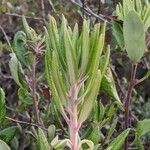
Comarostaphylis diversifolia
Summer-holly · Mock arbute · Summer-blooming manzanita
Description
Source: leafsnapComarostaphylis diversifolia, commonly known as summer holly or mountain misery, is a shrub species in the Ericaceae family. Native to California, it thrives in diverse habitats such as chaparral, oak woodlands, and mixed evergreen forests. The plant typically reaches up to 6 feet in height and features dense branching with small, oval-shaped leaves that are dark green. These leathery leaves have serrated edges and a glossy appearance on the top surface, while the underside is hairy. In spring, Comarostaphylis diversifolia produces clusters of small white or pinkish flowers at the tips of its branches. These blossoms attract various pollinators, including bees and butterflies. During the summer, the plant bears small red berries. While these berries are edible, they are not commonly eaten by humans due to their bitter taste. Comarostaphylis diversifolia is valued for its medicinal properties by Native American tribes, who have used it to treat various ailments such as stomachaches, colds, and coughs. Overall, Comarostaphylis diversifolia is a significant component of California's native flora. It provides essential habitat for wildlife and holds cultural importance for indigenous communities, who have traditionally utilized its medicinal qualities.
Care Guide
💧 Water Every 7 days
Summer-holly, which originates from arid regions, is highly drought-tolerant and thrives with minimal moisture. It typically needs watering every 2-3 weeks, with occasional deep watering during its growing season. This approach simulates the natural pattern of infrequent rainfall, helping to maintain the plant's health.
How should I water my Summer-holly?
To water your Summer-holly, you have flexibility in choosing the watering tool. Whether it's a watering can, hose, or even a cup, any common tool will do the job. The important thing is to apply the water directly to the soil, ensuring that all areas of the soil are equally moistened. Using filtered water is recommended to avoid any harmful particles from tap water. Additionally, using water that is at or slightly above room temperature is preferable to avoid shocking the Summer-holly. However, overall, the Summer-holly is not too particular about the type of water it receives and usually responds well to any kind of water.
What should I do if I give my Summer-holly plant too much or too little water?
Outdoor plants, especially newly planted ones or seedlings, can suffer from lack of watering. It is important to consistently water them for a few months while they are small or recently planted. Once the roots are established, Summer-holly plants can rely on rain most of the time. When Summer-holly is planted in pots, overwatering is more likely. If you accidentally overwater your Summer-holly, take immediate action to fix the situation. Stop watering the plant right away to minimize the effects of overwatering. Next, remove the Summer-holly from its pot to inspect the roots. If no root rot is present, you can return the plant to its container. If you notice signs of root rot, trim the affected roots and apply a fungicide to prevent further damage. Repot the plant in well-draining soil. For underwatered Summer-holly, simply water it more frequently. Underwatering is easily corrected as the plant's leaves will droop and dry out, but they will regain fullness quickly with sufficient watering. Adjust your watering frequency when you notice underwatering occurring.
How much water does my Summer-holly need and how often?
Most outdoor plants can grow naturally with rainfall. However, if your area doesn't receive much rainfall, you'll need to water your plants every two weeks in the spring and fall. During the summer, you'll need to water more frequently. In the winter, when plants grow slower and need less water, you can water them less often or not at all. For young or newly planted Summer-holly plants, it's important to water them more often to help them establish and become more tolerant of drought conditions. When it comes to potted plants, there are two main ways to determine how often to water your Summer-holly. The first way is to follow a set watering schedule, such as once a week or every other week. However, this approach may not always work well as it doesn't consider the specific growing conditions of your Summer-holly. Another approach is to check the moisture level of the soil. Ideally, you should wait until the top two to four inches of soil (about 1/3 to 1/2 depth of the pots) have completely dried out before watering again. This method takes into account the plant's changing water needs throughout the seasons.
How much water does my Summer-holly plant need?
To water your Summer-holly, you don't always need to use a lot of water. If only a few inches of soil have dried since your last watering, just give it about five to ten ounces of water. You can also consider the moisture level of the soil. Note how many inches of soil have dried out between waterings. To ensure the Summer-holly gets enough moisture, water until all the dry soil layers are moistened. If more than half of the soil is dry, give it more water until you see excess water draining from the pot's holes. If your Summer-holly is planted in a rainy outdoor area, it might not need extra watering. When it is young or still establishing, make sure it receives 1-2 inches of rain per week. Once it grows and establishes, it can survive on rainwater unless there's a hot spell without rain for 2-3 weeks. In that case, give it a thorough watering to prevent stress.
How can I know if I'm giving enough water to my Summer-holly plant?
The Summer-holly is more commonly affected by overwatering, which can be identified by yellowing leaves, leaf dropping, a shriveled plant structure, and potential root rot. Conversely, an underwatered Summer-holly will start to wilt and may show brown or brittle leaves. In either case, it is important to take action and restore the health of your Summer-holly.
☀️ Light Full sun
Summer-holly is native to open habitats, such as sunny meadows and forest edges, which provide abundant light. It does best in Full Sun but can also tolerate Partial Sun, adapting well to a range of sunlight conditions.
🌡️ Temperature 15–35°C
Summer-holly is a plant native to temperate regions. It prefers temperatures between 59 and 95 °F (15 to 35 ℃). In colder seasons, it is advisable to adjust the temperature toward this preferred range.
What is the ideal temperature range for Summer-holly?
Summer-holly, scientifically known as Comarostaphylis diversifolia, is a plant that thrives in temperate climates. It prefers temperatures between 59 to 95°F (15 to 35°C). Adjusting the environment to maintain temperatures within this range, especially during the colder seasons, is beneficial for its growth. Despite its strong cold resistance, in regions where winter temperatures are expected to fall below -15°C, measures should be taken to protect the plant from frost.
How can I protect Summer-holly from cold temperatures?
To protect Summer-holly from cold temperatures, especially when temperatures are predicted to drop below -15°C, it is important to take certain precautions. Wrapping the trunk and branches with non-woven fabric or cloth can provide essential cold protection. Additionally, watering the plant abundantly before the first freeze of autumn helps to ensure the soil remains moist and enters a frozen state, which is crucial for preventing drought and water scarcity during the winter and early spring months.
What are some symptoms of Summer-holly being affected by low temperatures?
When exposed to low temperatures, especially below -15°C, there may not be noticeable changes to Summer-holly during the winter. However, during spring, affected branches can become brittle, dry, and may fail to produce new shoots. To address this, pruning any dead branches that have not produced new leaves in the spring is recommended for the health and aesthetics of the plant.
How does high temperature affect Summer-holly and what can I do?
Summer-holly should ideally be kept at temperatures below 35°C during the summer. Exposing the plant to temperatures above 41°C can cause the leaves to lighten in color, the tips to become dry and withered, and increases susceptibility to sunburn. To mitigate these effects, removing sunburned and dried-up parts, relocating the plant to a shaded area or using shade cloth to block direct sunlight during the midday and afternoon, and watering the plant in the morning and evening to maintain soil moisture are effective strategies.
💨 Humidity
🪴 Soil 6-6
🌱 Fertilizer
Timing is important for fertilizing Summer-holly. Apply fertilizer in early spring and continue monthly through early summer. The fertilizer encourages attractive blooms and supplies energy during both dormant and active growth phases.
Why should I put fertilizer on my Summer-holly plant?
Fertilizing your Summer-holly is essential for several important reasons. Firstly, it helps in producing beautiful blooms. For optimal results, it is recommended to fertilize in early spring to ensure excellent flowers during the season. Additionally, fertilizer provides your Summer-holly with ample energy that it can store in the soil while it's in its dormant growth phases. By giving your Summer-holly extra nutrients during fall planting or late spring, it will be able to store more energy to utilize for active growth later on.
When should I put fertilizer on my Summer-holly?
To effectively fertilize Summer-holly, timing is crucial. Applying fertilizer too early while the plant is still dormant will be wasteful, as it will be washed away by rainwater, causing pollution. For best results, the first application of fertilizer should be in early spring, and then continue to fertilize once a month until early summer.
When is it not a good idea to put fertilizer on my Summer-holly plant?
To ensure optimal growth and blooming of Summer-holly, be mindful of the amount of nitrogen in the fertilizer. Excessive nitrogen can result in an abundance of leaves without many blooms. Choose a fertilizer with lower nitrogen levels compared to other nutrients. Furthermore, avoid fertilizing too late in the season, such as during early autumn, as this can cause excessive growth before winter sets in. Additionally, refrain from fertilizing Summer-holly during hot and dry periods when the soil is not as effective at delivering nutrients. Fertilizing during these times can stimulate growth that requires more water, which may not be readily available. It is advisable to apply fertilizer earlier in the season when temperatures are cooler. Lastly, keep in mind that Summer-holly can absorb fertilizer from nearby plants or lawns, so be cautious about unintentionally giving the tree or shrub a double dose of fertilizer.
What kind of fertilizer does my Summer-holly plant need?
To help Summer-holly plants thrive, the ideal fertilizer should have a balanced mix of nutrients, with slightly more phosphorus. Gardeners can also opt to improve the soil by adding organic materials like compost, worm castings, and manure. When flower buds begin to appear, experienced gardeners might choose to supplement with water-soluble fertilizers containing phosphorus, enhancing flower development and promoting larger, longer-lasting blooms. Fertilizers for Summer-holly are available in different forms, but liquid or powdered options are considered among the best. Regardless of the form chosen, it is important to dilute the fertilizer and apply it while watering the Summer-holly plants.
How should I fertilize my Summer-holly plant?
To properly fertilize your Summer-holly, it's important to follow the specific instructions for the type of fertilizer you're using. Researching how to use it for your particular plant is also crucial. Be careful not to overdo it, as too much fertilizer can be harmful. A good guideline is to determine the correct amount based on the age of the tree or the diameter of the trunk. Generally, you can estimate using one-tenth of a pound of fertilizer per year or per inch of trunk, with a maximum of one pound. Granular and organic fertilizers, like blood meal, can be applied by sprinkling them around the base of the tree, all the way to the drip line. Make sure the fertilizer does not come into contact with the trunk. Over time, the granules will break down and be absorbed by the roots. After fertilizing, it's beneficial to spread a layer of compost around the base of the tree, about an inch deep, and then thoroughly water it.
🪴 Pot & Repot
✂️ Pruning
To maintain the shape and promote growth of summer-holly, prune the plant from early to late winter. Start by removing any dead branches and thinning out crowded areas to improve air circulation. Light trimming can encourage the plant to become bushier, while proper pruning helps foster flowering and control the plant's size.
🌿 Propagating
🐛 Diseases & pets
☠️ Toxicity
Characteristics
- Plant Type
- Tree, Shrub
- Life Cycle
- Perennial
- Genus
- Comarostaphylis
- Family
- Ericaceae
- Hardiness Zone
- 7-10
- Mature Height
- 3.96 m
- Mature Spread
- 1.52 m to 3.05 m
- Leaf Color
- Dark Green
- Leaf Type
- Evergreen
- Flower Color
- White, Pink
- Flower Size
- 0.51 cm to 0.76 cm
- Bloom Time
- Early spring, Mid spring
- Planting Time
- Spring, Summer
- Harvest Time
- Summer