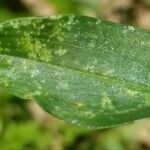
Commelina cyanea
Scurvy weed
Description
Source: leafsnapCommelina cyanea, commonly known as Scurvy Weed or Blue Spiderwort, is a perennial herbaceous plant from the Commelinaceae family. Although native to South America, it has been introduced and naturalized in many parts of the world. The plant can grow up to 60 cm tall and has a spreading habit with long, thin stems that bear lance-shaped leaves with pointed tips. The most striking feature of Commelina cyanea is its beautiful blue flowers, which bloom from spring through summer. These small flowers are clustered in groups of three on long stalks that arise from the leaf axils. Each flower has three petals: two large blue petals on top and a smaller white petal at the bottom. Scurvy Weed prefers moist soils in partial shade or full sun but can tolerate dry conditions once established. It is an easy-to-grow plant that requires minimal care, making it an excellent choice for novice gardeners. In addition to its ornamental value, Commelina cyanea also has medicinal properties, as it contains compounds such as flavonoids and alkaloids with anti-inflammatory effects. Overall, this beautiful plant adds color and interest to any garden while also providing potential health benefits for those who use it medicinally.
Care Guide
💧 Water Every 7 days
Scurvy weed thrives in humid subtropical climates and prefers weekly watering to keep its foliage dense without becoming waterlogged. It is resilient indoors and adapts well to different humidity levels. As an evergreen plant, scurvy weed efficiently retains water, maintaining its lush appearance throughout the year.
☀️ Light Partial sun
Scurvy weed does best in locations with moderate sunlight and does not require full sun to reach optimal growth. Its natural habitat is made up of lightly sunlit areas. The plant can tolerate places with low light, although its growth may slow and it may wilt.
What are the sunlight requirements for Scurvy weed?
Scurvy weed, also known as Commelina cyanea, requires partial sun, meaning about 3-6 hours of sunlight is ideal. It can also grow in full shade conditions, which is less than 3 hours of sunlight. Observing how sunlight moves through your garden is crucial for selecting spots that provide a balanced environment for your plants. Scurvy weed thrives in areas with moderate sun exposure and can adapt to mild sunlight or scarce light conditions, though limited light may slow its growth or cause wilting.
How can artificial lighting support Scurvy weed's growth indoors?
When natural sunlight is insufficient, artificial lighting can play a crucial role in promoting optimal growth for Scurvy weed indoors. LED lights are recommended for their ability to provide specific wavelengths needed by the plant. Full sun plants typically require 30-50W/sq ft of artificial light, partial sun plants need 20-30W/sq ft, and full shade plants benefit from 10-20W/sq ft. The light source should be placed 12-36 inches above the plant to mimic natural sunlight, and most plants will thrive with 8-12 hours of artificial light per day.
What are the symptoms of insufficient light in Scurvy weed?
Scurvy weed shows several symptoms when grown under insufficient light, including smaller new leaves, leggy or sparse growth, early leaf drop, halted growth, pale new leaves, chlorosis, sunscald, leaf curling, wilting, and leaf scorching. These symptoms indicate various stress responses to inadequate light, affecting the plant's overall health and growth capacity.
What solutions are recommended for Scurvy weed experiencing insufficient sunlight?
For indoor plants, gradually shifting them to sunnier spots each week until they receive proper sunlight (3-6 hours of direct sunlight daily) is recommended. If moving the plant isn't feasible, using artificial lighting, such as desk or ceiling lamps for at least 8 hours daily or investing in professional grow lights, can help. Outdoors, transitioning plants gradually to areas with more sunlight can prevent sunburn, while careful pruning of obstructions like trees can enhance sun exposure. For smaller plants, consider transplanting them during their dormant period to a location with ample sunlight and good drainage. It's important to note that parts of the plant affected by low light may not recover, but new growth following increased light exposure should be healthy.
🌡️ Temperature 5–25°C
Scurvy weed is typical of temperate climates, flourishing best in areas where temperatures lie between 41 to 77 °F (5 to 25 ℃). Native to regions with moderate temperatures, it will require careful management and acclimation if exposed to more extreme weather conditions.
What climates are ideal for Scurvy weed (Commelina cyanea)?
Scurvy weed, or Commelina cyanea, thrives in temperate climates, finding its ideal conditions in regions where the temperatures range between 41 to 77 °F (5 to 25 °C). Native to environments that experience moderate temperatures, it requires careful management if it encounters more extreme weather conditions. The plant is particularly cold-tolerant, meaning it does not need special frost protection measures in winter. However, it's beneficial to water the plant generously before the first freeze of autumn to ensure the soil stays moist and enters a frozen state. This preparation helps prevent drought and water scarcity for the plant during the cold months and into early spring.
How does Scurvy weed handle low temperatures?
Scurvy weed is remarkably tolerant of cold conditions, able to withstand winter temperatures down to -25°C without the need for additional frost protection. Despite this resilience, if the temperature falls below -25°C, while there might not be noticeable effects during the winter, such extreme cold can lead to decreased sprouting or even a total lack of sprouting in spring. To mitigate these issues, it is recommended to remove any parts of the plant that have failed to sprout once spring arrives.
What should I do if my Scurvy weed experiences high temperatures?
Scurvy weed struggles in high temperatures, particularly when the mercury rises above 25°C. In such conditions, its growth can halt, and it becomes more vulnerable to rot. If the plant is exposed to excessive heat, you should trim away any sunburned or dried-out sections. Additionally, moving the plant to a shaded location, particularly away from the harsh midday and afternoon sun, or employing a shade cloth can offer the necessary protection. To assist the plant further, ensure the soil remains moist by watering it during the cooler parts of the day, specifically in the morning and evening.
💨 Humidity
🪴 Soil 6-7
🌱 Fertilizer
The best time to fertilize Scurvy weed is in early spring, as it emerges from dormancy and begins active growth. Fertilization supplies the essential nutrients for healthy development. Although Scurvy weed has relatively low fertilizer requirements, applying fertilizer annually can improve its survival and encourage better, longer-lasting flowers.
🪴 Pot & Repot
✂️ Pruning
To promote robust growth and seasonal vitality in scurvy weed, prune it from early to late spring. Focus on removing dead stems and encouraging bushier growth by making proper cuts just above the nodes. This enhances regrowth, improves air circulation, and reduces the risk of disease.
🌿 Propagating
🐛 Diseases & pets
☠️ Toxicity
Characteristics
- Plant Type
- Herb
- Life Cycle
- Perennial
- Genus
- Commelina
- Family
- Commelinaceae
- Hardiness Zone
- 5
- Mature Height
- 20 cm
- Mature Spread
- 30 cm
- Leaf Color
- Green, Dark Green
- Leaf Type
- Semi-evergreen
- Flower Color
- Blue
- Flower Size
- 1.52 cm
- Bloom Time
- Late spring, Summer, Fall
- Planting Time
- Spring, Summer
- Harvest Time
- Summer, Fall, Early winter