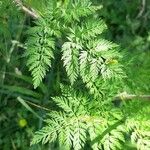
Conium maculatum
شوکران · شوکران زهرآلود، · Κώνειον το στικτόν (GR) (EL) · Poison hemlock · Hemlock
Description
Source: leafsnapConium maculatum, commonly known as poison hemlock, is a highly toxic biennial plant belonging to the Apiaceae family. Native to Europe and North Africa, it has been introduced and naturalized in many regions worldwide. The plant can reach heights of 2-3 meters and features a smooth, hairless stem that is often purple-spotted or streaked. The leaves of Conium maculatum are fern-like, finely divided into numerous small leaflets. Its small, white or yellowish-white flowers are arranged in umbrella-shaped clusters called umbels, located at the end of the branches. The plant typically blooms from June to August. All parts of Conium maculatum contain toxic alkaloids such as coniine and gamma-coniceine, which can cause respiratory failure if ingested by humans or animals. Symptoms of poisoning include nausea, vomiting, abdominal pain, dizziness, tremors, and ultimately paralysis, leading to death. Despite its high toxicity, Conium maculatum has been used for medicinal purposes since ancient times, primarily for its sedative properties, which provided pain relief during surgeries before the advent of anesthesia. However, its use is strongly discouraged due to its dangerous nature and should only be considered under strict medical supervision. In conclusion, while Conium maculatum may possess medicinal properties when used under strict medical supervision, its highly toxic nature makes it extremely dangerous if ingested without proper knowledge. Excessive consumption can lead to severe harm or even death.
🌳 Apart from its known toxicity and medicinal claims, historical sources indicate that poison hemlock was used as a means of state-sanctioned execution and for criminal purposes. The plant’s toxin was historically extracted and employed by professional poisoners, making it one of the earliest instruments of criminal poisoning — a use broadly condemned and feared throughout history.
🎭 You are going to be the death of me.
Care Guide
💧 Water Every 7 days
Poison hemlock flourishes in moderate climates that have regular moisture. To keep the soil consistently moist, it requires weekly watering. Although the plant can tolerate some drought, it has difficulty thriving in excessively wet or dry conditions. Such conditions can negatively impact its biennial growth cycle, especially during its active growing season.
How should I water my Poison hemlock?
To effectively water the Poison hemlock, follow these guidelines for the best results. Use filtered water that is at room temperature or slightly warmer. This is because tap water may contain harmful particles. The Poison hemlock is accustomed to a warm environment, so cold water can be too much for it. Avoid overhead watering to prevent issues with the foliage. Instead, focus on thoroughly saturating the soil with filtered, room temperature water. This will benefit the plant by keeping the roots moist and aiding in nutrient absorption.
What do I do if I give my Poison hemlock too much or too little water?
Overwatering and underwatering both harm Poison hemlock, but overwatering is more common. Too much water causes wilting, yellowing, and potential diseases like root rot, mold, and mildew. Underwatering is rarer because Poison hemlock can withstand drought better, but it can make leaves brittle and brown. It's important to recognize signs of overwatering early to prevent irreversible damage. Reduce watering immediately when you notice early signs, and check the soil's draining ability. If it drains poorly, replace it with a well-draining potting mix. If your Poison hemlock lacks water, increase watering until symptoms disappear.
How often should I give water to my Poison hemlock plant?
If your Poison hemlock is in a pot, the most precise way to determine if it needs water is to stick your finger into the soil. If the top two to three inches of soil are dry, it's time to water it. For those growing the Poison hemlock outdoors in the ground, you can use a similar method. Once the first few inches of soil have dried out, it's time to add water. Typically, you'll need to water this plant about once a week during the spring and early fall. However, in extremely hot weather, watering frequency may need to increase to twice or more per week. Despite this, mature, well-established Poison hemlock has an impressive ability to endure drought.
How much water does my Poison hemlock plant need?
To properly water your Poison hemlock, make sure you give it a generous amount of water. When the top two to three inches of soil are dry, it's time for a thorough watering. Add enough water to completely saturate the soil, allowing excess water to drain out from the pot's holes. If you don't see any excess water draining, you might not have watered enough. Avoid letting water accumulate, as this can harm the plant. Additionally, if water doesn't drain well from the pot, it's important to use well-draining soil. If your plant is outdoors, about 1 inch of rain per week should be enough.
How do I water my Poison hemlock when it is growing at different stages?
The water requirements of Poison hemlock vary depending on its growth stages. In the first few years and when newly transplanted, it needs more water. During these stages, the plant expends a lot of energy on developing new roots to support future growth. To aid optimal root performance, they require slightly more moisture than during mature phases. After a few seasons, the water needs decrease. Additionally, during the bloom period, the plant may require more water due to the significant moisture consumption during flower development.
☀️ Light Full sun
Poison hemlock grows best beneath open, clear skies with abundant sunlight all day. Its origin in sun-rich habitats lets it tolerate periods of moderate shade. However, too little or too much light can impede its healthy growth.
What are the sunlight requirements for Poison Hemlock?
Poison Hemlock thrives best under clear, open skies, requiring abundant sunlight throughout the day. It has adapted to environments with plenty of sunlight, allowing it to tolerate moderate shade. However, both insufficient and excessive exposure to light can negatively impact its growth. Specifically, it needs more than 6 hours of sunlight for full sun conditions and about 3-6 hours for partial sun conditions. It is important to observe your garden's sunlight patterns to ensure that your plants receive the optimal balance of light and shade to flourish.
How can artificial lighting support the growth of indoor plants like Poison Hemlock?
When natural sunlight is lacking, especially during winter or in less sunny indoor spaces, artificial lighting becomes crucial for the growth of indoor plants, including Poison Hemlock. LED lights are recommended due to their ability to be customized to the specific light wavelengths needed by plants. Full sun plants require 30-50W/sq ft, partial sun plants need 20-30W/sq ft, and full shade plants benefit from 10-20W/sq ft of artificial light. The artificial light source should be placed 12-36 inches above the plant, mimicking natural sunlight as closely as possible, with most plants needing 8-12 hours of light per day.
What are the symptoms of inadequate light exposure in Poison Hemlock?
Inadequate light exposure in Poison Hemlock can lead to several symptoms indicating the plant's struggle to grow properly. These include the development of smaller new leaves, leggy or sparse growth due to elongated spaces between leaves or stems, early dropping of older leaves as a resource conservation measure, delayed or halted growth, pale or irregularly colored new leaves because of insufficient chlorophyll, chlorosis which manifests as yellowing leaves, sunscald from excessive light causing damage to leaves or stems, leaf curling to minimize water loss and damage from extreme sunlight, wilting from increased transpiration and insufficient hydration, and leaf scorching evidenced by brown, dry, and crispy leaf edges or patches.
What solutions can be implemented for Poison Hemlock experiencing light-related growth issues?
For indoor Poison Hemlock plants struggling with light exposure, gradually moving them to sunnier locations to receive at least 6 hours of direct sunlight daily is recommended. Utilizing a south-facing window with open curtains during the day can maximize sunlight exposure. If moving the plant isn't feasible, considering artificial lighting, such as keeping a desk or ceiling lamp on for at least 8 hours daily or investing in professional plant grow lights, can provide additional light. For outdoor plants, it's essential to adjust their location to gradually expose them to more sunlight, avoiding sudden changes that could cause sunburn. Observing and minimizing obstructions like trees can increase sunlight access. In some cases, transplanting to a better-lit location may be necessary. Note that while parts of the plant damaged by insufficient light may not recover, new growth should be healthy with improved light conditions.
🌡️ Temperature 5–35°C
Poison hemlock is a plant that does best in its native temperate climate, where temperatures range from 68 to 95 °F (20 to 35 ℃). This means it is well-suited to areas whose summer highs remain within that range. In colder seasons, keep temperatures above 68 °F (20 ℃) to ensure healthy growth.
What is the ideal temperature range for growing Poison hemlock?
Poison hemlock thrives in temperate environments, with the ideal temperature range being 68 to 95 °F (20 to 35 ℃). To ensure healthy growth, it's crucial to maintain a temperature above 68 °F (20 ℃) during the colder seasons. Poison hemlock exhibits strong cold resistance, and typically does not require special frost protection measures in winter. However, if temperatures are expected to drop below this optimal range, it's important to protect the plant from the cold by covering it with soil or straw and watering it abundately before the first freeze in autumn to maintain moist soil.
How does Poison hemlock respond to low temperatures?
Poison hemlock is quite cold-tolerant and generally does better when the temperature stays above a certain minimum threshold. If the temperature drops below this limit during winter, while there may not be noticeable changes in the plant's appearance, it could lead to a decrease in sprouting or even a lack of sprouting in the spring. If this occurs, it's recommended to remove any parts of the plant that have failed to sprout in the spring.
What should I do if Poison hemlock experiences high temperatures?
During the summer, it's essential to keep Poison hemlock's temperature below a certain maximum to prevent stress on the plant. Exceeding this temperature limit can cause the leaves to lighten in color, curl, become susceptible to sunburn, and in severe cases, the entire plant may wilt and dry up. To mitigate these issues, trim away the sunburned and dried parts of the plant. Moving the plant to a shaded location or using a shade cloth can protect it from the midday and afternoon sun. Additionally, watering the plant in the morning and evening helps keep the soil moist and supports the plant's health.
💨 Humidity
🪴 Soil 6-7
🌱 Fertilizer
Poison hemlock is considered a heavy feeder with respect to nutrients. It needs frequent, small doses of nitrogen and potassium fertilizers and periodic applications of phosphorus, micronutrients, sulfur, and magnesium to sustain good growth and bright coloration. Continuous fertilization throughout the growing season prevents deficiency symptoms and maintains optimal growth.
🪴 Pot & Repot
✂️ Pruning
🌿 Propagating
🐛 Diseases & pets
☠️ Toxicity
Characteristics
- Plant Type
- Herb
- Life Cycle
- Biennial, Perennial
- Genus
- Conium
- Family
- Apiaceae
- Hardiness Zone
- 5-10
- Mature Height
- 1.52 m to 2.44 m
- Mature Spread
- 91 cm
- Leaf Color
- Green
- Leaf Type
- Deciduous
- Flower Color
- White
- Flower Size
- 10.16 cm to 15.24 cm
- Bloom Time
- Late spring, Early summer, Mid summer
- Planting Time
- Summer
- Harvest Time
- Mid summer
- Native Area
- Libya, Turkey, Sweden, India, Slovakia, Montenegro, Pakistan, Slovenia, Morocco, Croatia, Belarus, Germany, Jordan, Ethiopia, Romania, Latvia, Belgium, Moldova, Portugal, Netherlands, Saudi Arabia, Tunisia, Cyprus, Bulgaria, Ukraine, Lebanon, China, Afghanistan, Syria, Kyrgyzstan, Kazakhstan, Italy, Finland, Bosnia and Herzegovina, Iran, Azerbaijan, Austria, Eritrea, Yemen, Uzbekistan, Russia, Iraq, Estonia, France, Tajikistan, Czech Republic, Armenia, Poland, Greece, North Macedonia, Serbia, Lithuania, Norway, Spain, Switzerland, Vietnam, Denmark, Israel, Albania, Ireland, United Kingdom, Hungary, Algeria, Turkmenistan