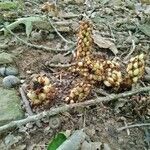
Conopholis americana
Squawroot · American cancer-root · American Cancerroot · Cancer root · Bear corn
Description
Source: leafsnapConopholis americana, commonly known as American cancer-root or squawroot, is a parasitic plant in the Orobanchaceae family. Native to North America, it is primarily found in the eastern and central regions of the United States. This plant is notable for its distinctive yellowish-brown stem, which can grow up to 30 cm tall, and its small, scale-like leaves. It produces small, greenish-yellow flowers that typically bloom from May to July. American cancer-root is parasitic and attaches itself to the roots of other plants, such as oak, beech, and hickory trees. It extracts nutrients from these host plants through specialized structures known as haustoria. Native Americans historically used American cancer-root for medicinal purposes, such as treating menstrual cramps, diarrhea, and reducing fever, among other conditions. Despite its name, "cancer-root," there is no scientific evidence supporting its effectiveness in treating cancer or any other serious illness. Overall, Conopholis americana stands out for its unique appearance and characteristics. It is an intriguing species of plant found in North America with a history of medicinal use by Native Americans.
Care Guide
💧 Water Every 7 days
The American Cancer-Root is well-suited to the deciduous forests of North America, thriving in consistently moist, well-drained soil. It is essential to water it once a week. As an obligate parasite, this plant extracts moisture and nutrients from host trees, taking advantage of natural rainfall and aligning its growth with seasonal water availability.
How should I water my American Cancer-Root plant in the most effective way?
To properly water the American Cancer-Root plant, it is important to use filtered water at room temperature. Tap water may contain harmful particles, so filtering the water is better for the plant's health. The water should also be at room temperature or slightly warmer to prevent shocking the plant's system, as it is used to warm environments. Instead of using overhead watering, it is recommended to directly apply the filtered room temperature water to the soil until it is completely soaked. This method is beneficial as it keeps the roots moist and allows them to spread and collect necessary nutrients in the soil.
What should I do if I give my American Cancer-Root plant too much or too little water?
Overwatering is a common issue for the health of American Cancer-Root plants, leading to wilting, yellowing leaves, and possible diseases like root rot, mold, and mildew. In contrast, underwatering is less common due to the plant's drought tolerance, but it can cause brittle, brown leaves. To prevent irreversible damage, it is important to identify the signs of overwatering early and reduce watering immediately. Assessing the soil quality and replacing it if it drains poorly can also help. On the other hand, if signs of underwatering occur, simply increase watering until the plant recovers.
How often should I water my American Cancer-Root plant?
To determine if your potted American Cancer-Root plant needs water, simply stick your finger into the soil. If the top two to three inches feel dry, it's time to give it some water. The same method can be used for American Cancer-Root plants grown outdoors. If the first few inches of soil are dry, it's time to water. Typically, watering once a week during spring and early fall is sufficient. However, during extremely hot weather, watering twice a week or more may be necessary. It's worth noting that mature, well-established American Cancer-Root plants can tolerate drought well.
How much water does my American Cancer-Root plant need?
To properly water your American Cancer-Root plant, do not hesitate to give it plenty of water. Make sure the top few inches of soil are dry before watering. Give it a good, deep watering that saturates the entire soil. The water should be enough that it drains out through the bottom holes of the pot. If you don't see water coming out, you may not have given enough water. However, be careful not to let water accumulate in the soil, as this can harm the plant. If no water drains at all, it could mean that the soil doesn't drain well, which is not good for the plant's health. If the plant is outside, it generally needs about 1 inch of rain per week.
How should I water my American Cancer-Root at different times it is growing?
The water needs of the American Cancer-Root vary depending on its growth stage. When the plant is in its early years or has been recently transplanted, it requires more water than usual because it is focused on developing new roots for future growth. These new roots perform best with higher moisture levels. As the plant matures, it will require less water. Additionally, during the bloom period, when the plant is producing flowers, it may need more water to support the development of the blooms.
☀️ Light Partial sun
American Cancer-Root typically does well in moderate light but can tolerate low-light conditions too. Sunlight promotes the plant’s healthy growth, though too much exposure can be harmful. Its native habitat, with dense tree cover, provides a mix of sun and shade and has shaped its tolerance for sunlight.
What are the sunlight requirements for American Cancer-Root?
American Cancer-Root requires partial sun, meaning it thrives on about 3-6 hours of sunlight per day, but it can also grow in full shade, where it receives less than 3 hours of sunlight. It's important to monitor the sunlight patterns in your garden, ensuring that you choose locations that provide a harmonious blend of light and shade suitable for the plant's needs. This balance is crucial for the plant's happiness and growth.
How does American Cancer-Root adapt to sun exposure and what are the essentials of its care?
American Cancer-Root flourishes under moderate illumination but can withstand minimal light, benefiting from sunlight for its wholesome development. However, excessive exposure can be detrimental. Originally from environments with considerable tree cover, the plant has adapted to accept sun and shade appropriately. For indoor plants especially, when natural sunlight is not sufficient, especially during winter or less sunny areas, artificial lights become essential. LED lights are a good choice for indoor plants, providing necessary wavelengths for growth. Depending on the plant's sun requirements, the intensity of artificial light and its distance from the plant should be adjusted, ensuring that the plants receive 8-12 hours of light daily to mimic natural daylight hours.
What symptoms indicate insufficient or excessive sunlight in American Cancer-Root?
Symptoms of insufficient light in American Cancer-Root include smaller new leaves, leggy or sparse growth, faster leaf drop, slower or no new growth, and lighter-colored new leaves. Excessive sunlight can lead to chlorosis, where leaves lose their green color, sunscald with pale or necrotic areas on the tissue, leaf curling, wilting due to increased water loss, and leaf scorching with brown, dry edges. These symptoms show how vital it is to maintain optimal light conditions for the health of the plant.
What solutions are available for managing light conditions for American Cancer-Root?
To manage light conditions for American Cancer-Root effectively, gradual adaptation to sunlight is key. For indoor plants, progressively shifting them to sunnier spots or using artificial light, such as desk or ceiling lamps for at least 8 hours daily, can help. Outdoors, plants should be moved to optimal sunlight spots gradually to prevent sunburn. If necessary, prune trees to reduce shade. For smaller plants, consider transplanting during their dormant period to locations with better sunlight and drainage. Remember, while parts of the plant affected by poor light might not recover, new growth will flourish under improved conditions.
🌡️ Temperature 0–35°C
The American Cancer-Root usually grows in temperate areas and needs a fairly mild temperature range, with its natural growing conditions extending from 32 ℉ (0 ℃) to 95 ℉ (35 ℃). It prefers temperatures of 50 ℉ (10 ℃) to 77 ℉ (25 ℃), but can tolerate warmer or cooler conditions when necessary. In winter, it is advised to keep the plant in a cooler range of 32 ℉ (0 ℃) to 50 ℉ (10 ℃).
What is the preferred temperature range for growing American Cancer-Root?
The American Cancer-Root prefers a temperature range of 50°F (10°C) to 77°F (25°C) for optimal growth. Its native environment ranges from 32°F (0°C) to 95°F (35°C), indicating it can adapt to higher or lower temperatures when necessary. During winter, keeping the plant in a cooler environment, between 32°F (0°C) and 50°F (10°C), is recommended due to its strong cold resistance.
How does the American Cancer-Root react to extreme temperatures, and what protective measures should be taken?
American Cancer-Root has strong cold resistance, but during winters with temperatures expected to drop below -35°C, it's important to take cold protection measures such as covering the plant with soil or straw. This helps prevent drought and ensures the soil remains moist during winter and early spring. Before the first freeze, watering the plant abundantly is recommended. For high temperatures above 35°C, the plant's leaves may become lighter, prone to curling, and may wilt in severe cases. Moving the plant to a shaded location or using a shade cloth, along with watering in the morning and evening, can help mitigate the effects of high temperatures.
What are the key symptoms of temperature stress in American Cancer-Root and the recommended solutions?
When the temperature drops below -35°C, American Cancer-Root may show no noticeable changes initially but can result in decreased or no sprouting during spring. The solution is to remove any parts that failed to sprout in spring. In high temperatures above 35°C, symptoms include lighter leaf color, curling, susceptibility to sunburn, and potential drying out of the plant. Solutions involve trimming sunburned and dried parts, relocating the plant to a shaded area, and ensuring the soil remains moist by watering in the morning and evening.
What is the botanical name of American Cancer-Root?
The botanical name of American Cancer-Root is Conopholis americana. This plant typically grows in temperate regions and is known for its adaptability to a wide range of temperatures, making it versatile in its cultivation and care.
💨 Humidity normal (40-60%)
This plant will thrive in moderate humidity, which is probably the level in your home. However, misting it a few times a week can be very beneficial. Make sure the room has good ventilation.
🪴 Soil 6-6
🌱 Fertilizer
A single fertilizer application in spring is typically enough for American Cancer-Root, although repeated feedings can maximize growth. Apply fertilizer once every month to a month and a half. Fertilization improves the leaves’ appearance and function, helping maintain even color and a healthy texture. It also encourages root growth and nutrient uptake, supporting long-term plant health.
Why should I put fertilizer on my American Cancer-Root plant?
The American Cancer-Root relies on its leaves for its main structure. Fertilization plays a crucial role in maintaining healthy leaves. It not only ensures consistent color and healthy texture but also promotes root growth below the surface. By fertilizing, you not only keep your plant healthy now but also improve its ability to absorb soil nutrients in the future.
When should I fertilize my American Cancer-Root plant?
If you grow your American Cancer-Root outdoors, it will send out new growth in early spring. This is a sign that it's time to start fertilizing. Normally, one application of fertilizer in the spring is enough for the plant to thrive. However, if you want to maximize growth, you can fertilize multiple times throughout the spring and early summer. In this case, feed the plant about once every month to a month and a half.
When is the best time to not fertilize my American Cancer-Root?
During late fall and winter, your American Cancer-Root will go into a dormant phase where it stops growing. It is best not to fertilize it during this time. If you do choose to fertilize during spring and summer, gradually reduce the amount as summer approaches because the growth rate of your American Cancer-Root also slows down. It is not advisable to fertilize during extremely hot weather or when the soil is excessively dry as it can cause stress and premature death for your American Cancer-Root.
What kind of fertilizer does my American Cancer-Root plant need?
Choosing the best fertilizer for an American Cancer-Root plant is actually quite simple. These plants do well with a general-purpose garden fertilizer that has equal amounts of nitrogen, phosphorus, and potassium. Look for a fertilizer with a ratio of 10-10-10 or something similar for best results. Avoid fertilizers high in nitrogen if unsure. The most effective fertilizers for an American Cancer-Root come in granular form and should be slow-release. Applying them to the soil is easy. Additionally, using organic soil amendments like compost can be helpful when feeding your American Cancer-Root plant.
How do I fertilize my American Cancer-Root plant?
To ensure proper growth of your American Cancer-Root, wait until early spring when its first leaves emerge from the soil's surface. Once this happens, apply a balanced slow-release fertilizer to the soil surrounding the plant's base. You can repeat this process later in the season if desired. Remember to apply the fertilizer to the soil at the base of the plant, not directly onto the plant itself. Sometimes, you may need to move some leaves to access the soil above the roots. Additionally, it is beneficial to water the American Cancer-Root before and after feeding it.
🪴 Pot & Repot
✂️ Pruning
American Cancer-root is a parasitic plant known for its cone-shaped flowers. To enhance the plant's health and vigor, it's important to prune it from early to late spring, making sure to remove any dead or diseased parts. Careful pruning is crucial to prevent damage to host plants and to support controlled growth and vitality.
🌿 Propagating
🐛 Diseases & pets
☠️ Toxicity
Characteristics
- Plant Type
- Herb
- Life Cycle
- Perennial
- Genus
- Conopholis
- Family
- Orobanchaceae
- Hardiness Zone
- 3-9
- Mature Height
- 5 cm to 20 cm
- Mature Spread
- 2 cm to 3 cm
- Leaf Color
- Tan, Brown
- Leaf Type
- Evergreen
- Flower Color
- Yellow, White, Cream, Orange
- Flower Size
- 2.54 cm
- Bloom Time
- Late spring, Early summer
- Harvest Time
- Mid summer