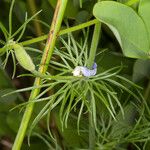
Consolida ajacis
Larkspur · Rocket larkspur · Eastern larkspur · Doubtful knight's-spur
Description
Source: leafsnapConsolida ajacis (doubtful knight's spur or rocket larkspur) is an annual flowering plant of the family Ranunculaceae native to Eurasia. It is widespread in other areas, including much of North America, where it is an introduced species. It is frequently grown in gardens as an ornamental for its spikes of blue, pink or white flowers. It may reach a meter in height. Since the aerial parts and seeds of C. ajacis have been found to contain diterpenoid alkaloids (see below), including the highly toxic methyllycaconitine, the plants should be considered as poisonous.
🌳 Besides its decorative use, rocket larkspur may serve as a natural dye owing to its pigments, notably its vivid blue flowers. It is also under study for phytoremediation, helping to indicate and remove soil heavy metals such as lead and cadmium, demonstrating an important role in ecosystem restoration and pollution reduction.
🎭 An open heart, warmth, tenderness, a longing to laugh
Care Guide
💧 Water
The doubtful knight's spur, originating from the Mediterranean, thrives in dry, warm climates and is drought-tolerant. It benefits from weekly deep watering. As an annual plant, its flowering cycle largely depends on water availability. To achieve optimal blooms, it is crucial to provide adequate moisture during its active growing season.
How do I water my plant called a Doubtful Knight's Spur in the best way?
To water Doubtful knight's spur, there are a few common watering tools you can use, such as a garden hose with a spray nozzle or a watering can. This plant is not very particular about how it receives water, as it can thrive with rainwater, tap water, or filtered water. However, it is advisable to avoid watering this plant from overhead to prevent leaf and flower damage and potential diseases. Instead, setting up a drip irrigation system is often the best watering method. This system ensures even and direct watering of the soil for Doubtful knight's spur. If you have a container-grown plant, the same watering approach can generally be followed. The difference lies in using a cup, watering can, or tap to apply water directly to the soil.
What should I do if I give my Doubtful knight's spur too much or too little water?
To remedy underwatering of your Doubtful knight's spur, simply water it more frequently when you notice it lacks moisture. Overwatering, on the other hand, can be a more serious problem. It can lead to diseases and the eventual decline and death of the plant. To prevent this, choose a suitable location for your plant with ample sunlight to help dry the soil and good drainage to prevent waterlogging. If your potted Doubtful knight's spur is overwatered, consider repotting it in a new pot with loose soil and efficient drainage. This will ensure proper watering and prevent water accumulation.
How often should I water my Doubtful knight's spur plant?
To keep your Doubtful knight's spur healthy, it is important to water it regularly throughout the growing season. In the spring, watering once a week should be sufficient. However, as the season progresses and temperatures rise, you may need to water it two to three times per week. It is crucial not to exceed this frequency as it can be harmful to the plant. Additionally, make sure to keep the soil consistently moist but not overly wet, regardless of how often you water. When it comes to Doubtful knight's spur in pots, the watering needs are slightly different. Potted plants tend to dry out faster, so in most cases, watering a container-grown Doubtful knight's spur a few times per week is necessary compared to once a week for plants in the ground.
How much water does my Doubtful knight's spur require?
Determining how much water to give to your Doubtful Knight's Spur can be approached in a few different ways. Some gardeners prefer to rely on their intuition and gauge soil moisture by feeling it. This method suggests watering until the first six inches of soil feels moist. Alternatively, you can use a standardized measurement. Typically, giving your Doubtful Knight's Spur about two gallons of water per week is recommended, taking into account factors like temperature and soil dryness. However, strictly adhering to these guidelines could lead to overwatering if your plant requires less water. When growing Doubtful Knight's Spur in a container, a different approach is necessary. The goal is to moisten all layers of soil that have dried out. You can check for moisture by sticking your finger in the soil or look for a slight trickle of excess water from the drainage holes.
How do I know if I am watering my Doubtful knight's spur enough?
Taking care of your Doubtful knight's spur can be a little challenging when it comes to watering. On one hand, these plants have deep roots, so you need to water the soil every week to keep them hydrated. However, be careful not to overwater them because Doubtful knight's spur are prone to root rot, which can cause the roots to rot and the plant to turn brown. Underwatering is less of a concern since these plants can survive without much watering for a while. But if you wait too long, the plant will start to wilt and you might see dry leaves.
☀️ Light Full sun
Rocket larkspur flourishes in locations that have unobstructed access to sunlight throughout the day and can endure areas where the sunlight is somewhat moderated. Insufficient sun exposure can potentially inhibit its development, whereas excessive amounts don't notably cause any harm.
What are the sunlight requirements for Doubtful knight's spur?
Doubtful knight's spur requires full sun, which means it thrives in areas that receive more than 6 hours of direct sunlight per day. It can also tolerate partial sun conditions, about 3-6 hours of sunlight. It's crucial to observe how sunlight moves through your garden to choose spots that offer a balanced light and shade environment for your plants. Insufficient or excessive exposure to sunlight can affect the plant's growth, but generally, more sunlight does not cause significant damage.
How does artificial lighting benefit indoor plants, and what should I know about using it?
Indoor plants, including Doubtful knight's spur when grown indoors, may require artificial lighting, especially in conditions where natural sunlight is insufficient. Artificial lights, like LED, can be customized to provide specific wavelengths needed for plant growth. For full sun plants, 30-50W/sq ft of artificial light is advisable, whereas partial sun plants need 20-30W/sq ft, and full shade plants 10-20W/sq ft. The light source should be placed 12-36 inches from the plant, and the duration should mimic natural daylight hours, typically 8-12 hours per day. This approach supports faster, healthier growth.
What symptoms indicate insufficient sunlight for Doubtful knight's spur?
Symptoms of insufficient sunlight in Doubtful knight's spur may include smaller new leaves, leggy or sparse growth, faster leaf drop, slower or no new growth, lighter-colored new leaves, and symptoms of chlorosis. These signs suggest the plant is not receiving adequate light, affecting its growth and overall health. Conversely, symptoms of too much sunlight can include sunscald, leaf curling, wilting, and leaf scorching, indicating the plant is receiving more light than it can handle.
What solutions can mitigate sunlight deficiency or excess in Doubtful knight's spur?
To mitigate sunlight deficiency for indoor plants, gradually move them to sunnier locations to receive at least 6 hours of direct sunlight daily. Use a south-facing window for maximum light exposure or artificial lighting if the plant is large. For outdoor plants, move them gradually to adjust to increased sunlight without causing sunburn. Reducing obstructions like pruning trees helps increase light exposure. Transplanting small outdoor plants during their dormant period can also ensure they get enough sunlight. Note that parts of the plant already affected may not recover, but new growth should be healthy with adjusted light conditions.
🌡️ Temperature 10–35°C
The Rocket larkspur is native to environments where the typical temperatures vary between 68 and 95 °F (20 to 35 ℃). It thrives in warm weather, but can withstand some degree of change. Adjustments to seasonal temperatures may be required for its best possible growth.
What is the Doubtful Knight's Spur and where is it indigenous to?
The Doubtful Knight's Spur, botanically known as Consolida ajacis, is indigenous to climates where temperatures typically range from 68 to 95 °F (20 to 35 °C). It flourishes in balmy weather and can tolerate some fluctuations in temperature, demonstrating a strong resistance to cold. Although it adapts well to various environments, seasonal temperature adjustments may be essential for its optimal growth.
How does the Doubtful Knight's Spur tolerate winter conditions?
The Doubtful Knight's Spur is notable for its strong cold resistance, usually negating the need for special frost protection measures during winter. However, if winter temperatures are expected to plummet below the plant's growth limit temperature, it becomes crucial to protect it against the cold. This can be achieved by covering the plant with insulating materials such as soil or straw. Additionally, watering the plant abundantly before the first freeze of autumn is recommended so that the soil stays moist and enters a frozen state, which helps prevent drought and water scarcity for the plant during the colder months and early spring.
What are the key symptoms to look out for in Doubtful Knight's Spur during low and high temperatures?
In low temperature conditions, the Doubtful Knight's Spur shows remarkable cold tolerance, thriving best when the temperature remains above a certain minimum. It should be kept above a tolerable growing temperature minimum during winter to prevent damage. Falling below the plant's growth limit temperature may not show immediate changes during winter, but can lead to decreased sprouting or no sprouting in spring. The recommended solution is to remove any parts of the plant that have failed to sprout in spring. In contrast, during high temperature conditions, it is crucial to keep the plant below a certain maximum suitable growth temperature. Exceeding this can cause the leaves to become lighter in color, curl, become susceptible to sunburn, or in extreme cases, cause the entire plant to wilt and dry. Solutions include trimming away sunburned and dried parts, moving the plant to a shaded location, or using a shade cloth to protect it from the harsh midday and afternoon sun. Watering the plant in the morning and evening to keep the soil moist is also beneficial.
💨 Humidity
🪴 Soil 6-7
🌱 Fertilizer
When the Rocket larkspur has most of its flowers fully bloomed, it indicates the appropriate moment to recommence fertilization. Start the fertilizing procedure once every three to four weeks, provided the weather conditions are suitable, when the flowers are flourishing the most. However, when the Rocket larkspur begins to generate fewer new flowers, cease fertilizing as there's no requirement for additional nutrients when the plant is not capable of producing more flowers.
Why should I fertilize my Doubtful knight's spur?
Plants, like Doubtful knight's spur, need nutrients to survive and gardeners understand this well. Without proper nourishment, Doubtful knight's spur will die shortly after pollination. Therefore, it is important to provide the right nutrients in appropriate amounts to ensure the plant thrives and produces beautiful flowers throughout the blooming season. Fertilizer plays a crucial role in helping Doubtful knight's spur develop a strong and healthy root system, which is necessary as the plant has thin and delicate roots. By fertilizing at planting, a solid root structure is established, providing stability to the plant and setting the stage for an impressive flowering display. Additionally, proper timing of fertilization can significantly prolong Doubtful knight's spur's flowering period.
What is the ideal time to fertilize my Doubtful knight's spur?
Doubtful knight's spur experiences significant growth after the last frost, so it is important to fertilize it during the planting phase. This can occur when the plant is initially placed in the ground or in planters. After this initial dose of fertilizer, there is no need to fertilize again until the blooms are fully opened later in the year. Once the blooms are at their peak, it is time to start fertilizing again every three to four weeks, as long as the weather allows. When the plant begins producing fewer new blooms, it is no longer necessary to fertilize as it cannot produce any more blooms.
When should I not put fertilizer on my Doubtful knight's spur?
Regular fertilizing is important for Doubtful knight's spur, but it's crucial to apply it at the right time. There are situations where holding back on fertilizing is necessary, mainly due to climate or controllable factors. If there are severe or unexpected changes in the weather, such as a sudden cold snap in the middle of summer, it's best to wait until it warms up again to start fertilizing. Similarly, if the soil is too dry or compacted, the fertilizer won't be able to be absorbed properly by the roots. So, it's important to wait until the soil conditions improve. Additionally, it's not advised to apply fertilizer when temperatures reach the 90-degree fahrenheit range, as the heat can break down the fertilizer too quickly. Lastly, if there are any pests or diseases affecting the plant, it's best to treat and resolve those issues before applying fertilizers again.
Which fertilizer does my Doubtful Knight's Spur plant need?
To ensure proper nourishment for Doubtful knight's spur, it is recommended to use a fertilizer formulated for high-yield blooming plants. Specifically, a fertilizer with a higher phosphorus content, denoted by a higher P number in its NPK ratio (for example, 10-30-10), is most effective. Many fertilizer brands offer suitable options for blooming plants like Doubtful knight's spur, which provide the necessary nutrients effortlessly. If choosing a pre-mixed fertilizer, it is important to follow the package instructions to avoid over or under-fertilization, both of which can negatively impact the plant's growth and even result in wilting.
How can I make my Doubtful knight's spur grow better?
Depending on the type of fertilizer you have, the instructions for fertilizing Doubtful knight's spur may vary. However, here are some general tips to follow. When you first plant Doubtful knight's spur, mix the recommended amount of fertilizer into the soil before planting and water it in. For subsequent fertilizing, the process may be a little different. If using pellet fertilizers, mix the pellets into the top inch of soil around the outer edge of the plant where the roots are located. Make sure to water them in well initially, and then water regularly afterwards. For other types of fertilizers, mix them into a watering can and apply them like you would regular water. Follow the instructions on the fertilizer packaging for consistency, but if you prefer a regular schedule, aim for fertilizing every three to four weeks.
🪴 Pot & Repot
During the repotting process of Rocket larkspur, choose a container that's 1-2 inches (2.5-5 cm) wider in diameter, with a focus on excellent drainage. Opt for a potting blend that provides good drainage and think about adding perlite for additional drainage capacity. Perform the repotting in spring or at the start of summer, drench completely with water, and then place it in a location with less sunlight initially.
✂️ Pruning
The Doubtful Knight's Spur is a plant known for its tall, spiky flowers. To keep it healthy and encourage abundant blooms, it's important to prune it from early to late spring. Remove any spent stems and deadhead the flowers to promote new growth and prevent the plant from becoming leggy. Make sure to use clean tools for precise cuts, and align your pruning efforts with the plant’s growth cycle for the best results.
🌿 Propagating
🐛 Diseases & pets
☠️ Toxicity
Characteristics
- Plant Type
- Herb
- Life Cycle
- Annual, Perennial, Biennial
- Genus
- Consolida
- Family
- Ranunculaceae
- Hardiness Zone
- 6-9
- Mature Height
- 0.61 m to 1.22 m
- Mature Spread
- 30 cm to 61 cm
- Leaf Color
- Green
- Leaf Type
- Deciduous
- Flower Color
- Blue, Purple, Pink, White
- Flower Size
- 5.08 cm
- Bloom Time
- Late spring, Early summer, Mid summer
- Planting Time
- Spring
- Harvest Time
- Mid summer