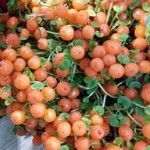
Coprosma granadensis
Makole · Coral moss · Coral-bead · English babytears · Bead plant
Description
Source: leafsnapCoprosma granadensis, commonly known as the Granada coprosma, is an evergreen shrub in the Rubiaceae family. Native to Central America, it is found in countries such as Mexico, Guatemala, Honduras, and Nicaragua. The plant typically grows to a height of up to 2 meters and features dense branching with small, glossy, dark green, oval-shaped leaves. From late spring through summer, the Granada coprosma produces small white flowers, which are followed by red berries. Although these berries are edible, their bitter taste makes them less commonly consumed by humans; however, they serve as an essential food source for birds. This versatile plant thrives in various soil types, including sandy and clay soils with good drainage. It prefers full sun to partial shade but is also tolerant of some shade. Coprosma granadensis is valued for several reasons. Its attractive foliage makes it an excellent choice for ornamental uses, such as hedges or borders in gardens and parks. Additionally, the plant has medicinal properties; traditionally, its leaves have been used to treat various ailments, including stomach problems. In summary, Coprosma granadensis is an attractive evergreen shrub with ornamental and ecological benefits. Its role in providing food for birds and its medicinal properties highlight its importance within Central America's biodiversity.
Care Guide
💧 Water Every 7 days
☀️ Light Partial sun
Coral moss prefers a fairly bright location but must be shielded from intense sunlight. Its roots originate from environments where taller plants filter the light. For healthy growth it needs moderate light levels. Excessive sun can burn the coral moss, while too little light can limit its development.
🌡️ Temperature 20–37.8°C
Coral moss comes from habitats where temperatures range between 68 and 100℉ (20 and 38℃). The plant generally favors warmer climates but can adapt with proper care. In colder periods, keep coral moss within its preferred temperature range so it can thrive.
💨 Humidity
🪴 Soil 5-6
🌱 Fertilizer
Correct fertilization is essential for Coral moss's health and appearance. Fertilize Coral moss during the summer, repeating the treatment monthly throughout the season. Nutrients drive growth and sustain the plant's parts. Fertilization improves Coral moss's floral display, ensuring the best blooms.
🪴 Pot & Repot 2-3 years
When repotting Coral moss, select a pot 1-2 inches (2.5–5.1 cm) larger that has ample drainage. Use a well-draining potting mix. Repot in spring or fall, making sure the root ball sits slightly below the rim of the flower pot. Water thoroughly after repotting and place the pot in a warm spot with indirect sunlight.
✂️ Pruning
🌿 Propagating
🐛 Diseases & pets
☠️ Toxicity
Characteristics
- Plant Type
- Herb
- Life Cycle
- Perennial
- Genus
- Coprosma
- Family
- Rubiaceae
- Hardiness Zone
- 9-11
- Mature Height
- 30 cm
- Mature Spread
- 30 cm
- Leaf Color
- Green
- Leaf Type
- Evergreen
- Flower Color
- White
- Flower Size
- 2.54 cm
- Bloom Time
- Late spring, Early summer, Mid summer
- Planting Time
- Spring, Summer, Autumn
- Harvest Time
- Mid summer, Late summer, Early fall, Mid fall
- Native Area
- Malaysia, Honduras, Mexico, Guatemala, Peru, Vanuatu, Philippines, Panama, New Zealand, China, Colombia, Cuba, Indonesia, Bolivia, Japan, Venezuela, El Salvador, Nicaragua, Ecuador, Costa Rica