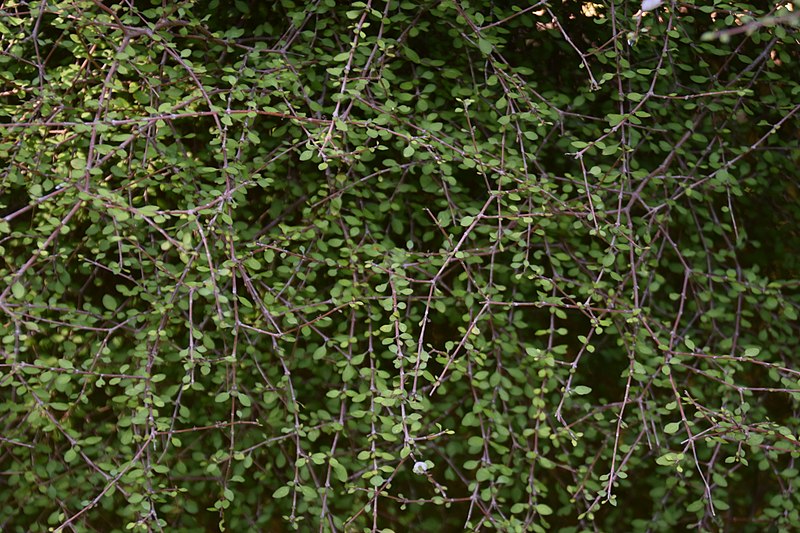
Coprosma virescens
Description
Source: leafsnapCoprosma virescens is an endemic New Zealand plant in the genus Coprosma of the family Rubiaceae. Its Māori name (in common New Zealand usage) is mingimingi, a name which is also applied to closely related species such as C. dumosa, C. rhamnoides, C. propinqua and C. crassifolia. It is a small-leaved shrub or tree which grows 2 to 3 metres (6 ft 7 in to 9 ft 10 in) high. It has very slender, more or less glabrous divaricating branches. The small leaves are petiolate with petioles from 2mm to 5mm long. The leaves narrow suddenly at the petiole and may be up to 9 millimetres (0.35 in) long and 6 millimetres (0.24 in) wide with wavy margins or a few blunt teeth throughout South Island in lower montane forest and scrubland. The apetalous male flowers occur in axillary clusters of one to two on very short branches. Female flowers are found on their own at the ends of short branchlets.The fruit is an oblong drupe, yellow to white in colour and up to 6 millimetres (0.24 in) long. However, the fruit appears greenish when ripe because of the visible presence of the green seeds within. This feature gives rise to the specific name.It has a wide distribution, from Masterton southwards on the North Island.
Care Guide
💧 Water
☀️ Light Partial sun
Mikimiki naturally occurs in habitats like forest understories and rocky areas, where it receives natural shade. It prefers partial sun but can tolerate full sun or full shade, illustrating its adaptable and hardy nature.
🌡️ Temperature 15–37.8°C
Mikimiki shows strong adaptability to different climate conditions, from scorching summers to chilly winters. However, it has a preferred temperature range for optimal growth. If temperatures rise too high, the plant is susceptible to heat and humidity stress, which can lead to its death. In areas where temperatures approach the lower limit of its cold tolerance, it is important to apply insulation measures to protect the plant.
💨 Humidity
🪴 Soil 6-8
🌱 Fertilizer
Fertilize your Mikimiki in early spring to encourage healthy growth. Regular feeding improves overall health, producing vigorous growth, greater tolerance of harsh conditions, and better resistance to pests and diseases. Follow a consistent fertilization schedule for your Mikimiki to preserve vibrant, deep-colored foliage and a lush appearance.
🪴 Pot & Repot
✂️ Pruning
Mikimiki is a resilient evergreen shrub known for its glossy leaves. To maintain its health and appearance, prune it in early spring. This involves removing dead branches and thinning out crowded areas to improve airflow, which encourages growth and flowering. Regular pruning helps prevent disease and enhances the shrub's overall appearance. Always use sharp, clean tools to ensure precise cuts.
🌿 Propagating
🐛 Diseases & pets
☠️ Toxicity
Characteristics
- Plant Type
- Shrub
- Life Cycle
- Perennial
- Genus
- Coprosma
- Family
- Rubiaceae
- Hardiness Zone
- 8-11
- Mature Height
- 2.13 m to 3.96 m
- Mature Spread
- 1.52 m to 2.44 m
- Leaf Color
- Olive Drab, Dark Olive Green
- Leaf Type
- Deciduous
- Flower Size
- 0.20 cm to 0.25 cm
- Bloom Time
- Mid fall, Late fall
- Planting Time
- Spring
- Harvest Time
- Late winter, Early spring, Mid spring
- Native Area
- New Zealand