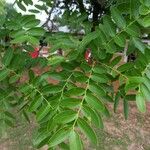
Cordyla africana
Bush Mango · Sunbird tree · Mtondo · Mutondo · Wild mango
Description
Source: leafsnapCordyla africana is a tall (up to 25 m), deciduous African tree with a large, spreading, much-branched crown, and a bole of some 2.2 m dbh. It is a member of the large leguminous family Fabaceae, and is known as wild mango in some areas. It is found up to 1000m elevation in large river valleys, in miombo woodland and coastal swampy evergreen forest, mostly on sandy soils, along the eastern parts of central and southern Africa. It occurs in South Africa in KwaZulu-Natal and Mpumalanga provinces, the Kruger National Park, Eswatini, Mozambique, Zimbabwe, Zambia, Malawi, Kenya and Tanzania. 'Cordyla' is from the Greek word 'kordyle', meaning a 'club' and is a reference to the club-shaped fruit and stalk.The mature bark is rough, dark brown and fissured, and a blaze showing yellow with orange streaks. The flowers are without petals and display yellow to orange stamens in axillary racemes 50mm long with up to 12 flowers, and these appear with the new leaves in September. As with Schotia flowers they face up and are nectar-filled, attracting a wide variety of birds. Unusually for the legume family, the fruit develops from the standard pod shape when young, into an indehiscent, up to 80 mm long golden-yellow and glossy ovoid fruit with a thick stalk. When mature it has a soft, thin skin with a slight depression on one side. Fruit falls when not quite ripe, and fully ripens on the ground. One to eight large brown seeds are enclosed in a yellow, sticky pulp, and these frequently germinate from within the fruit. The fruit is rich in Vitamin C and is sought after by many mammals, including elephant. (see Mfuwe Lodge) The leaflets show transparent gland dots and streaks when backlit. The twigs and green fruit exude latex when damaged. The tree was first described from Portuguese East Africa by the Jesuit priest João de Loureiro (1710-1791), who spent time as a missionary in Goa, Macao and Cochin China, but was also a naturalist and mathematician. There are 8 species of Cordyla currently recognised, confined to the eastern parts of Africa and the island of Madagascar.
Care Guide
💧 Water Every 7 days
☀️ Light Full sun
Cordyla comes from open habitats, such as sunny meadows and forest edges, which offer abundant light. It prospers in Full Sun but can also tolerate Partial Sun, adapting well to various sunlight conditions.
🌡️ Temperature 20–37.8°C
Cordyla comes from tropical areas, where the climate is generally warm and humid. Therefore it is well adapted to high temperatures and moisture. It does not tolerate sudden temperature shifts and prefers a steady temperature, so avoiding temperature fluctuations indoors is important. It typically cannot withstand cold and needs warmer conditions to grow. If the ambient temperature falls too low, the plant may stop growing or even die.
💨 Humidity
🪴 Soil 6-8
🌱 Fertilizer
The best time to fertilize a Cordyla is in early spring, as it breaks dormancy. This promotes overall growth and flower development. Fertilization improves the foliage, stems, and branches, while encouraging large, vivid, and long-lasting flowers. It assists in moving nutrients from the roots to the flowers and enhances the plant's health and disease resistance.
🪴 Pot & Repot
✂️ Pruning
🌿 Propagating
🐛 Diseases & pets
☠️ Toxicity
Characteristics
- Plant Type
- Tree
- Life Cycle
- Perennial
- Genus
- Cordyla
- Family
- Fabaceae
- Hardiness Zone
- 10-12
- Mature Height
- 14.94 m to 24.99 m
- Mature Spread
- 10.06 m to 14.94 m
- Leaf Color
- Dark Green
- Leaf Type
- Deciduous
- Flower Color
- Yellow
- Flower Size
- 1.02 cm to 1.52 cm
- Bloom Time
- Early fall, Mid fall
- Planting Time
- Spring, Autumn
- Harvest Time
- Winter
- Native Area
- Malawi, Mozambique, Zambia, Kenya, Tanzania, Zimbabwe