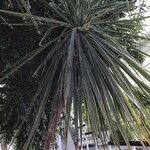
Cordyline indivisa
Blue dracaena · Mountain cabbage tree · Spike dracaena
Description
Source: leafsnapCordyline indivisa, commonly known as the Mountain Cabbage Tree or the New Zealand Cabbage Tree, is a striking evergreen native to New Zealand. As a member of the Asparagaceae family, it can grow up to 10 meters tall with a spread of 3 meters. Its long, sword-shaped leaves, which can reach up to 1 meter in length, are bluish-green in color. This plant thrives in well-drained soil and requires full sun or partial shade. While it is tolerant of coastal conditions, it does not fare well in frost. During the summer, the Cordyline indivisa produces small white flowers that are followed by small red berries. In its native habitat, the Maori people traditionally used Cordyline indivisa for medicinal purposes and crafted ropes and baskets from its leaves. Today, it is widely appreciated as an ornamental tree in gardens and parks due to its striking appearance. Overall, Cordyline indivisa is an impressive evergreen tree with unique foliage that adds interest to any landscape design. It also holds cultural significance in New Zealand's history.
🌳 The cabbage tree plays an important role in landscaping because of its distinctive appearance and also serves as a versatile material for artistic carving. Its wood is known for its durability and has traditionally been used by Māori artisans to make intricate sculptures and building components.
🎭 Survival and revival of democracy
Care Guide
💧 Water Every 7 days
The mountain cabbage tree thrives in cool, moist environments and prefers consistent moisture and high humidity. To keep the soil evenly moist without causing waterlogging, it's best to water the plant weekly. It's ideal to grow this plant indoors to prevent root rot. Year-round hydration is essential for maintaining its vibrant foliage.
How should I water my Mountain cabbage tree?
Watering your Mountain cabbage tree is quite simple and flexible. You can use any common watering tool like watering cans, hoses, or even cups. The important thing is to water the soil directly and evenly, ensuring that all areas receive moisture to nourish the entire root system. It's helpful to use filtered water to avoid harmful particles from tap water. Additionally, it's best to use water at or slightly above room temperature since extreme temperatures can be a bit shocking for the plant. Overall, the Mountain cabbage tree usually adapts well to various water sources.
What do I need to do if I give my Mountain cabbage tree too much or too little water?
Outdoor plants, especially newly planted ones or seedlings, are prone to not receiving enough water. It's important to keep watering them continuously for a few months while they are small or just planted. Once their roots are established, the Mountain cabbage tree can rely mostly on rain. When you have the Mountain cabbage tree planted in pots, overwatering is more likely to happen. If you accidentally overwater your plant, you should take immediate action to fix the situation. First, stop watering the plant right away to minimize the effects of overwatering. Then, remove the tree from its pot to check its roots. If none of the roots show signs of root rot, you can put the plant back in its container. However, if you do find root rot, trim away the affected roots and consider applying a fungicide to prevent further damage. Finally, repot the Mountain cabbage tree using well-draining soil. As for underwatering, it is usually an easy problem to solve. If you underwater the plant, its leaves will droop, dry out, and fall off. After giving it sufficient water, the leaves will quickly return to their fullness. Take immediate action to correct your watering frequency when underwatering occurs.
How often should I give water to my Mountain cabbage tree?
Most plants grow naturally outdoors and can thrive with rainfall. However, if your area doesn't receive enough rainfall, you'll need to provide adequate watering every 2 weeks in the spring and fall. In the summer, you'll need to water more frequently. In the winter, when plants require less water, you should water sparingly and may not need to water at all. If you have a young or newly planted Mountain cabbage tree, it's important to water it more frequently to help it establish and become more adaptable to drought conditions. For potted plants, there are two main approaches to determining watering frequency for your Mountain cabbage tree. The first is to follow a predetermined schedule, such as watering once a week or once every other week. However, this may not always be suitable as it doesn't take into account the specific growing conditions of your plant. It's also important to adjust your watering frequency based on the season. During summer, when your plant's water needs are highest, a fixed schedule may not be enough. An alternative approach is to observe the moisture level of the soil. Generally, it's best to wait until the top two to four inches of soil (about one-third to half the depth of the pot) have completely dried out before watering again.
How much water does my Mountain cabbage tree require?
When watering your Mountain cabbage tree, it's important to note that it doesn't always require a lot of water. If only a few inches of soil have dried since your last watering, you can provide about five to ten ounces of water each time. To determine the amount of water needed, check how many inches of soil have dried out between waterings. If more than half of the soil is dry, give more water until you see excess water coming out of the drainage holes. If your tree is outdoors and receives plenty of rain, it may not need additional watering. However, when the tree is young or establishing, make sure it gets 1-2 inches of rain per week. As it grows, it can rely solely on rainwater, but in hot weather with no rain for 2-3 weeks, consider giving it a full watering to prevent stress.
How can I know if I'm giving enough water to my Mountain cabbage tree?
The Mountain cabbage tree is commonly affected by overwatering, which can be identified through various signs. An overwatered tree may have yellowing leaves and may shed some leaves. Additionally, overwatering can lead to the plant's structure shriveling and root rot. Conversely, an underwatered tree will also begin to wilt and may exhibit brown or brittle leaves. Whether you observe signs of overwatering or underwatering, it is important to address the issue promptly in order to revive the health of your Mountain cabbage tree.
☀️ Light Full sun
The cabbage tree flourishes with abundant sunlight, although it can tolerate lighter shade. Native to regions with strong sun, it prefers bright light for optimal health and growth at all stages. Too little sunlight can limit growth, while excessive exposure may cause leaf burn.
What are the sunlight requirements for the Mountain cabbage tree?
The Mountain cabbage tree thrives in environments that offer a combination of sun and shade. It can tolerate full sun exposure without significant impact on its growth and well-being, although it originates from regions with varied sunlight intensity. Ideally, it benefits from about 3-6 hours of sunlight daily for partial sun conditions, but it can also withstand more than 6 hours of sunlight, which is considered full sun exposure. Keeping an eye on the movement of sunlight through your garden will help identify the perfect spots that provide a healthy balance of light and shade, ensuring the plant's happiness.
How does artificial lighting benefit indoor Mountain cabbage trees?
Indoor Mountain cabbage trees require sufficient lighting to grow optimally, particularly during winter or in less sunny spots where natural sunlight is limited. Artificial lighting serves as an essential alternative by promoting faster and healthier growth. LED lights are highly recommended for their ability to provide specific wavelengths needed by plants. Full sun plants need 30-50W per square foot, partial sun plants need 20-30W per square foot, and full shade plants need 10-20W per square foot of artificial light. The light source should be placed 12-36 inches above the plant to mimic natural sunlight, and most plants benefit from 8-12 hours of light per day.
What are the symptoms of insufficient light in Mountain cabbage trees?
Insufficient light can lead to several symptoms in Mountain cabbage trees, including smaller new leaves, leggy or sparse growth, faster leaf drop, slower or no new growth, and lighter-colored new leaves. These symptoms indicate the plant's struggle to adapt to low light conditions, potentially leading to chlorosis (yellowing leaves), sunscald (damage from intense light), leaf curling (to reduce sunlight exposure), wilting (due to water loss from overexposure), and leaf scorching (brown, dry edges from excessive sunlight). These symptoms highlight the need for adequate light for the plant's health.
What strategies can be used to address light deficiencies in Mountain cabbage trees both indoors and outdoors?
To address light deficiencies in Mountain cabbage trees, gradual adaptation to changing light conditions is key. Indoors, shifting plants to sunnier spots weekly until they receive 3-6 hours of direct sunlight daily or using artificial lights for at least 8 hours a day can significantly improve growth. Outdoors, similarly moving plants to progressively sunnier locations can prevent sunburn while promoting healthier growth. For plants in the ground, reducing obstructions such as pruning trees or transplanting smaller plants during their dormant period to locations with ample sunlight and good drainage is beneficial. It's crucial to remember that parts of the plant affected by previous light deficiencies may not recover, but new growth should be healthier following these adjustments.
🌡️ Temperature 20–37.8°C
The cabbage tree is native to temperate regions and prefers a temperature range of 68 to 100 ℉ (20 to 38 ℃). In summer it can tolerate highs up to 104 ℉ (40 ℃), and in winter it can withstand lows down to 25 ℉ (-4 ℃). In hotter areas, planting the cabbage tree in partial shade is advised to prevent heat stress.
What is the botanical name of the Mountain cabbage tree?
The botanical name of the Mountain cabbage tree is Cordyline indivisa. This distinctive name helps in scientifically identifying the plant, distinguishing it from other species within the Cordyline genus.
💨 Humidity normal (40-60%)
This plant will thrive in moderate humidity, which is probably the level in your home. However, misting it a few times a week can be very beneficial. Make sure the room has good ventilation.
🪴 Soil 6-7
🌱 Fertilizer Every 30 days
Fertilizing is essential for the Cabbage tree's care. Regular applications during the growing season maintain the energy needed for its showy leaves and encourage overall growth. Skipping fertilization can lead to unhealthy leaves, reduced ornamental value, and stunted or weak growth that is more likely to break.
Why is it important to put fertilizer on my Mountain cabbage tree?
No matter what type of Mountain cabbage tree you have, regular fertilization is essential for maintaining its overall health. Providing the right nutrients will promote stronger growth and enhance the tree's resilience against harsh conditions, diseases, and pests. The foliage of the Mountain cabbage tree is particularly attractive, so it is crucial to take steps to preserve it. This involves following a specific fertilization schedule for your tree to stimulate the development of vibrant, colorful leaves and an overall lush appearance.
When should I put fertilizer on my Mountain cabbage tree for the best results?
To ensure healthy growth of your Mountain cabbage tree, it is best to fertilize it during late winter or early spring. This provides the tree with the necessary nutrients to thrive once the weather warms up. If you live in a warm climate region, it is also beneficial to give an additional fertilizer feeding in early fall. This not only supplies more nutrients for the following growing season but also helps the tree withstand the winter cold. Fertilizing earlier in the fall allows for enough time for new branches to develop and endure the colder months.
When is it not a good idea to fertilize my Mountain cabbage tree?
There are specific times of the year when you should avoid fertilizing your Mountain cabbage tree. The first time is during the early and mid-winter months when the tree is dormant and doesn't require any feeding. It's also not advisable to fertilize the plant in late spring and throughout the summer. During this period, the weather tends to be hotter and drier, increasing the chances of a negative response to fertilization. To prevent any problems, it's best to follow a fertilization schedule that focuses on feeding in early spring and early fall.
What kind of fertilizer does my Mountain cabbage tree need?
Mountain cabbage trees primarily require nitrogen, but phosphorus and potassium are also important. Therefore, using a balanced fertilizer such as 10-10-10 is beneficial for these trees. However, achieving optimal growth often requires a more specific nutrient ratio. In many cases, a slightly higher nitrogen content, such as a ratio of 10-6-4, can be more effective. Additionally, you can choose between a granular or liquid-based fertilizer when fertilizing.
How should I feed my Mountain cabbage tree?
To fertilize your Mountain cabbage tree, you have two options: granular fertilizer or liquid fertilizer. If you choose granular fertilizer, simply sprinkle it on the soil at the right time. The slow-release properties of granular fertilizer will gradually release nutrients into the soil. It's usually a good idea to water your tree lightly before applying the fertilizer. On the other hand, if you prefer liquid fertilizer, mix it with water and pour it around the base of the tree. However, this method is less commonly used. Before fertilizing, it can be helpful to perform a soil test to determine if any adjustments to the pH are necessary.
🪴 Pot & Repot 2-3 years
When repotting Cabbage tree, pick a pot 1-2 inches (2.5–5.1 cm) larger with good drainage. Use a well-draining potting mix. Repot in spring or fall, making sure the root ball sits slightly below the rim of the flower pot. Water thoroughly after repotting and place it in a warm spot with indirect sunlight.
✂️ Pruning
The mountain cabbage tree features large, lance-shaped leaves and requires minimal pruning, which is best done in late winter. To maintain its health and shape, remove any dead or damaged leaves and trim long stems. Regular pruning helps improve airflow and light penetration for the plant. Be sure to use clean, sharp tools to prevent disease, and consult reputable sources for additional care tips.
🌿 Propagating
🐛 Diseases & pets
☠️ Toxicity
This plant is not toxic to humans but is mildly toxic to felines and canines, especially if ingested.
Characteristics
- Plant Type
- Shrub
- Life Cycle
- Perennial
- Genus
- Cordyline
- Family
- Asparagaceae
- Hardiness Zone
- 9-11
- Mature Height
- 0 cm to 66 cm
- Mature Spread
- 4.88 m
- Leaf Color
- Green
- Leaf Type
- Evergreen
- Flower Color
- White
- Flower Size
- 0.51 cm to 0.51 cm
- Bloom Time
- Late spring, Early summer, Mid summer
- Planting Time
- Spring, Autumn
- Harvest Time
- Mid summer
- Native Area
- New Zealand