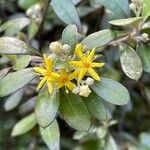
Corokia cotoneaster
Wire nettingbush · Korokia
Description
Source: leafsnapCorokia cotoneaster is a small evergreen shrub native to New Zealand, belonging to the Argophyllaceae family. Typically, it can reach a height of up to 2 meters. The plant is notable for its unique appearance, featuring small, oval-shaped leaves that are silver-grey and have a woolly texture on the underside. Its silver-grey stems further enhance its distinctive look. During spring and summer, Corokia cotoneaster produces small yellow flowers. These are followed by black or orange berries in autumn, which attract birds and other wildlife, making it an excellent choice for wildlife gardens. This shrub is easy to grow and thrives in well-drained soil with full sun or partial shade. Although it can tolerate drought conditions once established, it requires regular watering during the first few years of growth. Corokia cotoneaster has several uses, such as serving as hedging or an ornamental feature in gardens, thanks to its year-round unique appearance. Its hardiness makes it particularly suitable for coastal areas where other plants may struggle due to salt exposure. Overall, Corokia cotoneaster is a versatile evergreen shrub that adds interest and texture to any garden setting while also providing food for wildlife throughout the year.
🌳 Wire-netting bush is chiefly recognized for its distinctive, eye-catching shape, making it a popular option for ornamental use, particularly in horticultural arrangements like hedges and topiary. Its silvery-gray foliage and zigzagging branches create a striking visual contrast in garden settings. Although it is not widely exploited for commercial products, its pliable branches could be used in artisanal crafts, and its dense foliage can serve as a privacy screen or windbreak in landscape architecture.
Care Guide
💧 Water Every 7 days
The wire-netting bush is native to the rocky coasts of New Zealand, where it displays a remarkable tolerance to drought and can thrive with minimal watering. To care for this plant, water it every two weeks and plant it outdoors in well-draining soil to replicate its natural habitat. Additionally, make sure it receives plenty of natural light to promote optimal growth.
How should I water my Wire-netting bush?
To water your Wire-netting bush, you have plenty of options. You can use a watering can, hose, or even a cup – whatever works for you. It's important to direct the water to the soil, making sure to moisten all areas evenly so that the entire root system gets what it needs. Tap water may contain harmful particles, so using filtered water is a good idea. Also, try to use water that is at or slightly above room temperature, as extreme temperatures can be a bit too much for the Wire-netting bush. But don't worry too much, this plant usually handles any kind of water just fine.
What should I do if I give too much or too little water to my Wire-netting bush?
Outdoor plants, especially newly planted ones or seedlings, are often at risk of not being watered enough. It's crucial to water them regularly for the first few months, especially when they are still small or recently planted. Once the roots are established, Wire-netting bush plants can usually rely on rainfall. However, when Wire-netting bush is grown in pots, overwatering becomes more common. If you accidentally overwater your Wire-netting bush, there are steps you can take to fix the situation. First, stop watering the plant immediately to minimize the impact of overwatering. Then, remove the plant from the pot and inspect the roots. If there is no root rot, you can return the plant to its pot. If root rot is present, trim away the affected roots and consider using a fungicide to prevent further damage. Lastly, repot the Wire-netting bush in well-draining soil. On the other hand, if you underwater your Wire-netting bush and notice drooping and drying leaves, simply water the plant more frequently. It's important to adjust your watering frequency as soon as you notice underwatering.
How often should I give water to my Wire-netting bush?
Most plants growing outdoors can rely on rainfall, but if your area lacks rainfall, it's important to provide adequate watering every 2 weeks in the spring and fall, and more frequently in the summer. In winter, when growth is slower and plants require less water, it's best to water sparingly or not at all. However, if your Wire-netting bush is young or newly planted, it may need more frequent watering to help establish its growth and develop into a more adaptable and drought-tolerant plant. Determining the watering frequency for potted Wire-netting bushes can be done in two ways. The first option is to follow a set watering schedule, such as once every week or every other week. However, this approach may not always be suitable as it doesn't take into account the specific growing conditions of your plant. Another approach is to adjust the watering frequency based on soil moisture. It's generally recommended to wait until the top two to four inches of soil (about ⅓ to ½ the depth of the pots) have completely dried out before watering again. This method ensures that you're providing water when the plant actually needs it, rather than following a fixed schedule. Keep in mind that during summer, your Wire-netting bush may require more frequent watering than what a set schedule suggests, as its water needs are higher during this season.
How much water does my bush with wire-netting need?
To properly water your Wire-netting bush, it's important to know that it doesn't always require a lot of water. If only a few inches of soil have dried since the last watering, giving the plant about five to ten ounces of water should be sufficient for healthy growth. To determine the amount of water needed, you can assess the moisture level of the soil. Take note of how many inches of soil have dried out between waterings. To ensure your Wire-netting bush receives enough moisture, water it enough to moisten all the dry soil layers since the last watering. If more than half of the soil has dried out, you may need to give it more water. In such cases, continue adding water until it starts draining from the pot's drainage holes. If your Wire-netting bush is planted in an area that receives ample rain, additional watering may not be necessary. However, when the plant is young or establishing itself, make sure it receives 1-2 inches of rain per week. As it matures, it can rely solely on rainfall, but if there is a period of hot weather with no rain for 2-3 weeks, consider giving it a thorough watering to prevent stress.
How do I know if I am giving enough water to my Wire-netting bush?
The Wire-netting bush is often overwatered, which can be identified by yellowing leaves, leaf drop, shriveling plant structure, and root rot. On the other hand, an underwatered Wire-netting bush will wilt and have brown or brittle leaves. If you notice any signs of overwatering or underwatering, it's important to intervene and restore the plant's health.
☀️ Light Full sun
Wire-netting bush grows best with plenty of sunlight, though it can also tolerate modest amounts of light. Its native habitat matches this, showing vigorous growth. If light is too intense, the plant’s health can suffer. Likewise, insufficient light can limit its development.
What are the sunlight requirements for a Wire-netting bush?
The Wire-netting bush requires full sun, meaning it thrives with above 6 hours of sunlight daily, but it can also tolerate partial sun, with about 3 to 6 hours of sunlight. It's essential to observe how sunlight moves through your garden to find the ideal spot that offers a good balance of light and shade, ensuring the plant's health and happiness.
What are the essential growing conditions for the Wire-netting bush?
The Wire-netting bush flourishes with abundant sun exposure yet can adapt to lesser light conditions, mirroring its natural habitat's environment. Its growth can be vibrant under ideal conditions, but excessive sunlight can negatively affect its health, and insufficient light may limit its development. To compensate for a lack of natural sunlight, especially in winter or darker spaces, artificial lighting can be crucial. Optimal growth indoors requires adequate lighting, with LED lights being a recommended choice because they provide necessary wavelengths. Full sun plants need 30-50W per square foot of artificial light, partial sun plants 20-30W, and full shade plants 10-20W. The artificial light source should be placed 12-36 inches above the plant and kept on for 8-12 hours per day to mimic natural sunlight conditions.
What are the symptoms of improper lighting for a Wire-netting bush?
A Wire-netting bush not receiving sufficient light may show several symptoms: smaller new leaves, leggy or sparse growth, faster leaf drop, ceased or slow new growth, paler new leaves indicating chlorophyll and nutrient deficiency, chlorosis or yellowing leaves due to excessive sunlight damaging photosynthesis, sunscald marked by pale or bleached areas from intense sunlight exposure, leaf curling as a protective measure against extreme sunlight, wilting due to increased water loss, and leaf scorching, with brown or crispy leaf edges from too much sunlight. These symptoms highlight the plant's struggle with either too much or too little light.
How can you address lighting issues for a Wire-netting bush?
To address lighting issues for a Wire-netting bush, consider these strategies: Indoors, gradually move the plant to receive at least 6 hours of direct sunlight daily, using south-facing windows for maximum exposure and keeping curtains open during the day. Use artificial light for large or immovable plants, ensuring at least 8 hours of light daily. Outdoors, adapt plants to sunlight gently by moving them weekly to sunnier spots, avoiding abrupt exposure changes to prevent sunburn. Also, for ground plants, reduce obstructions such as overhanging branches, and consider transplanting smaller plants during their dormant period to sunnier locations with good drainage. Note that damaged parts might not recover, but increased light exposure will promote healthy new growth.
🌡️ Temperature 5–32.2°C
Wire-netting bush naturally occurs in habitats where temperatures lie between 41 and 90 °F (5 and 32 ℃). It flourishes in these mild conditions. Taking seasonal fluctuations into account, keeping temperatures within this range will help ensure its healthy growth.
What is the native environment for the Wire-netting bush?
The Wire-netting bush, botanically known as Corokia cotoneaster, is native to environments where temperatures fluctuate between 41 to 90 °F (5 to 32 °C). It thrives in these moderate conditions, which are integral to its healthy growth. This bush is highly cold-tolerant, negotiating winter without necessitating additional frost protection. Yet, to prepare it for winter's demands, it's advisable to water the plant generously before the first freeze of autumn. This practice ensures that the soil remains moist when it freezes, helping the plant to avoid drought and water scarcity during the colder months and into early spring.
What should I do if my Wire-netting bush experiences temperatures below -25°C?
While the Wire-netting bush is extremely cold-tolerant, temperatures dipping below -25°C can be harmful. While you might not notice immediate damage during the winter, spring could reveal brittle, dry branches, and a lack of new shoots. To manage this, it's recommended to prune away the damaged, dead branches that fail to produce new leaves come spring. This helps the plant to recover and continue its growth cycle.
How does the Wire-netting bush react to high temperatures, and what are the solutions?
The Wire-netting bush does not fare well under high temperatures, particularly those exceeding 32°C. In such conditions, the bush may exhibit significant leaf drop, and in severe cases, the entire plant might wither and die. To protect and revive your plant, trim away any sunburned and dried parts. Relocate the plant to a spot that offers protection from the midday and afternoon sun, or employ a shade cloth to mitigate direct sun exposure. Additionally, watering the plant in the cooler periods of the morning and evening can help keep the soil at an optimum moisture level, further safeguarding your Wire-netting bush from the stress of high temperatures.
💨 Humidity
🪴 Soil 6-7
🌱 Fertilizer Every 30 days
The timing of fertilizing the Wire-netting bush is important. Apply fertilizer in early spring and continue monthly until early summer. Fertilizer promotes attractive blooms and supplies energy during both dormant and active growth periods.
Why do I have to put fertilizer on my Wire-netting bush?
Fertilizing a Wire-netting bush is important for several reasons. Firstly, it helps the bush produce beautiful blooms. For optimal flower growth, it is best to fertilize in early spring. Secondly, fertilizer provides the bush with energy that it can store in the ground during dormant growth phases. By giving the bush extra nutrients during fall planting or late spring, it can store more energy to use when active growth resumes.
When should I fertilize my Wire-netting bush?
Proper timing is essential when fertilizing Wire-netting bushes. It is important to avoid applying fertilizer too early while the bushes are still dormant. Otherwise, the fertilizer will not be effective and could be washed away by rainwater, resulting in waste and pollution. The ideal time to start fertilizing is in early spring, and it should be done monthly until early summer.
When should I not add fertilizer to my Wire-netting bush?
To ensure proper growth of Wire-netting bush, it is important to be mindful of the type and timing of fertilizer application. Avoid using fertilizers high in nitrogen as this can result in excessive leaf growth but limited blooming. Look for fertilizers with lower nitrogen levels compared to other nutrients. Refrain from fertilizing the bush in late autumn, as this can encourage excessive growth right before winter, which is not desirable. Additionally, avoid fertilizing during hot and dry periods, as dry soil does not effectively deliver nutrients and can lead to overstimulated growth that requires more water, which may not be available. It is advisable to apply fertilizer earlier in the season when temperatures are cooler. Remember that Wire-netting bush may absorb fertilizer intended for nearby plants or lawns, so take care to avoid unintentionally giving the bush an overdose of fertilizer.
What kind of fertilizer does my Wire-netting bush need?
The ideal fertilizer for a Wire-netting bush should have a balanced mix of the three main plant nutrients, with slightly more phosphorus. Another option is to improve the soil by adding organic materials like compost, worm castings, and manure. Experienced gardeners might use water-soluble fertilizers with extra phosphorus when the flower buds start to appear, which helps the flowers grow larger and bloom longer. There are many forms of fertilizers that work well for Wire-netting bushes, but the best ones are usually liquid or powdered. No matter which form you choose, make sure to dilute the fertilizer and apply it while watering the bush.
How can I fertilize my Wire-netting bush?
To ensure the healthy growth of your Wire-netting bush, it's crucial to follow specific fertilizer instructions and do some research. Over-fertilizing can be harmful, so it's important to determine the appropriate amount. A general guideline is to use the tree's age or trunk diameter as a reference. The recommended amount is roughly one-tenth of a pound per year or per inch of trunk, with a maximum of one pound. Granular fertilizers and organic options like blood meal can be applied by sprinkling around the base of the tree, extending to the drip line. Be cautious not to let the fertilizer come in contact with the trunk. These granules gradually break down and seep into the soil, nourishing the roots. After fertilizing, spread a layer of compost about an inch deep around the base of the tree and water thoroughly.
🪴 Pot & Repot 2-3 years
Repot the wire-netting bush every 2 to 3 years in the spring, using a slightly larger container to accommodate its zigzagging branches. After repotting, place the plant in bright, indirect light and carefully monitor the soil moisture. This will ensure optimal recovery and highlight the plant’s unique silhouette.
✂️ Pruning
The wire-netting bush has dense foliage with intricate branching. Prune it in late spring to promote growth and maintain its shape. During pruning, remove any dead branches and thin out crowded areas. Be sure to use sterilized tools to prevent the spread of disease. Proper pruning encourages more flowering and helps maintain a vigorous, attractive plant.
🌿 Propagating
🐛 Diseases & pets
☠️ Toxicity
It has no toxicity status.
Characteristics
- Plant Type
- Shrub
- Life Cycle
- Perennial
- Genus
- Corokia
- Family
- Argophyllaceae
- Hardiness Zone
- 5-7
- Mature Height
- 3.05 m
- Mature Spread
- 2.13 m
- Leaf Color
- Green
- Leaf Type
- Evergreen
- Flower Color
- Yellow
- Flower Size
- 2.54 cm
- Bloom Time
- Late spring, Early summer, Mid summer
- Planting Time
- Spring, Autumn
- Harvest Time
- Mid summer
- Native Area
- New Zealand