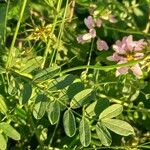
Coronilla varia
Crownvetch · Purple crown vetch · Purple Crownvetch · Common crown vetch · Crown-vetch coronilla
Description
Source: leafsnapSecurigera varia (synonym Coronilla varia), commonly known as crownvetch or purple crown vetch, is a low-growing legume vine. It is native to Africa, Asia and Europe and is commonly used throughout the United States and Canada for erosion control, roadside planting and soil rehabilitation. It has become an invasive species in many states of the US. Crownvetch grows 1 to 2 feet tall and bears small clusters of 1/2-inch pink and white flowers from early summer to late fall. The variety Penngift produces mounds of pink flowers. Crownvetch is a tough, aggressive spreading plant that will crowd out its neighbors in a show garden but is well suited to a sunny bank, where it will grow for decades with little to no fertilizing, mowing, or weeding since the thick foliage prevents weeds from growing amid it. Its deep, tenacious, complex root system and thick, fern-like leaves provide excellent erosion control where it is used as a ground cover. However, this legume has a very long germination period of about 6 months and does not create full coverage until two or three years later.
🌳 Under its purple flowers and clover-like leaves, crown vetch is especially useful in agriculture. Its strong roots make it effective at holding soil together and preventing erosion. The plant’s long vines form a protective mat that guards against soil loss and provides a base for other plants. Additionally, crown vetch supplies nectar to bees, supporting honey production.
Care Guide
💧 Water
Average water needs,watering when the top 3 cm (1,18") of soil has dried out. Can survive in dry soils; only water during very prolonged dry spells.
☀️ Light Full sun
Crown vetch strongly prefers plentiful sunlight like that of its native habitat. Adequate light is essential for its health and development. While it can tolerate lower light levels, steady exposure to ample light supports its vigorous growth. However, both insufficient and excessive light can lead to poor growth and health problems.
🌡️ Temperature 5–35°C
Crown vetch grows best in temperatures between 41 and 95 ℉ (5 and 35 ℃). The plant is native to temperate areas and adapts to seasonal temperature shifts. In colder periods, it is advisable to protect the plant, for example by covering it, to avoid frost damage. During hotter periods, occasional misting can help prevent dehydration.
💨 Humidity
🪴 Soil 6-7
🌱 Fertilizer
A single spring application of fertilizer is generally adequate for Crown vetch, though repeated feedings can optimize growth. Apply fertilizer every month to a month and a half. Fertilization improves the look and function of the leaves, helping maintain even color and a healthy texture. It also promotes root development and nutrient uptake, supporting long-term plant health.
🪴 Pot & Repot
✂️ Pruning
🌿 Propagating
🐛 Diseases & pets
☠️ Toxicity
Coronilla varia contains the toxin beta-nitropropionic acid (3-NPA) primarily in the leaves and growing stems. Ruminants are able to detoxify the 3-NPA in their rumens, while simple stomached animals cannot. The 3-NPA once absorbed will cause methemoglobinemia.
Characteristics
- Plant Type
- Herb
- Life Cycle
- Perennial
- Genus
- Coronilla
- Family
- Fabaceae
- Hardiness Zone
- 4-10
- Mature Height
- 49 cm to 91 cm
- Mature Spread
- 91 cm
- Leaf Color
- Green
- Leaf Type
- Deciduous
- Flower Color
- Pink, White, Lavender
- Flower Size
- 2.54 cm to 5.08 cm
- Bloom Time
- Late spring, Early summer, Mid summer
- Planting Time
- Spring
- Harvest Time
- Mid summer
- Native Area
- Turkey, Austria, Slovakia, Montenegro, Slovenia, Croatia, Belarus, Mali, Iraq, Germany, Estonia, Romania, Latvia, Belgium, Moldova, Netherlands, Czech Republic, Bulgaria, Armenia, Poland, Greece, Lebanon, Lithuania, Norway, Syria, Italy, Spain, Switzerland, Iran, Albania, Ireland, United Kingdom, Hungary, Azerbaijan, Turkmenistan