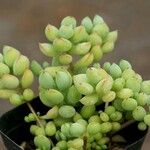
Cotyledon pendens
Aakula draxa mokka
Description
Source: leafsnapCotyledon pendens, simply known as the Cliff Cotyledon, is a unique succulent plant in the Sedum genus. The shrublet features branching, hanging stems bearing small, fleshy leaves. The leaves are grayish-green with powdery bloom and red margins. The Cliff Cotyledon produces long, branched inflorescences that bloom with up to 4 bell-shaped, reddish-orange flowers at the ends. The dense foliage growth provides a nearly crowded look, giving the succulent a beautiful, full appearance.
Care Guide
💧 Water Every 7-10 days
The Cliff Cotyledon is well-suited to rocky and dry environments, exhibiting excellent drought tolerance. It is important to water it weekly, using well-draining soil to prevent over-saturation. Being an evergreen plant, the Cliff Cotyledon retains moisture in its leaves, making it perfect for indoor cultivation where temperatures are consistent, and watering is controlled.
How should I water my Cliff cotyledon plant?
To properly water the Cliff cotyledon, it is important to consider a few factors. Firstly, using filtered water is recommended, as tap water may contain harmful particles. Additionally, the water should be at room temperature or slightly warmer to prevent any shock to the plant, considering its preference for warmer environments. It is best to avoid overhead watering, as this can cause issues with the foliage. Instead, simply apply the filtered room temperature water directly to the soil until it is completely soaked. This method of watering is beneficial as it ensures that the roots are moisturized and able to spread through the soil, allowing the plant to absorb the necessary nutrients.
What do I do if I give my Cliff cotyledon plant too much or too little water?
Overwatering is a more common problem than underwatering for the health of your Cliff cotyledon. When the plant receives too much water, its stems and leaves may wilt and turn yellow. Overwatering for a long time can also lead to diseases like root rot, mold, and mildew, which can kill the plant. Underwatering is less common for the Cliff cotyledon because it can tolerate drought fairly well. However, underwatering can still happen, resulting in brittle and brown leaves. It's important to recognize the signs of overwatering early on. Some diseases caused by overwatering, like root rot, are difficult to correct if not addressed promptly. If you notice early signs of overwatering, you should reduce your watering schedule right away. It's also a good idea to check the quality of the soil. If it drains poorly, replace it with a loose and well-draining potting mix. On the other hand, if you notice signs of underwatering, simply water more regularly until the signs disappear.
How often should I water my Cliff cotyledon plant?
If your Cliff cotyledon plant is in a pot, the most precise way to determine if it needs water is by sticking your finger into the soil. If the top two to three inches of soil feels dry, it's time to water. If you have a Cliff cotyledon planted directly in the ground outdoors, you can use a similar method to test the soil. Once again, if the top few inches of soil have dried out, it's time to water. Generally, during the spring and early fall, watering once a week will suffice. However, during extremely hot weather, you may need to water twice or more per week. It's worth noting that mature, well-established Cliff cotyledons have a remarkable ability to withstand drought.
How much water does my Cliff cotyledon plant need?
When it's time to water your Cliff cotyledon, don't hesitate to give it a good amount of water. Make sure the top 2-3 inches of soil are dry before watering thoroughly. You want to add enough water to saturate the entire soil. The water should also flow through the drainage holes at the bottom of the pot. If you don't see excess water draining, you may have not given enough water. However, be careful not to let the water accumulate inside the soil, as this can be dangerous for the plant. On the other hand, if water is not draining well from the pot, it indicates poorly draining soil, which is harmful to the plant's health and should be avoided. If the plant is outside, receiving about 1 inch of rain per week should be enough.
How do I water my Cliff cotyledon at different stages of growth?
The water needs of the Cliff cotyledon can change depending on growth stages. In the first few years or after transplanting, more water is needed. During these stages, the plant focuses on developing new roots, which require extra moisture. However, as the plant matures, it will require less water. Another stage that may require increased watering is during the bloom period when the plant is developing flowers.
☀️ Light Full sun
Native to arid areas, the Cliff cotyledon flourishes in full sun, as its native habitat has intense sunlight and very little shade. It can also tolerate partial sun, giving it some flexibility in how it grows.
🌡️ Temperature 20–37.8°C
Although Cliff cotyledon can withstand some heat, it mainly thrives and grows in cooler seasons and becomes dormant in summer. In hot summer weather, shade should be given to prevent scorching from intense sun. Watering should also be reduced or stopped during the hottest period to avoid root rot. Cliff cotyledon grows vigorously in winter and spring. If temperatures do not fall too low, it will continue to grow steadily.
💨 Humidity dry (<40%)
This plant prefers dry conditions, so don't mist it. However, watering it less often can also thrive in higher humidity.
🪴 Soil 6-7
🌱 Fertilizer
Cliff cotyledon only needs light fertilizer applications once or twice a year during the growing season. Do not fertilize in winter or summer while it is dormant. Use less fertilizer on repotted plants and wait a few months after repotting before applying fertilizer. Fertilization helps maintain healthy growth and promotes flowering.
🪴 Pot & Repot Every 2 years
When repotting a Cliff cotyledon, choose a pot slightly larger than the current one that has good drainage. Use a gritty, well-draining succulent or cactus mix. Gently remove the plant from its old container, brush off excess soil, and place it into the new pot at the same depth. Wait several days before watering so any root damage can heal. Repot in spring or fall and keep it in a brightly lit spot.
✂️ Pruning
The cliff cotyledon is a trailing succulent known for its vibrant blooms. To promote healthy growth and abundant flowering, prune it from early to late spring. Be sure to remove any dead stems and take care not to damage the delicate branches. Pruning at the right time encourages vigor and prevents overgrowth, helping the cliff cotyledon thrive in its environment.
🌿 Propagating
🐛 Diseases & pets
☠️ Toxicity
Though it makes for a unique house plant, the Cliff Cotyledon is not ideal for households with children and pets. The succulent contains toxins that are highly dangerous to animals. Ingesting the poisonous sap may result in nausea, vomiting, diarrhea, and other gastrointestinal symptoms.
Characteristics
- Plant Type
- Vine, Herb
- Life Cycle
- Perennial
- Genus
- Cotyledon
- Family
- Crassulaceae
- Hardiness Zone
- 10-11
- Mature Height
- 1 cm to 24 cm
- Mature Spread
- 1.52 m
- Leaf Color
- Green, Red
- Leaf Type
- Evergreen
- Flower Color
- Orange, Yellow
- Flower Size
- 1.02 cm to 2.03 cm
- Bloom Time
- All year round
- Planting Time
- Spring, Summer, Autumn
- Harvest Time
- All year round
- Native Area
- South Africa