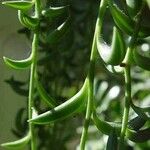
Crassothonna capensis
Ruby necklace
Description
Source: wikipedia (CC BY-SA)Crassothonna capensis, also known as little pickles (USA), ruby necklace (Australia), Cape aster, Cape Othonna, and Bobbejaankool (Afrikaans), is a species of the genus Crassothonna previously (Othonna) in the family Asteraceae, and is a native of the Eastern Cape of South Africa. It is a native highveld species that originates from the southern Drakensberg region.
🌳 Although little pickles are not commonly noted for a wide range of uses, their succulent leaves and drought tolerance make them well suited for water-wise gardens and landscapes. In areas where water is limited and conservation is necessary, little pickles can be used to create sustainable green spaces. Furthermore, their distinctive appearance adds aesthetic appeal and biodiversity to plantings, making them both a practical and decorative element in xeriscaping.
Care Guide
💧 Water
Little Pickles is well-adapted to arid conditions, as it stores water in its fleshy leaves. To care for it, water sparingly, about once every three weeks, and use well-draining soil to mimic its natural habitat. Ideal for indoor growth, Little Pickles is an evergreen plant that requires only minimal moisture.
☀️ Light Full sun
Little pickles does best with abundant sunlight, which encourages healthy growth. It can also tolerate areas with moderate light. Having originated in regions with plentiful sun exposure, the plant may show reduced growth in less sunny spots, while excessive light can cause damage.
🌡️ Temperature 20–37.8°C
Little pickles favor temperatures between 68 and 100 ℉ (20 and 38 ℃) and perform best in their native habitat, which has warm summers and mild winters. During winter, it is recommended to keep temperatures between 50 and 68 ℉ (10 and 20 ℃) for optimal growth.
💨 Humidity
🪴 Soil 6-7
🌱 Fertilizer
For Little pickles, light doses of fertilizer once or twice a year during the growing season are enough. Do not fertilize in winter or in summer when the plant is dormant. Cut back on fertilizer for repotted plants and wait a couple of months after repotting before you start feeding again. Fertilizing helps maintain healthy growth and promotes blooms.
🪴 Pot & Repot Every 2 years
When repotting Little pickles, choose a pot slightly larger than the current one that provides good drainage. Use a gritty, well-draining succulent or cactus mix. Gently remove the plant from its old pot, brush off excess soil, and plant it at the same depth. Wait a few days before watering so any root damage can heal. Repot in spring or fall and place it in a brightly lit location.
✂️ Pruning
🌿 Propagating
🐛 Diseases & pets
☠️ Toxicity
Characteristics
- Plant Type
- Succulent, Vine, Herb
- Life Cycle
- Perennial
- Genus
- Crassothonna
- Family
- Asteraceae
- Hardiness Zone
- 9-11
- Mature Height
- 10 cm
- Mature Spread
- 20 cm
- Leaf Color
- Green, Red, Purple
- Leaf Type
- Evergreen
- Flower Color
- Yellow
- Flower Size
- 2.54 cm
- Bloom Time
- Late spring, Early summer, Mid summer
- Planting Time
- Spring, Summer, Autumn
- Harvest Time
- Summer
- Native Area
- South Africa