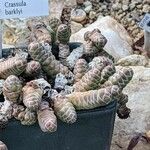
Crassula barklyi
Bandaged finger · Rattlesnake buttons · Rattlesnake tail
Description
Source: leafsnapRattlesnake tail (Crassula barklyi) is a perennial succulent plant native to Lesotho, Namibia, South Africa, and Eswatini.
Care Guide
💧 Water
Crassula is perfect for succulent beginners because it is super low-maintenance. It retains plenty of moisture in its leaves. The sign that it needs to water is only when the soil is dried out completely.
☀️ Light Full sun
Native to dry regions, Bandaged finger thrives in full sun, its native habitat marked by intense sunlight and scarce shade. It also tolerates partial sun, providing some flexibility in its growth.
🌡️ Temperature 20–37.8°C
Although Bandaged finger can tolerate some heat, it prefers and grows best in cooler seasons and goes dormant during summer. In hot summer conditions, provide shade to avoid scorching from strong sunlight. Watering should be cut back or stopped during the hottest part of the year to prevent root rot. Bandaged finger grows vigorously in winter and spring, and it will continue to grow steadily so long as temperatures do not fall too low.
💨 Humidity
🪴 Soil 6-7
🌱 Fertilizer
For Bandaged finger, small amounts of fertilizer given once or twice a year during the growing season are adequate. Do not fertilize in winter or summer while it is dormant. Cut back on fertilizer for recently repotted plants and wait a few months after repotting before feeding. Fertilizing helps maintain healthy growth and encourages flowering.
🪴 Pot & Repot Every 2 years
When repotting Bandaged finger, pick a pot slightly larger than the current one that has good drainage. Use a well-draining, gritty succulent or cactus mix. Gently remove the plant from its old pot, brush off excess soil, and set it in at the same depth. Wait a few days before watering so any root damage can heal. Repot in spring or fall, and place it in a brightly lit spot.
✂️ Pruning
Spring or summer is the best time for Crassulas to be pruned but they can also be pruned year-round. If you want the plant to branch out early, you can start pruning the plant even when they’re small.
🌿 Propagating
🐛 Diseases & pets
☠️ Toxicity
The Crassula genus is considered toxic to animals and humans. If ingested, this plant may cause vomiting, depression, and incoordination. All parts of the plants are considered poisonous as the toxic component of the plant is still unknown. It is advised to keep pets and children away from this possible harmful plant.
Characteristics
- Plant Type
- Succulent
- Life Cycle
- Perennial
- Genus
- Crassula
- Family
- Crassulaceae
- Hardiness Zone
- 9-11
- Mature Height
- 10 cm
- Mature Spread
- 15 cm to 20 cm
- Leaf Color
- Brown, Green
- Leaf Type
- Evergreen
- Flower Color
- White
- Flower Size
- 0.51 cm to 0.76 cm
- Bloom Time
- Mid summer, Late summer, Early fall
- Planting Time
- Spring, Summer
- Harvest Time
- Fall
- Native Area
- South Africa