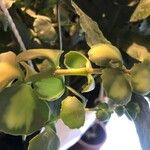
Crassula sarmentosa
Jade-tree
Description
Source: leafsnapCrassula sarmentosa, commonly known as String of Buttons or Necklace Vine, is a succulent plant that belongs to the Crassulaceae family. Native to South Africa and Mozambique, this plant is widely cultivated as an ornamental due to its attractive appearance and ease of care. The plant features trailing stems that can grow up to 60 cm long. Its small, round, and flattened leaves are a bright green color and are arranged in opposite pairs along the stem, enhancing its visual appeal. During the summer months, Crassula sarmentosa produces small clusters of white or pink flowers. These star-shaped flowers, each with five petals, emit a sweet fragrance that attracts pollinators such as bees. This succulent prefers bright, indirect light but can tolerate some direct sunlight during cooler months. For optimal growth, it requires well-draining soil mixtures, such as those designed for cacti. Watering should be done sparingly in the summer and significantly reduced during the winter dormant period. Propagating Crassula sarmentosa is easy through stem cuttings, which root quickly in well-draining soil mixtures under proper conditions. Overall, Crassula sarmentosa is an excellent addition to any indoor or outdoor garden. Its low maintenance requirements and unique trailing habit make it perfect for hanging baskets or cascading over walls and shelves, making it ideal for those who love plants but have limited space available.
Care Guide
💧 Water Every 7 days
Trailing jade thrives in semi-arid environments and requires infrequent watering, approximately every three weeks. It's important to allow the soil to dry out completely between waterings to prevent root rot. This plant grows best indoors in well-draining soil. It is sensitive to cold but highly tolerant of drought conditions.
☀️ Light Partial sun
Jade trailing is derived from settings with filtered sunlight, like the lower layers of forests or stony regions that naturally offer shade. While it favors semi-sun environments, it is also capable of withstanding exposure to full sun.
🌡️ Temperature 20–37.8°C
Although Trailing jade can tolerate some heat, it mainly flourishes and grows in the cooler seasons and becomes dormant in summer. In hot summer temperatures, shade should be provided to avoid scorching from intense sunlight. Watering should also be reduced or stopped during the hottest part of the year to prevent root rot. Trailing jade grows vigorously in winter and spring; as long as the temperature does not fall too low, it will continue to grow steadily.
💨 Humidity dry (<40%)
This plant prefers dry conditions, so don't mist it. However, watering it less often can also thrive in higher humidity.
🪴 Soil 6-7
🌱 Fertilizer
For Trailing jade, it's adequate to apply light quantities of fertilizer once or twice a year during the period of growth. The application of fertilizer should be evaded in the winter and summer seasons when the plant is in a dormant state. After repotting, the use of fertilizer should be lessened and one should wait for a few months before applying fertilizer. The act of fertilizing aids in robust growth and stimulates flowering.
🪴 Pot & Repot
✂️ Pruning
To keep your trailing jade in good shape, prune any excess or dense branches in the spring and autumn using a knife or scissors. If you want to propagate the plant, cut thick stems with 5-6 leaves, apply sulfur powder to the wound, and allow it to heal before planting. Make sure to slightly moisten the soil when planting the cutting.
🌿 Propagating
🐛 Diseases & pets
☠️ Toxicity
This plant has been found to be mildly toxic to humans, producing symptoms such as vomiting and diarrhea. However, these plants are featured on the ASPCA's list of extremely poisonous plants for dogs and cats. If your cat or dog is enticed to eat the plant, they may suffer jade plant poisoning symptoms.
Characteristics
- Plant Type
- Herb, Vine, Succulent
- Life Cycle
- Perennial
- Genus
- Crassula
- Family
- Crassulaceae
- Hardiness Zone
- 9-11
- Mature Height
- 30 cm
- Mature Spread
- 61 cm
- Leaf Color
- Yellow, Green, Red
- Leaf Type
- Evergreen
- Flower Color
- Pink, White
- Flower Size
- 0.51 cm to 0.76 cm
- Bloom Time
- Winter
- Planting Time
- Spring, Summer, Autumn
- Harvest Time
- Late winter, Early spring, Mid spring
- Native Area
- South Africa, Zimbabwe