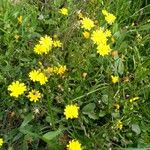
Crepis capillaris
Hawksbeard · Smooth Hawk's-beard · Green crepis · Smooth hawksbeard
Description
Source: leafsnapCrepis capillaris, the smooth hawksbeard, is a species of flowering plant in the tribe Cichorieae within the family Asteraceae, and is native to Europe. It has become naturalized in other lands and is regarded as a weed in some places.Crepis capillaris is a low, annual plant common in disturbed ground and open habitats, such as thin grassland, lawns, spoil heaps, rocky banks and on roadsides, the stems often trailing along the ground but sometimes erect, the leaves sometimes forming a rosette. It flowers from June to December: 298 in the Northern Hemisphere, producing an array of numerous small flower heads. Each head has as many as 60 yellow ray florets but no disc florets.
💡 Smooth hawksbeard, scientifically known as Crepis capillaris, is a small annual plant that belongs to the same family as dandelions and sunflowers. Originally native to Europe, this plant has spread and become naturalized in many other regions around the world. While it is typically regarded as a weed, it is not considered invasive. You can often find smooth hawksbeard growing in fields and along disturbed areas.
Care Guide
💧 Water
Smooth hawksbeard grows best in moderately moist conditions, favoring soil that remains consistently damp but not waterlogged. To keep it well-hydrated, water it weekly. As a plant native to temperate regions, smooth hawksbeard adjusts well to seasonal rainfall and is resilient across different climate zones.
How should I water my Smooth hawksbeard plant?
Smooth hawksbeard can be watered using various tools, such as a garden hose with a spray nozzle or a watering can. It is not very particular about the type of water it receives, whether it's rainwater, tap water, or filtered water. However, it is generally advised not to water it from above as this can harm the leaves and flowers and may cause disease. A drip irrigation system is often recommended for watering Smooth hawksbeard as it provides even and direct watering to the soil. For a container-grown Smooth hawksbeard, you can use a cup, watering can, or tap to water it directly onto the soil.
What should I do if I give my Smooth hawksbeard too much or too little water?
The remedy for underwatering Smooth hawksbeard is simple: water it more regularly when you notice it lacks moisture. Overwatering, on the other hand, can be a serious problem if not caught early. It can cause diseases that lead to the decline and death of the plant. To prevent this, choose a suitable growing location with plenty of sunlight to dry the soil and good drainage to prevent waterlogging. If you overwater a potted Smooth hawksbeard, consider changing it to a new pot with better soil drainage and more drainage holes. Repot with loose soil and a pot that drains efficiently.
How frequently should I give water to my Smooth hawksbeard plant?
Smooth hawksbeard requires regular watering throughout the growing season. In the spring, you should water it once a week. As the season progresses and it gets warmer, you may need to water it two to three times a week. However, watering it more than that can harm the plant. Regardless of how often you water, make sure the soil is moist but not overly wet. If you have a potted Smooth hawksbeard, you will need to water it more frequently. Soil in pots can heat up and dry out faster than ground soil, so plan to water a container-grown plant a few times per week, compared to just once per week for a plant in the ground.
How much water does my Smooth hawksbeard plant require?
Determining how much water to give your Smooth hawksbeard can be approached in a few ways. Some gardeners prefer to gauge moisture levels by feeling the soil. In this method, watering is done until the top six inches of soil feel moist. Alternatively, you can rely on a set measurement. On average, Smooth hawksbeards require approximately two gallons of water per week, adjusted for factors like temperature and soil dryness. However, strict adherence to this guideline can lead to overwatering if your plant requires less. When growing in containers, you'll need a different approach. Ensure all layers of soil are moistened by either feeling for moisture with your finger or observing a slight trickle from the drainage holes.
How can I know if I am giving enough water to my Smooth hawksbeard plant?
Avoiding overwatering your Smooth hawksbeard can be quite challenging. On one hand, these plants have deep roots that need to be watered weekly. However, they are highly prone to root rot and browning if overwatered. Underwatering is less of a concern, as these plants can survive without additional watering for a while. However, if you wait too long, the plant will likely start wilting and develop dry leaves.
☀️ Light Full sun
The smooth hawksbeard prefers spots that receive largely unobstructed sunlight for most of the day, which supports healthy growth. It can also prosper in areas with moderate light penetration. Its native habitat shapes this sunlight preference. Excessive or insufficient sun exposure can negatively affect its growth.
What are the sunlight requirements for Smooth Hawksbeard?
Smooth Hawksbeard thrives in areas that receive full sun for the majority of the day, requiring above 6 hours of sunlight to promote healthy growth. It can also adapt to partial sun, needing about 3-6 hours of sunlight. The plant shows a strong affinity for unobstructed solar exposure, which is influenced by its original habitat. However, both over and underexposure to sunlight could negatively impact its growth. It's important to watch how sunlight moves through your garden to choose the perfect balance of light and shade, ensuring the plants' happiness.
How can artificial lighting support Smooth Hawksbeard grown indoors?
For Smooth Hawksbeard plants grown indoors, where natural sunlight might be insufficient, artificial lighting can be a vital solution. Indoor plants require adequate lighting for optimal growth, especially in winter or in less sunny spaces. Consider choosing the right type of artificial light, such as LED lights, which can provide specific wavelengths that your plants need. Full sun plants need 30-50W/sq ft of artificial light, partial sun plants require 20-30W/sq ft, and full shade plants need 10-20W/sq ft. The light source should be placed 12-36 inches above the plant to mimic natural sunlight, and most plants need 8-12 hours of light per day.
What are the symptoms of insufficient or excessive light for Smooth Hawksbeard?
When cultivated indoors or in conditions of inadequate light, Smooth Hawksbeard may exhibit symptoms such as smaller leaves, leggy or sparse growth, faster leaf drop, slower or no new growth, lighter-colored new leaves, and chlorosis. Excessive sunlight can cause symptoms like sunscald, leaf curling, wilting, and leaf scorching. These changes notify the need for adjusting the plant's exposure to light. It's vital to monitor these symptoms to ensure the plant receives the optimal amount of sunlight for its health.
What solutions are available for managing sunlight exposure for Smooth Hawksbeard?
To ensure optimal growth for Smooth Hawksbeard, it's crucial to manage its sunlight exposure effectively. For indoor plants, gradually move them towards sunnier locations each week, aiming for at least 6 hours of direct sunlight daily. Utilizing a south-facing window and keeping curtains open during the day can provide maximum sunlight exposure. If necessary, use artificial light for at least 8 hours daily. For outdoor plants, adapt them to sunlight gradually to prevent sunburn. Reducing obstructions, such as pruning trees or transplanting to sunnier locations, can also enhance sunlight access. Remember, while parts of the plant affected by insufficient sunlight may not recover, new growth after increasing light exposure should be healthy.
🌡️ Temperature 0–35°C
Smooth hawksbeard originates from habitats where temperatures range from 68 to 95°F (20 to 35°C). The plant favors moderate warmth but can tolerate somewhat higher temperatures. In winter, a heated greenhouse is best.
What is the optimal temperature range for Smooth hawksbeard?
Smooth hawksbeard is native to ecosystems where temperatures range from 68 to 95°F (20 to 35°C). This plant prefers mild warmth but can adapt to slightly warmer climates. In ecosystems where temperatures fall below or rise above this range, special care may be needed to ensure the plant's health.
How should Smooth hawksbeard be cared for in winter?
In wintertime, if temperatures are expected to remain within the plant's cold tolerance, special frost protection measures are not necessary. However, for temperatures expected to drop below -35°C, it's crucial to protect the plant from cold by covering it with soil or straw. Additionally, watering the plant abundantly before the first freeze in autumn is recommended to keep the soil moist, helping prevent drought and water scarcity during winter and early spring.
What should be done if Smooth hawksbeard is exposed to temperatures below -35°C?
If Smooth hawksbeard experiences temperatures below -35°C, though it may not show noticeable changes during winter, it could result in decreased sprouting or no sprouting during springtime. To counteract this, in spring, it's advised to remove any parts of the plant that have failed to sprout, promoting healthier growth for the surviving sections.
How does high temperature affect Smooth hawksbeard?
During summer, it's essential to keep the Smooth hawksbeard's environment below 35°C. Exposure to temperatures above 38°C can lead to the leaves becoming lighter in color, curling, becoming prone to sunburn, and in severe cases, causing the entire plant to wilt and dry. To mitigate these effects, sunburned and dried-up parts should be trimmed away. The plant should be moved to a shaded location or covered with a shade cloth to protect it from midday and afternoon sun. Additionally, watering the plant in the morning and evening will help keep the soil moist and support the plant's well-being.
💨 Humidity
🪴 Soil 6-7
🌱 Fertilizer
Smooth hawksbeard benefits from regular, dilute applications of fertilizer to encourage healthy leaf development. You should fertilize Smooth hawksbeard about once a month during the summer months. Nitrogen is essential for foliage, and adding nitrogen-rich sources helps Smooth hawksbeard thrive.
🪴 Pot & Repot
✂️ Pruning
🌿 Propagating
🐛 Diseases & pets
☠️ Toxicity
Crepis capillaris is not particularly toxic.
Characteristics
- Plant Type
- Herb
- Life Cycle
- Annual, Biennial, Perennial
- Genus
- Crepis
- Family
- Asteraceae
- Hardiness Zone
- 3-9
- Mature Height
- 10 cm to 91 cm
- Mature Spread
- 10 cm to 49 cm
- Leaf Color
- Green
- Leaf Type
- Deciduous
- Flower Color
- Yellow
- Flower Size
- 1.02 cm to 1.52 cm
- Bloom Time
- Late spring, Early summer, Mid summer
- Planting Time
- Autumn
- Harvest Time
- Early summer, Mid summer
- Native Area
- India, Austria, Sweden, Slovakia, Montenegro, Croatia, Slovenia, Belarus, Russia, Germany, Romania, Belgium, Netherlands, France, Portugal, Czech Republic, Bulgaria, Poland, Ukraine, Serbia, Lithuania, Norway, Italy, Spain, Switzerland, Denmark, Albania, Ireland, United Kingdom, Hungary