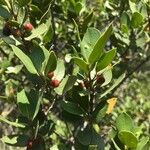
Crossopetalum rhacoma
Maidenberry · Rhacoma · Florida crossopetalum · Poison cherry
Description
Source: leafsnapCrossopetalum rhacoma, commonly known as Jamaica Wild Coffee or simply Wild Coffee, is a small evergreen shrub belonging to the Rubiaceae family. Native to Jamaica and other Caribbean islands, this plant can grow up to 3 meters in height. It displays a dense branching habit, with glossy green, oval-shaped leaves arranged in opposite pairs. The flowers of Crossopetalum rhacoma are small and either white or cream-colored, each with five petals. These flowers appear in clusters at the ends of the branches from late spring through summer. Following the flowering season, the plant produces small red berries that contain one or two seeds. Often cultivated for its attractive foliage, flowers, and berries, Crossopetalum rhacoma is a popular ornamental plant. Additionally, it has medicinal uses, as it contains caffeine-like compounds traditionally employed to treat headaches, reduce fever, and alleviate stomach ailments. The plant thrives in well-drained soils with moderate moisture levels but can also endure drought conditions once established. It prefers full sun exposure but can tolerate partial shade. Overall, Crossopetalum rhacoma is valued as an ornamental shrub with medicinal properties, making it a favored choice among gardeners seeking both beauty and functionality in their plants.
Care Guide
💧 Water Every 7 days
☀️ Light Full sun
Maidenberry comes from open habitats, such as sunny meadows and forest edges, which offer abundant light. It does best in Full Sun but can also tolerate Partial Sun, adapting well to different sunlight conditions.
🌡️ Temperature 20–37.8°C
Maidenberry comes from tropical areas, where the climate is usually warm and humid. Consequently, it is well-suited to high temperatures and humidity. It does not tolerate abrupt temperature shifts and prefers a steady thermal environment, so avoiding temperature fluctuations indoors is important. It typically cannot endure cold conditions and needs relatively high temperatures to grow. If the ambient temperature falls too low, the plant may stop growing or even die.
💨 Humidity
🪴 Soil 6-8
🌱 Fertilizer
Fertilizing a Maidenberry is best done in early spring as it comes out of dormancy. This encourages overall growth and flower development. Fertilizer benefits the foliage, stems, and branches, and supports flowers that are larger, more vibrant, and longer-lasting. It helps transport nutrients from the roots to the blooms and enhances the plant’s health and resistance to disease.
🪴 Pot & Repot
✂️ Pruning
Maidenberry plants have small, glossy leaves and delicate berries. Pruning them in early spring helps maintain healthy growth by removing dead branches and lightly shaping the plant. However, it's important to avoid excessive pruning. This timing aligns with the maidenberry's natural growth cycle, enhancing air circulation, light penetration, and overall health, which in turn improves berry production.
🌿 Propagating
🐛 Diseases & pets
☠️ Toxicity
Characteristics
- Plant Type
- Shrub
- Life Cycle
- Perennial
- Genus
- Crossopetalum
- Family
- Celastraceae
- Hardiness Zone
- 10-12
- Mature Height
- 2.13 m to 3.05 m
- Mature Spread
- 0.91 m to 2.13 m
- Leaf Color
- Green, Dark Green
- Leaf Type
- Evergreen
- Flower Color
- White
- Flower Size
- 0.25 cm to 0.51 cm
- Bloom Time
- Late spring, Summer
- Planting Time
- Spring, Summer, Autumn
- Harvest Time
- Late summer, Fall
- Native Area
- Colombia, Bahamas, Belize, Cuba, Mexico, Venezuela, Jamaica