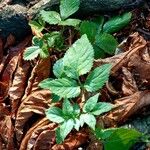
Cryptotaenia canadensis
White chervil · Wild chervil · Honewort · Canadian Honewort · Canada Honewort
Description
Source: leafsnapCryptotaenia canadensis, the Canadian honewort, is a perennial plant species native to the eastern United States and eastern Canada. Its young leaves and stems can be used as a boiled green or seasoning similar to parsley. The parsniplike roots can be cooked and eaten.
🎭 Abundant, resilient, productive
Care Guide
💧 Water
Canadian honewort flourishes in moist, shaded woodland areas, where it needs regular moisture without becoming waterlogged. It's best to water it weekly. Generally grown outdoors, Canadian honewort benefits from mulching, which helps retain soil moisture and mimics its natural forest habitat.
How should I water my Canadian honewort plant?
To water the Canadian honewort, it is best to use filtered water at room temperature. Tap water may contain harmful particles, so it is important to avoid using it. The plant prefers warm water as it is used to warmer climates, and cold water can be a shock to its system. Instead of watering from above, it is recommended to apply the filtered room temperature water directly to the soil until it is completely soaked. This method helps to keep the roots moist and allows them to spread in the soil to gather the necessary nutrients for the plant's health.
What should I do if I give too much or too little water to my Canadian honewort plant?
Overwatering and underwatering can harm your Canadian honewort, but overwatering is a more common problem. When this plant gets too much water, its stems and leaves may wilt and turn yellow. Overwatering for a long time can also lead to diseases like root rot, mold, and mildew, which can kill the plant. Underwatering is less likely for the Canadian honewort because it can tolerate drought. Still, there is a possibility of underwatering, which causes brittle, brown leaves. It's important to spot signs of overwatering early on. Some diseases, like root rot, may not be fixable if you wait too long. If you see early signs of overwatering, reduce watering immediately. Check the soil to see if it drains poorly; if so, replace it with a loose, well-draining potting mix. For underwatering, simply water more regularly until the signs subside.
How many times should I water my Canadian honewort?
If your Canadian honewort plant is in a pot, the best way to determine if it needs water is by checking the moisture of the soil. Simply stick your finger into the soil and if the top two to three inches are dry, it's time to water it. For those who have their Canadian honewort growing outdoors in the ground, you can use a similar method to test the soil. Once you find that the top few inches of soil have dried out, it's time to water. Typically, during spring and early fall, you'll find yourself watering this plant about once a week using this method. However, during extremely hot weather, you may need to increase your watering frequency to twice or more per week. Keep in mind that mature and well-established Canadian honewort plants have the impressive ability to withstand drought.
How much water does my Canadian honewort plant need?
When watering your Canadian honewort, it's important to give it a good amount of water. Make sure the first two to three inches of soil are dry before watering. Water the plant thoroughly, making sure to soak the entire soil. You should add enough water so that excess water drains out of the pot's drainage holes. If you don't see excess water draining, you may not have given enough water. However, be careful not to let water accumulate too much in the soil, as this can be harmful to the plant. On the other hand, if water is not draining well, it may indicate poorly draining soil, which is bad for the plant's health. If the plant is outside, one inch of rain per week should be enough.
How should I water my Canadian honewort as it grows in different stages?
The water needs of the Canadian honewort vary depending on its growth stages. In the first few years of its life or when it has been recently transplanted, more water is required. During these stages, the plant focuses on developing new roots, which need extra moisture to support future growth. As the plant matures, it requires less water. Another stage that requires additional watering is the bloom period, as flower development requires a significant amount of moisture.
☀️ Light Partial sun
Canadian honewort grows best with moderate sunlight but is also capable of surviving in dimmer spots. In its native range it is often seen thriving where sunbeams filter through the trees. Excessive light can hinder its growth, while insufficient light may restrict its development.
What are the sunlight requirements for Canadian honewort?
Canadian honewort requires moderate sunlight exposure, thriving in partial sun (about 3-6 hours of sunlight) and can grow in full shade (less than 3 hours of sunlight). It's often found thriving in its natural habitat where sunlight filters through the treelines. Excessive sunlight or insufficient light can impede its growth, so it's important to observe the movement of sunlight through your garden to find spots that offer a balance of light and shade, conducive to the plant's well-being.
Can Canadian honewort be grown with artificial lighting?
Yes, Canadian honewort can be grown with artificial lighting, especially when natural sunlight is insufficient. Indoor plants benefit greatly from artificial lighting, which promotes faster and healthier growth. LED lights are a popular choice as they can be customized to provide specific light wavelengths needed by plants. The recommended artificial light intensity varies by plant type. Plants should be placed 12-36 inches away from the light source, with an exposure of 8-12 hours per day to mimic natural daylight hours. This can help in achieving optimal growth indoors.
What are the symptoms of insufficient light for Canadian honewort?
When grown indoors with insufficient light, Canadian honewort may exhibit symptoms like small leaves, leggy or sparse growth, faster leaf drop, slower or no new growth, and lighter-colored or chlorotic leaves. Extreme sunlight conditions can lead to sunscald, leaf curling, wilting, leaf scorching, and chlorosis - a condition where leaves lose their green color due to the breakdown of chlorophyll. These symptoms indicate that the plant is struggling with the current light conditions.
How can I manage Canadian honewort with inadequate sunlight?
To manage Canadian honewort with inadequate sunlight, optimize plant growth by gradually moving them to sunnier spots each week until they reach 3-6 hours of direct sunlight daily. If the plant is large or hard to move, consider using artificial light sources such as desk or ceiling lamps for at least 8 hours daily, or invest in professional grow lights. For outdoor plants, ensure a gradual adaptation to sunnier locations to prevent sunburn. If necessary, reduce light obstructions by pruning or move smaller plants during their dormant period to locations with ample sunlight and good drainage.
🌡️ Temperature 5–32.2°C
Canadian honewort naturally grows in the cooler areas of North America, indicating it favors cooler conditions. Its ideal temperature span is 41 to 90 ℉ (5 to 32 ℃), so it can tolerate a range of temperatures. In winter, indoor plants should be maintained at 60 to 65 ℉ (15.5 to 18.3 ℃) to enable dormancy.
What is the native growth environment for Canadian honewort?
Canadian honewort, or Cryptotaenia canadensis, thrives in the cooler regions of North America. This indicates that it prefers cooler temperatures and is able to adapt to a wide temperature range, from 41 to 90°F (5 to 32°C). To facilitate dormancy, it is recommended that indoor plants are kept at 60 to 65°F (15.5 to 18.3°C) during the winter. Due to its strong cold resistance, special frost protection measures are not generally necessary. However, in extremely cold conditions where temperatures are expected to drop below -30°C, some form of cold protection, like covering the plant with soil or straw, is advisable. Additionally, watering the plant abundantly before the first freeze of autumn to keep the soil moist can help prevent drought and water scarcity during the colder months.
How does Canadian honewort react to low temperatures?
Canadian honewort exhibits significant cold tolerance, optimally thriving when temperatures are above 5°C. During winter, temperatures should ideally remain above -25°C. If temperatures fall below -30°C, the plant may still survive the winter without noticeable harm, but there could be problems with sprouting in the following spring—either decreased sprouting or none at all. To address this, it is recommended to remove any parts of the plant that have failed to sprout in the spring.
What should be done if Canadian honewort experiences high temperatures?
In the summer, it is important to ensure that temperatures for the Canadian honewort do not exceed 32°C. Exposure to temperatures above 35°C can lead to the plant’s leaves becoming lighter, curling, and being prone to sunburn. In severe cases, this can result in the entire plant wilting and drying out. To mitigate these effects, any sunburned or dried-up parts should be trimmed off. Moving the plant to a shaded area or using a shade cloth can protect it from the intense midday and afternoon sun. Additionally, watering the plant in the morning and the evening to maintain soil moisture can be beneficial.
💨 Humidity
🪴 Soil 6-7
🌱 Fertilizer
Usually a single fertilizer application in spring is adequate for Canadian honewort, though several feedings can maximize growth. Apply fertilizer about once every one to one and a half months. Fertilizing improves the leaves' appearance and function, helping maintain even color and a healthy texture. It also promotes root growth and nutrient uptake, supporting the plant's long-term health.
🪴 Pot & Repot
✂️ Pruning
Canadian honewort is characterized by its delicate compound leaves and small white flowers. To encourage healthy growth, prune the plant from early to late spring. Removing spent flowers helps prevent self-seeding, and cutting back damaged stems enhances air circulation, reduces the risk of disease, and keeps the plant looking its best.
🌿 Propagating
🐛 Diseases & pets
☠️ Toxicity
Characteristics
- Plant Type
- Herb
- Life Cycle
- Perennial
- Genus
- Cryptotaenia
- Family
- Apiaceae
- Hardiness Zone
- 4-8
- Mature Height
- 30 cm to 91 cm
- Mature Spread
- 61 cm
- Leaf Color
- Green
- Leaf Type
- Deciduous
- Flower Color
- White
- Flower Size
- 2.54 cm
- Bloom Time
- Late spring, Early summer, Mid summer
- Planting Time
- Spring
- Harvest Time
- Mid summer