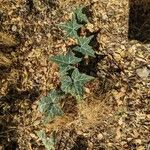
Cucurbita palmata
Coyote gourd · Coyote melon
Description
Source: leafsnapCucurbita palmata is a species of flowering plant in the squash family known by the common names coyote melon and coyote gourd. It is similar to Cucurbita californica, Cucurbita cordata, Cucurbita cylindrata, and Cucurbita digitata and all these species hybridize readily. It was first identified by Sereno Watson in 1876. These species form the only restricted xerophyte species group in the genus Cucurbita. Each member of this species group is native to the Southwestern United States and Northwestern Mexico where they are relatively uncommon. Each group member is found in hot, arid regions with low rainfall. They prefer soil that is loose, gravelly, and well-drained. C. palmata is native to northeastern Baja California, southeastern California, and southwestern Arizona to a point near the Colorado River. The juvenile leaves of C. cylindrata, C. cordata, C. digitata, and C. palmata show a high degree of similarity, but their mature leaves are visibly different, as are their root structures. C. palmata and C. digitata are sympatric, with C. palmata separating the ranges of C. digitata at the juncture of Baja California, California, and Arizona. C. palmata fruits are diffuse green mottle that turns yellow at maturity, striped, and round.
Care Guide
💧 Water
Originating from arid regions, the coyote melon is highly drought-tolerant and requires watering only once a week. Its hardy nature allows it to thrive in dry climates by efficiently managing water storage and usage, making it well-suited to areas with sparse rainfall.
How should I water my Coyote melon?
The Coyote melon has specific preferences regarding both the amount of water it receives and how it is watered. If you do not use the proper watering technique, you may end up harming your tomatoes. The recommended way to water a Coyote melon is to gradually and gently apply the water directly to the soil. Avoid pouring all of the water into the soil at once and refrain from overhead watering. While it is important to water slowly, you should also ensure that the water reaches deep into the soil to keep it adequately moist throughout.
What should I do if I give my Coyote melon too much water or too little water?
If you have overwatered your Coyote melon and are worried about disease, it's important to act quickly. The best approach is to remove the plant from its current spot and let the roots dry out a bit before replanting in a location with good drainage. If you grow in pots, consider moving the plant to a pot with better drainage. On the other hand, if you have underwatered your plant, simply increase the frequency of watering.
How often should I give water to my Coyote melon?
Coyote melon needs a lot of water during its growing season. To meet this high water requirement, it is important to water the plant regularly in the spring and summer. In the early stages of growth, watering once or twice a week is sufficient. As the season progresses, the frequency of watering should be increased, possibly up to twice a day or more during summer months, depending on the weather. After the plant has completed its main growth phases, watering can be reduced to about once a week until the end of the growing season.
How much water does my Coyote melon require?
Coyote melon plants are highly popular among both professional and amateur gardeners. As a result, there is a lot of knowledge about how to care for them, including specific information about their water needs. On average, Coyote melon plants should receive about 1 - 1.5 inches of water per week. It is best to water them evenly throughout the week. When the weather gets warmer, you may need to increase the amount of water, but generally, providing two inches of water per week is a good starting point.
How can I know if I'm giving enough water to my Coyote melon plant?
Your Coyote melon can experience problems from both underwatering and overwatering. These issues can have similar symptoms, such as foliage discoloration and wilting. When underwatered, the leaves will curl and droop initially, followed by a decrease in their vigor. Underwatering can also result in stunted growth and poor development, as this plant needs a significant amount of water. On the other hand, overwatering can lead to diseases like rot and unpleasant smells from the soil. Symptoms of underwatering show up faster than overwatering, and you may notice standing water or waterlogged soil in case of overwatering.
☀️ Light Full sun
Coyote melon grows best in areas with plenty of sunlight, which supports healthy growth. While it can tolerate shadier conditions, sunlight greatly influences its vigor. Its native habitat is defined by full sun. Both very low and very high levels of sunlight can affect its survival.
How much sunlight does the Coyote melon require to grow?
To ensure successful growth and fruit production, it is generally recommended to provide Coyote melon with a minimum of 6 to 8 hours of daily sunlight.
What kind of sunlight does Coyote melon need?
To grow coyote melon effectively, you should choose a spot with unobstructed direct sunlight, avoiding areas overshadowed by trees, fences, or buildings. As a rule of thumb, the plant's growth rate determines its sunlight requirements - the faster it grows, the more hours of sunlight it needs. For optimal photosynthesis, morning sun is preferred.
Should I keep Coyote melon out of the sun?
In most climates, coyote melon doesn't require protection from the sun. However, people living in deserts or near the equator may find the sun too intense for the plants they wish to cultivate, but this is not the norm.
What happens if Coyote melon doesn't get enough sunlight?
All plants need sunlight to convert into energy. Plants with a short growing season require even more light and energy than slow-growing plants. This is because they need to go through all the necessary processes for growth and fruit production within a short span of time. Insufficient sunlight in Coyote melon can be identified by pale and yellow leaves that lack enough chlorophyll to maintain a healthy green color. These leaves may eventually fall off, and new growth is stunted and weak. In an attempt to reach available light, the plant may become thin and sparse. Ultimately, without enough light, the Coyote melon plant cannot produce large, high-quality edible leaves or fruit. Since the plant requires ample energy to develop leaves and fruits, a lack of light will negatively impact the harvest.
What will happen if Coyote melon gets too much sunlight? What happens if Coyote melon gets too much sunlight?
Coyote melon is susceptible to sunburns caused by intense sunlight, particularly when combined with high temperatures and inadequate water. The afternoon sun poses the highest risk of burning the plants. When the leaves get scalded, they develop faded patches ranging from light brown to white on the top areas of the plant that are most exposed to the sun. This vulnerability is especially prominent right after the plants are moved from a shady spot to direct sunlight. To prevent sunscald in young plants, it helps to gradually transition them or provide a barrier during the adjustment period. In most cases, Coyote melon leaves grow large enough to shield the fruits from the sun's harshest rays. However, if the fruits come into contact with intense sunlight, they may also be damaged. Therefore, it's important not to overly prune the protective leaves to prevent burning the fruits.
🌡️ Temperature 20–35°C
Coyote melon is native to habitats with a moderate temperature range and grows best in temperatures of 68 to 95 °F (20 to 35 ℃). Care must be taken to adjust growing conditions as seasonal temperatures change to ensure healthy growth.
What temperature is best for Coyote melon?
Coyote melon thrives in a specific temperature range where it is unlikely to experience damage from extreme cold or hot conditions. However, if you notice the leaves changing color, it could indicate that the Coyote melon is not in an ideal environment. Ideally, try to maintain temperatures between 70-85℉ (21-30℃) for your Coyote melon. If the temperature occasionally goes above 85℉ (30℃) during the day or drops to 70℉ (21℃) at night, there is no need to panic.
How can I keep Coyote melon safe from very hot or very cold weather outside?
If your Coyote melon is planted outdoors, it may not be practical to move it indoors. However, you can still take steps to help it withstand extreme temperatures. One option is to create a shade tent using stakes and cloth, which will block out some of the intense heat from the sun. This will protect the melon from direct sunlight exposure. Another possibility is to build a small greenhouse around the plant, using garden stakes and clear or translucent plastic. This will create a greenhouse effect and help warm up the plant, shielding it from cold and chilly winds. When nighttime temperatures reach 40℉(10℃), you can remove the greenhouse.
Does the Coyote melon require varying temperatures in different seasons?
Coyote melon generally thrives in a specific temperature range throughout the year. However, the care it requires can vary depending on the season. During the hottest months, it benefits from some extra shade and a gentle breeze to handle the heat. Conversely, in cooler months where temperatures can go below 40℉(10℃), it should be shifted away from cold windows and doors.
How can I make sure the temperature for my Coyote melon stays right?
Keeping your Coyote melon at the right temperature can be fairly simple. For indoor growing, you can easily move the plant to different locations within your indoor space that best meet its temperature requirements. Avoid placing it near air conditioning vents, heaters, doors that open frequently, or drafty windows. If you are growing your Coyote melon outside, it becomes a little more difficult to control the temperature. If it's in a pot, you can bring it indoors when the temperatures outside get too extreme. However, if it's planted directly in the ground, you may need to take other measures to protect it. To shield it from the intense sun and cold winds that could harm your plant, try placing the Coyote melon under cover.
💨 Humidity
🪴 Soil 6-7
🌱 Fertilizer
For Coyote melon, choose natural organic materials such as compost, grass clippings, or manure. A slow-release granular fertilizer or commercial fertilizer can be applied sparingly. Work the organic fertilizer into the soil before planting. Generally, one to two fertilizer applications per growing season are adequate for a bountiful harvest.
🪴 Pot & Repot
✂️ Pruning
Prune the coyote melon between early and late spring to manage its growth, remove damaged areas, and enhance fruit production. Concentrate on trimming excessive vines and yellowing leaves to improve air circulation and sunlight exposure, which helps minimize the risk of diseases. This practice promotes a manageable size, healthy plants, and increased yield.
🌿 Propagating
🐛 Diseases & pets
☠️ Toxicity
Characteristics
- Plant Type
- Herb, Vine
- Life Cycle
- Perennial, Annual
- Genus
- Cucurbita
- Family
- Cucurbitaceae
- Hardiness Zone
- 9-10
- Mature Height
- 5 cm to 10 cm
- Mature Spread
- 0.91 m to 2.13 m
- Leaf Color
- Green
- Leaf Type
- Deciduous
- Flower Color
- Yellow
- Flower Size
- 6.35 cm to 7.62 cm
- Bloom Time
- Summer
- Planting Time
- Spring, Summer, Autumn
- Harvest Time
- Late summer, Early fall, Mid fall
- Native Area
- Mexico