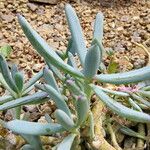
Curio repens
Blue chalk sticks · Blue toes
Description
Source: leafsnapThe Blue Chalk Stick (Senecio serpens, Curio repens), also known as the Blue Finger, Dead Man’s Finger, or the Kleinia, is a South African succulent ground cover that belongs to the Asteraceae family. Blue chalksticks have foliage consisting of short cylindrical stems that may grow up to 8 inches tall and 2 inches wide. Blue chalksticks are a unique succulent that blooms from spring to autumn and becomes dormant in the summer. Its leaves are thick and finger-like, measuring around 1.5 inches (4 cm) long and 0.33 (7 mm) in diameter. They have a blunt tip with a brown mucro and a small window with 10-20 striations that are indistinct. The leaves seem light blue, but rubbing off the chalk reveals a blue-green below.
💡 Blue Chalksticks (Curio repens) is often considered the ideal succulent for individuals born under Pisces, the twelfth sign of the astrological Zodiac. As a water sign represented by the symbol of a fish, Pisces resonates with the ocean and aquatic imagery. The blue hues of Blue Chalksticks evoke the sea, and its growth pattern resembles an underwater coral reef, further connecting it to this water sign.
🌳 The striking blue leaf coloring of the Chalksticks plant adds an eye-catching decorative charm to rock or succulent gardens. It is especially valued for its unusual winter growth and can quickly provide dense ground cover for smaller gardens, helping to deter deer and rabbits. This species pairs well with Aloe in rock or succulent gardens and complements African daisies, adding splashes of color to gardens with richer soil.
🎭 Durability, agelessness, riches, affluence, grows in clusters
Care Guide
💧 Water Every 2-3 weeks
Blue Chalksticks, a native of the arid regions of South Africa, thrives in high temperatures and requires only infrequent rainfall. This drought-tolerant succulent needs watering just once every three weeks. It prefers full sun and maintains its lush foliage throughout the year, being an evergreen. These characteristics make it an ideal choice for outdoor cultivation.
☀️ Light Full sun
The Blue chalksticks plant flourishes when exposed to substantial sunlight and can endure moderate sun levels, too. It characteristically develops well in its indigenous settings under generous sunlight, which is a key factor for its balanced growth. Conversely, insufficient sunlight may hinder its growth. Overexposure to the sun, however, could trigger stress and affect its health negatively.
🌡️ Temperature 20–37.8°C
Blue chalksticks thrive in temperatures between 68 and 100 ℉ (20 to 38 ℃). They are originally from regions that have warm climates, like South Africa. To accommodate for the shifts in the seasons, offer plenty of light and lessen the frequency of watering when the weather is cooler.
💨 Humidity
🪴 Soil 6-7
🌱 Fertilizer
For Blue chalksticks, administering minimal amounts of fertilizer 1-2 times annually during the growth period is adequate. Refrain from fertilizing during winter and summer when it's in a dormant state. Lessen the fertilizer quantity for rehoused plants and hold off on fertilization for a few months post-repotting. Fertilizing aids in robust growth and promotes flowering.
🪴 Pot & Repot Every 2 years
Choose a pot a bit larger than the previous one that possesses efficient drainage when repotting Blue chalksticks. It would be best to use a crumbly succulent or cactus mix with excellent drainage. Safely uproot the plant from its current pot, dust away extra soil, and reposition it at an equal depth. Allow a couple of days to pass before watering, providing time for the roots to recuperate from any potential damage. Opt to repot during the spring or fall, and then place it somewhere that has a lot of light.
✂️ Pruning
This slow-growing succulent requires little to no care and attention. Pinch the plants back if they get lanky or extremely tall to shape them and encourage them to spread out in a bushier growth style.
🌿 Propagating
🐛 Diseases & pets
☠️ Toxicity
All Senecio plants are toxic. Ingestion can cause fatal liver disease in animals when eaten in large quantities over a long period of time. Wear gloves when working with the plants; the sap can cause severe irritation. Be careful when planting Senecio species if you have children, pets, or livestock.
Characteristics
- Plant Type
- Succulent, Herb
- Life Cycle
- Perennial
- Genus
- Curio
- Family
- Asteraceae
- Hardiness Zone
- 9-12
- Mature Height
- 20 cm
- Mature Spread
- 61 cm to 91 cm
- Leaf Color
- Blue, Silver, Green, Bronze
- Leaf Type
- Evergreen
- Flower Color
- Yellow
- Flower Size
- 2.54 cm
- Bloom Time
- Mid summer
- Planting Time
- Winter, Spring
- Harvest Time
- Mid summer, Late summer
- Native Area
- South Africa