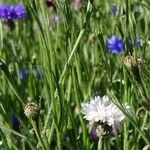
Cyanus segetum
Cornflower · Bachelor button · Bachelor's button · Bluebottle · Blue Cap
Description
Source: leafsnapCentaurea cyanus, commonly known as cornflower or bachelor's button, is an annual flowering plant in the family Asteraceae native to Europe. In the past, it often grew as a weed in cornfields (in the broad sense of "corn", referring to grains, such as wheat, barley, rye, or oats), hence its name. It is now endangered in its native habitat by agricultural intensification, particularly by over-use of herbicides. However, Centaurea cyanus is now also naturalised in many other parts of the world, including North America and parts of Australia through introduction as an ornamental plant in gardens and as a seed contaminant in crop seeds.
🌳 Besides its aesthetic appeal, the cornflower also has a scientific role as an indicator of copper levels in soil. It can tolerate and grow in soils with elevated copper concentrations that may be harmful to other plants. This trait enables botanists and environmental scientists to evaluate soil health and identify areas that might be affected by copper pollution, signaling when an ecosystem could be under stress from heavy metal contamination.
🎭 Single life, Hope for love, Sophistication
Care Guide
💧 Water Every 3 days
Cyanus Segetum plants need 1 inch water every week, particularly in the hotter months. You must allow the soil to dry out between watering but be careful to not dry up completely. Otherwise the plants will flop. In this way, thorough watering will help flourish the plants.
☀️ Light Full sun
Cornflower does best in areas that receive abundant sunlight for much of the day. It can also tolerate locations with moderate sunlight. Excessive or insufficient light can hinder the plant’s growth. In its natural habitat, it usually grows in open areas exposed to plentiful sunshine.
🌡️ Temperature 5–32.2°C
Cornflower's natural habitat thrives in temperate climates. It particularly prefers a temperature range of 68 to 95 °F (20 to 35 ℃). Be aware of seasonal changes and adjust temperatures accordingly.
💨 Humidity normal (40-60%)
This plant will thrive in moderate humidity, which is probably the level in your home. However, misting it a few times a week can be very beneficial. Make sure the room has good ventilation.
🪴 Soil 6-7
🌱 Fertilizer
When Cornflower has opened most of its blooms to full size, resume fertilizing. At about the time blooms are at their peak, fertilize once every three to four weeks, as weather permits. Then, when Cornflower begins producing fewer new blooms, stop fertilizing; there’s no need to fertilize when the plant can no longer produce more blooms.
🪴 Pot & Repot
When repotting Cornflower, choose a pot that's 1–2 inches (2.5–5.1 cm) larger in diameter and make sure it has good drainage. Use a well-draining potting mix and consider adding perlite for extra drainage. Repot in spring or early summer, water thoroughly afterward, and place the plant in a shady spot at first.
✂️ Pruning
🌿 Propagating
🐛 Diseases & pets
☠️ Toxicity
Cyanus Segetum is non-toxic for humans. It is a natural food dye with slightly spicy and cloak like flavor. It is used to decorate salads and cakes at times.
Characteristics
- Plant Type
- Herb
- Life Cycle
- Annual, Perennial, Biennial
- Genus
- Cyanus
- Family
- Compositae
- Hardiness Zone
- 4-8
- Mature Height
- 20 cm to 91 cm
- Mature Spread
- 15 cm to 30 cm
- Leaf Color
- Green
- Leaf Type
- Deciduous
- Flower Color
- Blue
- Flower Size
- 3.56 cm
- Bloom Time
- Late spring, Early summer, Mid summer
- Planting Time
- Spring, Summer
- Harvest Time
- Mid summer
- Native Area
- Turkey, Sweden, Austria, Slovakia, Montenegro, Pakistan, Slovenia, Croatia, Belarus, Uzbekistan, Russia, Iraq, Germany, Estonia, Romania, Latvia, Belgium, Moldova, Portugal, Netherlands, France, Tajikistan, Czech Republic, Bulgaria, Armenia, Poland, Greece, Ukraine, Serbia, Lebanon, Lithuania, Norway, Syria, Italy, Kazakhstan, Spain, Switzerland, Denmark, Finland, Iran, Albania, Ireland, United Kingdom, Hungary, Azerbaijan, Turkmenistan