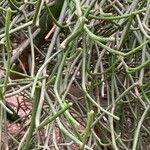
Cynanchum viminale
Caustic bush · Caustic creeper · Rapunzel plant · Somabutta · Soma
Description
Source: leafsnapCynanchum viminale is a leafless succulent plant in the family Apocynaceae. The species is native to West Africa, the Indian Ocean and Western Pacific region. The species' natural range extends from South Africa throughout much of Africa and the Middle East to India, Indochina, Southern China, Indomalaya and into Meganesia. The species is also found on several Indian Oceans islands including Mauritius, Réunion and the Seychelles. In keeping with its wide distribution, the species is known by a range of common names, including caustic-creeper, caustic bush, sacred soma, soma, rou shan hu, Rapunzel plant, liane calle and kitupa.
Care Guide
💧 Water
The moon plant originates from arid regions and is highly drought-tolerant. Watering it twice a week helps support its growth. As an outdoor plant in xeric landscapes, it thrives in well-draining soil that mimics its native dry habitat.
☀️ Light Full sun
Originating from arid regions, the Moon plant flourishes in full sun, its native habitat marked by intense sunlight and scant shade. It can also tolerate partial sun, giving it some flexibility in its growth.
What are the sunlight requirements for the Moon plant (Cynanchum viminale)?
The Moon plant (Cynanchum viminale) requires specific sunlight conditions to thrive. For 'Full sun' exposure, it needs above 6 hours of sunlight daily. If the area gets about 3-6 hours of sunlight, it is considered 'Partial sun'. It's important to observe how sunlight moves through your garden to ensure that you choose locations that provide the optimal balance of light and shade. This mindfulness towards the plant's sunlight needs ensures their health and happiness.
🌡️ Temperature 20–37.8°C
The moon plant grows best at temperatures between 68 and 100 °F (20 to 38 ℃). It does not tolerate colder conditions. As seasons change, watch the temperature — it may need some extra warmth.
What is the ideal temperature range for a Moon plant to thrive?
The Moon plant, scientifically known as Cynanchum viminale, flourishes best in temperatures ranging from 68 to 100°F (20 to 38°C). It does not adapt well to colder environments. As the seasons change, it's important to monitor the temperature closely, as the plant may require additional warmth to maintain its health and growth.
💨 Humidity
🪴 Soil 6-7
🌱 Fertilizer
Moon plant requires only light applications of fertilizer once or twice a year during the growing season. Do not fertilize in winter or summer, when it is dormant. Reduce feeding for plants that have been repotted and wait a couple of months after repotting before applying fertilizer. Fertilizing promotes healthy growth and encourages flowering.
🪴 Pot & Repot
✂️ Pruning
The moon plant is a robust climbing plant known for producing small clusters of flowers. To encourage growth and improve air circulation, it's best to prune it in early spring. Avoid heavy pruning later in the season, as this can stress the plant. Regular pruning helps maintain the plant's shape, encourages dense foliage, and protects against pests and diseases.
🌿 Propagating
🐛 Diseases & pets
☠️ Toxicity
Characteristics
- Plant Type
- Vine, Succulent
- Life Cycle
- Perennial
- Genus
- Cynanchum
- Family
- Apocynaceae
- Hardiness Zone
- 9-11
- Mature Height
- 4.88 m
- Mature Spread
- 49 cm to 91 cm
- Leaf Color
- Light Green
- Leaf Type
- Semi-evergreen
- Flower Color
- White
- Flower Size
- 0.51 cm to 1.02 cm
- Bloom Time
- Summer, Early fall, Mid fall
- Planting Time
- Spring, Summer, Autumn
- Harvest Time
- Fall, Early winter, Mid winter