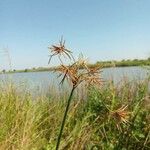
Cyperus articulatus
Chintul · Guinea-rush · Jointed flat sedge · Piripiri · Jointed Flatsedge
Description
Source: leafsnapCyperus articulatus, commonly known as jointed flatsedge, is a perennial plant in the family Cyperaceae. It is native to tropical and subtropical regions of Africa, Asia, Australia, and the Pacific Islands. This plant has a distinctive appearance with slender stems that can grow up to 1 meter in height and feature joints at intervals of 2-10 cm. The leaves are long, narrow, and end in a pointed tip. The flowers of Cyperus articulatus are small and inconspicuous, arranged in clusters at the end of each stem. They bloom from summer through the fall, producing small brown fruits that contain seeds. The plant prefers moist soil conditions such as those found in marshes or wetlands, but it can also grow in drier areas like savannas and grasslands. It is commonly used for erosion control due to its extensive root system, which helps stabilize the soil. Cyperus articulatus has been used for medicinal purposes by various cultures around the world, including in Africa, where it is used to treat stomach ailments such as diarrhea and dysentery. Overall, Cyperus articulatus is an interesting plant with unique characteristics that make it an important part of various ecosystems around the world, while also offering medicinal benefits to humans.
Care Guide
💧 Water Every 7 days
Jointed flatsedge flourishes in standing water and needs a continuous supply of water to grow well. To decrease how often you need to water it, use trays with high edges. In cooler temperatures, reduce watering to prevent root rot, and always leave a small part of the pot dry.
☀️ Light Full sun
Jointed flatsedge is found in habitats with abundant sunlight, such as the shallow edges of ponds and lakes. It prefers full sun, although it can tolerate partial sun.
What are the sunlight requirements for Jointed flatsedge (Cyperus articulatus)?
Jointed flatsedge, or Cyperus articulatus, thrives in various sunlight conditions. It requires full sun, which means it needs above 6 hours of direct sunlight daily to flourish optimally. However, it can also tolerate partial sun, meaning it can grow well with about 3-6 hours of sunlight. It's important to observe how sunlight moves through your garden carefully. By doing so, you can ensure that you choose spots that provide the perfect balance of light and shade for your Jointed flatsedge, ultimately ensuring the plant's happiness and health.
🌡️ Temperature 15–37.8°C
Jointed flatsedge comes from tropical areas, where the climate is usually warm and humid. Consequently, it is well suited to high temperatures and moisture. It does not tolerate abrupt temperature changes and prefers a steady thermal environment, so preventing temperature swings indoors is important. It generally cannot endure cold and needs warmer conditions to develop. If the ambient temperature falls too low, the plant may stop growing or even die.
What is the botanic name of Jointed flatsedge?
The botanic name of Jointed flatsedge is Cyperus articulatus. This name helps in identifying the plant scientifically and ensures clarity in communication about the species across different regions and languages.
💨 Humidity
🪴 Soil
🌱 Fertilizer
Jointed flatsedge requires minimal fertilization. You should apply a standard-strength fertilizer once a month during its active growth period. Unlike other plants of a similar size, jointed flatsedge has lower nutritional needs.
🪴 Pot & Repot
✂️ Pruning
Jointed flatsedge thrives in wetland environments and is characterized by its unique jointed stems. For optimal care, it's best to prune in early spring. This helps remove dead stems and encourages new growth. During the growing season, avoid excessive pruning. Regular pruning enhances the plant's vigor, reduces the risk of disease, and helps control its spread. Always follow best practices for optimal results.
🌿 Propagating
🐛 Diseases & pets
☠️ Toxicity
Characteristics
- Plant Type
- Grass
- Life Cycle
- Perennial
- Genus
- Cyperus
- Family
- Cyperaceae
- Hardiness Zone
- 8-11
- Mature Height
- 0.91 m to 1.83 m
- Mature Spread
- 49 cm to 91 cm
- Leaf Color
- Green
- Leaf Type
- Deciduous
- Flower Color
- Red, Brown
- Flower Size
- 2.03 cm to 8.89 cm
- Bloom Time
- Summer, Early fall, Mid fall
- Planting Time
- Spring, Summer, Autumn
- Harvest Time
- Late summer, Fall, Early winter
- Native Area
- Sri Lanka, Burkina Faso, Belize, India, Mexico, Guatemala, Madagascar, Pakistan, Nigeria, Guinea-Bissau, Tanzania, Benin, Sierra Leone, Cameroon, Mozambique, Saudi Arabia, Malawi, Honduras, Peru, Bangladesh, Panama, Chad, Colombia, Togo, Senegal, Eswatini, Iran, Ecuador, Côte d'Ivoire, Costa Rica, Gambia, Congo (DRC), Egypt, Angola, Namibia, Rwanda, Yemen, Kenya, Niger, Jamaica, Zimbabwe, Mali, Cuba, Equatorial Guinea, Burundi, Liberia, Venezuela, Brazil, Ghana, Botswana, Congo, Nepal, South Africa, Zambia, Sudan, Mauritania, Guinea, Bolivia, Vietnam, Myanmar, Guyana, Nicaragua, Thailand, Gabon