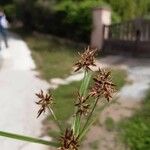
Cyperus fuscus
Brown Galingale · Brown flatsedge · Black Cyperus · Brown Cyperus · Brown umbrella sedge
Description
Source: leafsnapCyperus fuscus is a species of sedge known by the common name brown galingale, or brown flatsedge. This plant is native to much of Europe, Asia and North Africa from England, Portugal and Morocco east to China and Thailand. It is an introduced species in North America, where it is naturalized in widely scattered locations in the United States and Canada.Cyperus fuscusis a plant of wet areas, particularly disturbed places such as ditches and temporary ponds. It is an annual herb with paper-thin stems reaching 30 centimeters in maximum height. There may be short, flat leaves about the base of the plant. The inflorescence contains three to 15 spikelets, which are flat, oval or rectangular, and dark brown to deep purple. Each spikelet has around ten flowers enclosed in dark bracts. The fruit is a light brown achene about a millimeter long. In the UK, Cyperus fuscus is one of 101 species named as a priority for conservation by the conservation charity Plantlife.
Care Guide
💧 Water
Brown flat sedge thrives in wetland habitats with high moisture levels but can withstand short dry spells. It needs weekly watering to stay hydrated and is usually grown outdoors to take advantage of natural rainfall and changing water levels, which are essential for its growth and seasonal adaptations.
What should I do if I give my Brown flat sedge too much water or too little water?
Proper watering is essential for this beautiful ornamental grass. In the ground, watering issues can be resolved, but in a container, the wrong amount of water can quickly kill Brown flat sedge. When this grass doesn't receive the right amount of water, it may stop growing. Overwatering causes yellow leaves with brown tips, while underwatering leads to drooping leaves, weak seed head production, and browned leaves. If you suspect improper watering, first determine if it's too much or too little. If it's too much, stop watering immediately and be patient as heavy soils take time to dry out. Test the soil for moisture when new growth appears to decide if more water is needed. If it's too little, give the grass a deep drink and see if it perks up. Remember, it's better to water deeply and infrequently to encourage deep roots and improve drought resistance.
How often do I need to water my Brown flat sedge?
The watering needs of Brown flat sedge depend on the planting location. In general, watering once a week is recommended. In hot climates, watering once or twice a week in the summer might be necessary. In moderate climates, watering once every seven days or more may be sufficient. Grass in containers typically requires more frequent watering compared to grasses in the ground. However, the location also matters, as shaded grasses require less frequent watering than those planted in the ground. Water Brown flat sedge only when the soil is dry. To determine if the soil is dry, you can press your finger a couple of inches into the soil or use a portable scale to weigh the potted grass. If the roots lack sufficient water, the grass blades may appear folded along their centers and thinner than usual. Despite its drought tolerance, regular deep waterings will result in beautiful color. In its natural habitat, Brown flat sedge grows in open scrubland exposed to extreme heat, bright sun, and intermittent rain. Although it is drought-resistant, this grass still requires care and attention. Consistent watering is beneficial for its optimal growth. When first planted, Brown flat sedge needs more frequent watering until it establishes deep roots. Potted Brown flat sedge tends to dry out quickly, especially if exposed to hot, direct sun for a significant portion of the day. Test the soil every 3 to 4 days and water only when it feels dry. Soil type also affects the watering needs of in-ground Brown flat sedge. Heavy clay soil may appear dry at the surface while retaining moisture below, so less watering is needed. Sandy soils that drain quickly will require more frequent watering.
What things do I need to consider when watering my Brown flat sedge in different seasons, climates, or stages of growth?
To determine if you are watering enough, pay attention to the rate at which your grasses are growing. Brown flat sedge tends to double in size within a year during the hottest months. If the weather is hot but the grass is not growing vigorously, you may need to adjust your watering schedule. In winter, you can water once a month, but make sure to check the soil for moisture first. During the warmest months when the grass is actively growing, it will require more water. However, during winter and cooler months, the need for water decreases significantly. Remember to always let the soil dry out completely before watering Brown flat sedge.
☀️ Light Full sun
Brown flat sedge flourishes in full sunlight for most of the day, though it can also tolerate shorter periods of sun. Originating from regions with abundant sunshine, its growth stages remain consistent despite changes in light. It can, however, suffer from too little or too much solar exposure.
What are the sunlight requirements for plants?
Plants need varying amounts of sunlight to thrive. Full sun refers to areas receiving above 6 hours of sunlight per day, and partial sun refers to about 3-6 hours of sunlight. It's important to observe the movement of sunlight in your garden to select the best spots that offer the right balance of light and shade for your plants, ensuring they grow happily and healthy.
How does Brown flat sedge react to different sunlight exposures?
Brown flat sedge, or Cyperus fuscus, flourishes best under full exposure to sunlight for the majority of the day but can tolerate lesser degrees of sunlight. It originates from areas with abundant sunshine, meaning its growth is consistent regardless of slight changes in light exposure. However, it may suffer if it receives too little or too much sun, indicating the importance of finding a balanced sunlight environment for the plant.
What is the role of artificial lighting for indoor plants?
Artificial lighting is essential for indoor plants, especially when natural sunlight is insufficient, like during winter or in less sunny spaces. LEDs are popular because they can be customized to provide specific wavelengths needed by plants. For full sun plants, 30-50W/sq ft is recommended; partial sun plants need 20-30W/sq ft, and full shade plants require 10-20W/sq ft. Positioning the light 12-36 inches from the plant and ensuring it receives 8-12 hours of light per day mimics natural light conditions and promotes healthy growth.
What are symptoms of light deficiency in Brown flat sedge?
When Brown flat sedge doesn't receive enough light, it may display symptoms like smaller new leaves, leggy or sparse growth, faster leaf drop, slower or no growth, and lighter-colored or yellowish leaves. These signs indicate that the plant is struggling to adapt to inadequate light conditions, thus affecting its health and appearance.
How can you remedy light deficiency for indoor and outdoor plants?
To address light deficiency, gradually move plants to sunnier locations to ensure they receive at least 6 hours of sunlight daily. For indoor plants, use a south-facing window or consider artificial lighting such as desk lamps or grow lights for at least 8 hours daily. For outdoor plants, avoid sudden changes in light and consider pruning obstructions to increase sun exposure. Transplanting to a sunnier location with good drainage can also benefit smaller plants. However, damaged parts may not recover fully, but new growth should be healthier.
🌡️ Temperature 15–35°C
Brown flat sedge can tolerate a wide range of temperatures, but its distribution may still be restricted by different combinations of moisture and heat. It grows best in warm summer climates with sufficient rainfall or watering. Extended periods of cloudy, rainy weather or prolonged high temperatures can increase the chance of Brown flat sedge dying. In winter, adequate protection from cold can boost the plant’s survival rate.
💨 Humidity
🪴 Soil
🌱 Fertilizer
🪴 Pot & Repot
✂️ Pruning
To promote healthy growth and a compact appearance, regularly prune brown flat sedge from early to late spring to remove dead foliage. Use sharp, sterile tools to prevent infection. For the best results, follow pruning guidelines from reliable gardening manuals to ensure optimal health and vigor of your brown flat sedge.
🌿 Propagating
🐛 Diseases & pets
☠️ Toxicity
Characteristics
- Plant Type
- Grass
- Life Cycle
- Annual
- Genus
- Cyperus
- Family
- Cyperaceae
- Hardiness Zone
- 7-10
- Mature Height
- 3 cm to 30 cm
- Mature Spread
- 15 cm to 25 cm
- Leaf Color
- Dark Green
- Leaf Type
- Evergreen
- Flower Color
- Brown
- Flower Size
- 1.27 cm
- Bloom Time
- Summer, Early fall
- Planting Time
- Autumn
- Harvest Time
- Late summer, Fall
- Native Area
- Libya, Egypt, India, Turkey, Sweden, Austria, Slovakia, Montenegro, Pakistan, Thailand, Croatia, Slovenia, Morocco, Belarus, Uzbekistan, Russia, Iraq, Germany, Estonia, Romania, Latvia, Belgium, Portugal, Netherlands, France, Tajikistan, Tunisia, Czech Republic, Cyprus, Bulgaria, Poland, Laos, Greece, Armenia, Ukraine, Serbia, Lebanon, Lithuania, China, Afghanistan, Syria, Kyrgyzstan, Kazakhstan, Italy, Spain, Switzerland, Vietnam, Denmark, Mongolia, Iran, Albania, Azerbaijan, United Kingdom, Hungary, Algeria, Turkmenistan