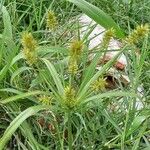
Cyperus strigosus
Straw-Color Flat Sedge · False nut sedge · Strawcolored flatsedge · False nutsedge · Stawcolored Flatsedge
Description
Source: leafsnapCyperus strigosus is a species of sedge known by the common names false nutsedge and straw-colored flatsedge. It is native to the United States, Cuba and Canada, where it grows in wet areas in many habitat types, including disturbed and cultivated areas such as roadsides and crop fields. It is common and sometimes weedy. It is a perennial sedge growing up to 70 centimetres tall. The inflorescence is a cluster of many linear-shaped spikelets up to 3 centimetres long each. A few long, leaf-like bracts grow at the base of the spike.Introduced populations occur in Bulgaria, France, Italy, Spain and Bangladesh.
🎭 Firm, diminished, fan
Care Guide
💧 Water Twice per week
Straw-colored flatsedge thrives in moist environments, preferring soil that is consistently damp yet well-draining. To maintain optimal moisture levels, it is important to water the plant twice a week. This plant flourishes outdoors, where natural rainfall during its active growing season supports vigorous growth.
What should I do if I give my Strawcolored flatsedge too much or too little water?
Proper watering is crucial for the health of this beautiful ornamental grass. When planted in the ground, watering issues can be resolved. However, when grown in a container, the wrong amount of water can quickly kill Strawcolored flatsedge. Insufficient water can cause this grass to stop growing and result in drooping leaves, weak seed head production, and browning. Conversely, overwatering can cause yellow leaves with brown tips. If you suspect improper watering, first determine if it's too much or too little. If it's overwatered, stop watering immediately and allow time for heavy soils to dry out. Test the soil for moisture before deciding if more water is needed. On the other hand, if it's underwatered, give the grasses a deep drink and observe if they perk up. Remember, a long, thorough watering is better than shallow, frequent waterings as it helps grasses develop deep roots and become more drought-resistant.
How frequently should I water my Strawcolored flatsedge?
The watering needs of Strawcolored flatsedge depend on where it is planted. In general, watering this grass once a week is recommended. However, in hot climates, watering once or twice a week during the summer may be necessary. In moderate climates, watering once every seven days or more may be sufficient. Grass in containers typically require more frequent watering than grasses planted in the ground. The location of the grass also plays a role - shaded grasses need to be watered less frequently than those planted in the ground. It is important to only water Strawcolored flatsedge when the soil is dry. You can check this by pressing your finger a couple of inches into the soil or by weighing the potted grass to see if it feels light. When the roots lack sufficient water, the grass blades may appear folded along their centers and thinner than usual. Despite its drought tolerance, regular and deep waterings will result in a beautiful color for Strawcolored flatsedge. In its natural habitat, Strawcolored flatsedge grows in open scrubland, exposed to extreme heat, bright sun, and intermittent rain. Although this grass is drought resistant, it still requires care and attention. Consistent watering is beneficial for Strawcolored flatsedge, even though it can handle harsh and dry conditions. When newly planted, Strawcolored flatsedge needs more frequent watering until it establishes deep roots. Potted Strawcolored flatsedge dries out quickly, especially if it is placed in hot, direct sun. Testing the soil every 3 to 4 days and watering when it feels dry is recommended. Strawcolored flatsedge planted in the ground generally requires less watering, but this depends on the type of soil. Clay soil holds water for a long time and may feel dry at the surface while still retaining moisture below, while sandy soils that drain quickly will need more frequent watering.
What do I need to be cautious about when watering my Strawcolored flatsedge in various seasons, climates, or during different growth stages?
To determine if you are watering enough, observe the growth rate of your grasses. Strawcolored flatsedge tends to double in size in a year, especially during the hottest months. If the weather is hot but the grass isn't growing vigorously, you may need to adjust your watering schedule. In winter, you can likely water just once a month, but check the soil for moisture. During the grass's growth cycle in the warm months, it will require more water, while in winter and cooler months, the water needs will significantly decrease. Remember to always let the soil for Strawcolored flatsedge dry out completely before watering.
☀️ Light Full sun
Strawcolored flatsedge performs best with continuous, full-day sunlight. It can also withstand moderate amounts of light. Light has a strong effect on its growth, reflecting its origin in open, unobstructed fields. Both excessive and insufficient sunlight can harm its health.
What are the sunlight requirements for Strawcolored flatsedge (Cyperus strigosus)?
Strawcolored flatsedge requires full sun exposure, defined as above 6 hours of sunlight daily, for optimal growth. It can also tolerate partial sun, which means around 3-6 hours of sunlight. Observing how sunlight moves through your garden is crucial to find spots offering a perfect balance of light and shade, ensuring the plant's happiness.
How does sunlight affect the growth of Strawcolored flatsedge?
The growth of Strawcolored flatsedge is significantly affected by sunlight, with sustained exposure to full day sun being ideal. This preference is rooted in its natural habitat of open, unobscured fields. Both excessive and insufficient sunlight can have adverse effects on its health. Artificial lighting can provide a vital solution for indoor plants when natural sunlight is insufficient, with recommendations for light types, intensity, proximity, and duration to mimic natural conditions.
What are some symptoms of incorrect lighting for Strawcolored flatsedge?
Symptoms of incorrect lighting for Strawcolored flatsedge include small or pale new leaves, leggy or sparse growth, faster leaf drop, slower or no new growth, chlorosis (yellowing leaves), sunscald, leaf curling, wilting, and leaf scorching. These symptoms indicate either too little or too much light exposure, both of which can negatively impact the plant's health.
What solutions can help Strawcolored flatsedge thrive in terms of lighting?
To ensure optimal growth for Strawcolored flatsedge, gradually increase its exposure to sunlight to achieve at least 6 hours of direct sunlight daily. For indoor plants, consider using artificial light if the plant is large or not easily movable, with at least 8 hours of light daily. Outdoor plants should be moved gradually to sunnier locations to avoid sunburn. Removing obstructions or transplanting to sunnier spots can also help increase sun exposure. Note that while parts of the plant damaged by insufficient light may not recover, new growth will be healthy with proper light adjustments.
🌡️ Temperature 5–35°C
Strawcolored flatsedge is native to habitats that experience a range of temperatures. It tolerates temperatures from 41 to 95 ℉ (5 to 35 ℃). In cooler conditions it may alter its growth patterns to conserve energy. In warmer conditions it may require extra watering to prevent dehydration and sustain growth.
What is Strawcolored Flatsedge and its native environment?
Strawcolored flatsedge, botanically known as Cyperus strigosus, is a plant native to environments with varying temperatures. It has adapted to a wide temperature range, thriving in conditions from 41 to 95°F (5 to 35°C). This broad tolerance allows it to cope with both cold and hot climates by adjusting its growth habits and moisture requirements to conserve energy or prevent dehydration, respectively.
Does Strawcolored Flatsedge require frost protection measures?
Despite its strong cold resistance, special frost protection measures for Strawcolored flatsedge might still be necessary in extreme conditions. If winter temperatures are expected to drop below -30°C, it's important to safeguard the plant. Protection can be provided by covering the plant with soil or straw. Additionally, watering the plant abundantly before the first freeze helps keep the soil moist, entering a frozen state that aids in preventing drought and water scarcity during the winter and early spring.
How does Strawcolored Flatsedge respond to low temperatures?
Strawcolored flatsedge is highly cold-tolerant, optimally thriving when the temperature stays above 5°C. However, during winter, it should ideally remain above -25°C to avoid adverse effects. Temperatures falling below -30°C might not show immediate damage during winter, but could lead to a decrease in spring sprouting, or in some cases, plants may not sprout at all. To mitigate damage, it's recommended to remove any parts of the plant that have failed to sprout in spring.
How does Strawcolored Flatsedge respond to high temperatures?
In the summer months, it's important to ensure that temperatures for Strawcolored flatsedge do not exceed 35°C. Exceeding 38°C can cause the leaves to lighten in color, curl, and become susceptible to sunburn. In severe cases, the plant may completely wilt and dry out. To manage high temperature stress, trim away any sunburned or dried up parts of the plant, move it to a shaded location during the midday and afternoon sun, or use a shade cloth. Keeping the soil moist by watering in the morning and evening is also crucial for its well-being in high temperatures.
💨 Humidity
🪴 Soil 6-7
🌱 Fertilizer
Strawcolored flatsedge needs extra nutrients to encourage healthy new growth. In spring, putting compost around the base of the plant will effectively supply the nutrition it requires. Fertilizing supports vigorous growth and helps the plant resist diseases and pests.
🪴 Pot & Repot
✂️ Pruning
In the fall, it's important to cut back dead stems to prevent diseases. Pruning straw-colored flatsedge needs to be done carefully because cutting the leaflets can lead to unsightly brown tips, which are part of the plant's natural defense mechanism. Instead of removing these brown tips, it's better to let the plant outgrow them as it continues to develop.
🌿 Propagating
🐛 Diseases & pets
☠️ Toxicity
Characteristics
- Plant Type
- Grass
- Life Cycle
- Perennial
- Genus
- Cyperus
- Family
- Cyperaceae
- Hardiness Zone
- 4-9
- Mature Height
- 61 cm
- Mature Spread
- 30 cm
- Leaf Color
- Green
- Leaf Type
- Deciduous
- Flower Color
- Yellow, Green
- Flower Size
- 1.02 cm to 4.06 cm
- Bloom Time
- Early summer, Mid summer
- Planting Time
- Spring, Summer
- Harvest Time
- Mid summer, Late summer
- Native Area
- Mexico, Cuba