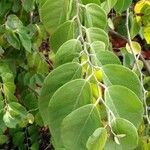
Dalbergia ecastaphyllum
Coinvine · Bejuco de Peseta · Hay-scented Buckler-fern · Liane á Clous
Description
Source: leafsnapDalbergia ecastaphyllum, commonly known as the Jamaican dogwood or Florida fishpoison tree, is a species of flowering plant belonging to the pea family. It is native to the coastal regions of Florida, the Caribbean, and Central and South America. This tree can reach heights of up to 20 meters and features a broad crown with dark green, pinnately compound leaves. It produces small flowers that are either white or pinkish, which bloom from late spring to early summer. Indigenous peoples have used the Jamaican dogwood for centuries due to its medicinal properties, particularly for pain relief. The tree contains several bioactive compounds, such as rotenone, which have been demonstrated to have anticonvulsant effects. The wood from Dalbergia ecastaphyllum is highly valued for its durability and attractive appearance, making it a popular choice for furniture making. However, overharvesting has led to its classification as an endangered species by the International Union for Conservation of Nature (IUCN). In conclusion, Dalbergia ecastaphyllum is an important plant with significant medicinal properties and commercial value. However, due to its endangered status, careful management is essential to ensure its sustainability.
Care Guide
💧 Water Every 7 days
☀️ Light Full sun
Coinvine is a plant that originates from open spaces, like bright meadows and the edges of forests, where it can receive plenty of sunlight. It flourishes best in Full Sun but can equally tolerate Partial Sun, showing a good adaptability to varying sunlight conditions.
🌡️ Temperature 20–37.8°C
Coinvine is native to tropical areas characterized by warmth and dampness. This has conditioned it to thrive in hot and humid conditions. It gravitates towards stable temperature settings and is not fond of abrupt changes in temperature. Hence, within indoor environments, it's crucial to maintain consistent temperatures. The plant typically finds it difficult to survive in cold conditions and favours warmer temperatures to facilitate its growth. Should the ambient temperature decrease excessively, the plant's growth could halt or it could perish.
💨 Humidity
🪴 Soil 6-8
🌱 Fertilizer
For the proper care of Coinvine, fertilization is essential. Providing regular nourishment throughout the growth period aids in maintaining vitality for vibrant leaves and promotes holistic development. Overlooking the need for fertilization may lead to sickly leaves, reduced aesthetic value, and inhibited or frail growth susceptible to snapping.
🪴 Pot & Repot
✂️ Pruning
Coinvine features twining, woody stems and compound leaves. To maintain its shape, remove dead wood, and improve airflow, prune it in early spring. Regular pruning encourages growth and flowering. Be sure to use clean tools to prevent disease, and consult horticultural guidelines for the best practices.
🌿 Propagating
🐛 Diseases & pets
☠️ Toxicity
Characteristics
- Plant Type
- Shrub
- Life Cycle
- Perennial
- Genus
- Dalbergia
- Family
- Fabaceae
- Hardiness Zone
- 10-12
- Mature Height
- 2.13 m to 3.96 m
- Mature Spread
- 3.05 m to 4.88 m
- Leaf Color
- Dark Green, Forest Green
- Leaf Type
- Evergreen
- Flower Size
- 0.51 cm to 0.76 cm
- Bloom Time
- Summer
- Planting Time
- Spring, Summer, Autumn
- Harvest Time
- Late summer, Early fall, Mid fall
- Native Area
- Belize, Angola, Honduras, Mexico, Guatemala, Peru, Nigeria, Guinea, Gambia, Guinea-Bissau, Panama, Jamaica, Benin, Colombia, Bahamas, Cuba, Sierra Leone, Equatorial Guinea, Cameroon, Liberia, Venezuela, Brazil, Togo, Ghana, Guyana, Senegal, Nicaragua, Côte d'Ivoire, Costa Rica