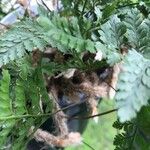
Davallia tyermannii
Rabbits Foot
Description
Source: wikipedia (CC BY-SA)Davallia tyermanii, the bear's foot fern or white rabbit's foot fern, is a species of fern in the family Davalliaceae, native to northern Myanmar, southern China, and Taiwan. A rhizomatous epiphyte or lithophyte reaching 0.5 m, it is typically found in the subtropics. Under its synonym Humata tyermanii it has gained the Royal Horticultural Society's Award of Garden Merit. It is available from commercial suppliers, and requires full sun.
Care Guide
💧 Water
The White Rabbit's Foot Fern thrives in humid conditions and benefits from consistent moisture, although it also has a moderate tolerance for drought. To keep its foliage healthy, it's best to water it twice a week. Usually grown indoors, this fern flourishes in well-draining soil that mimics its natural, airy habitat.
☀️ Light Full shade
White rabbits foot fern is native to habitats such as forest understories and rocky locations where natural shade occurs. It prefers full shade but can tolerate partial sun.
🌡️ Temperature 20–37.8°C
White rabbits foot fern is fairly adaptable to temperature, able to endure high heat and wide temperature fluctuations. In hot weather, you should pay attention to watering and provide suitable shade to avoid sunburn. However, White rabbits foot fern is relatively sensitive to low temperatures. Although it can tolerate some chill, very cold conditions can cause frost damage.
💨 Humidity
🪴 Soil 6-7
🌱 Fertilizer
🪴 Pot & Repot 2-3 years
When repotting White rabbits foot fern, select a pot 1-2 inches (2.5–5.1 cm) larger with ample drainage. Use a well-draining potting mix. Repot in spring or fall, ensuring the root ball sits slightly below the rim of the flower pot. Water thoroughly after repotting and place it in a warm spot with indirect sunlight.
✂️ Pruning
To encourage new growth and improve the appearance of your white rabbit's foot fern, prune it in early spring by removing any dead or yellowing fronds. Be careful not to over-prune, as this can stress the plant. Maintaining good airflow and light is also important. Pruning at this time takes advantage of the fern's natural growth cycle, helping it thrive during the growing season.
🌿 Propagating
🐛 Diseases & pets
☠️ Toxicity
Characteristics
- Plant Type
- Fern
- Life Cycle
- Perennial
- Genus
- Davallia
- Family
- Polypodiaceae
- Hardiness Zone
- 10-11
- Mature Height
- 20 cm to 30 cm
- Mature Spread
- 30 cm to 61 cm
- Leaf Color
- Dark Green
- Leaf Type
- Semi-evergreen
- Planting Time
- Spring, Summer, Autumn
- Native Area
- Myanmar, India, China