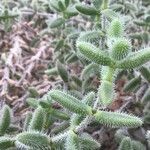
Delosperma echinatum
Pickle plant · Pickle Cactus
Description
Source: leafsnapDelosperma echinatum is a succulent plant, native to South Africa. It is also known as the pickle plant. The new genus Delosperma was erected by English botanist N. E. Brown in 1925, with this species later acknowledged as the type species.Scottish plant-hunter Francis Masson collected this species for Kew Gardens in 1774. French naturalist Jean-Baptiste Lamarck described it as Mesembryanthemum echinatum in 1786, from material in France that most likely had come from England.
🌳 The Pickle Plant is a mat-forming succulent appreciated for its unique appearance, attractive flowers, and resilience. It is often used as ground cover in dry, sunny, or partially shaded areas. Additionally, it makes a lovely addition to rock gardens and is occasionally featured in miniature gardens due to its resemblance to small cacti.
Care Guide
💧 Water Every 2-3 weeks
The Pickle Plant is well-suited for arid climates and can thrive with minimal moisture due to its high drought tolerance. It requires watering only every 2–3 weeks, and it's important to allow the soil to dry out completely between waterings. When grown indoors, the Pickle Plant prefers well-draining soil and containers to prevent waterlogging, simulating its natural habitat.
What do I do if I give my Pickle Plant too much or too little water?
Pickle Plant is a type of succulent that can tolerate long periods without water. However, if you forget to water your Pickle Plant for a month or more, it may become thirsty and show signs of damage. An underwatered Pickle Plant will have shriveled, dry, and flat leaves. Some leaves may have dried up completely, turned brown and crispy, or fallen off the plant. The soil will also be completely dried out. To revive an underwatered Pickle Plant, give it plenty of water by submerging the pot in water for 5-10 minutes. Once the soil feels moist, remove any dried out leaves to make space for new growth. On the other hand, overwatering can be harmful to a Pickle Plant and may even be fatal. Too much moisture can lead to root rot, where fungi and bacteria thrive in the soil and feed on the roots. Overwatered Pickle Plants will have yellow, swollen, and translucent leaves that may burst open. If the problem continues, the leaves may turn brown or black and easily fall off. To check if overwatering is the issue, examine the soil for excess moisture. To save an overwatered Pickle Plant, remove it from the pot and inspect the roots and soil. If the roots show signs of rot, the plant may not be salvageable. However, if only some roots are affected, remove the unhealthy ones and dip the remaining healthy roots in fungicide. Repot the Pickle Plant in fresh, well-draining soil. Although not always successful, this process can help the plant recover and start growing again in the next season.
How much water should I give my Pickle Plant?
To determine how often to water the Pickle Plant, it is best to check the soil and only water when it is completely dry. You can do this by sticking your finger in the pot or using a moisture meter to check the soil below the surface. If you have planted it in a deep pot, you can use a stick or chopstick to do this. If the soil feels even slightly moist, wait a few days and check again. In general, most people will need to water the Pickle Plant every two weeks in the summer and once a month in the winter. However, there are various factors that can affect the watering frequency, and the following section provides some considerations to help you determine how often to water.
What things should I think about when watering my Pickle Plant?
To properly water your Pickle Plant, you need to consider several environmental factors. The size of the container and the type of soil used will determine how often and how much water is needed. Make sure to choose a container with good drainage to prevent overwatering. Smaller containers hold less moisture and will require more frequent watering, while larger pots will stay moist longer and need less frequent watering. Avoid using an oversized pot, as this can lead to overwatering. When repotting, choose a container that is just one size larger than the current one, and opt for a shallow container since Pickle Plants have shallow root systems. In terms of timing, Pickle Plants need less water during the winter when growth slows down and they aren't utilizing as much energy or water. Cooler winter air also reduces water evaporation, which means the soil retains moisture for longer compared to the summer. Additionally, the climate in your location plays a role. If you live in a humid and rainy area, you will need to water less frequently than in a dry and arid climate. Keep in mind that even within the same geographic location, conditions can vary depending on the season and the use of indoor heating and air conditioning. For outdoor planting, once a Pickle Plant has established its root system in the ground, it generally doesn't require supplemental watering beyond what it receives naturally from precipitation and dew. However, during extended dry periods, occasional watering may be necessary. In areas where Pickle Plants can only be grown in containers, they can be moved outside in the spring and summer when temperatures are suitable, and brought indoors when temperatures start to drop. It's important to note that potted Pickle Plants kept outside usually require more water due to increased sun exposure, even if they are placed on a shaded porch.
How should I water a Pickle Plant?
The best way to water a Pickle Plant is to soak it thoroughly and then allow it to dry out before watering again. This plant is somewhat drought tolerant, so you can let it get quite dry before watering again. It's better to give this type of plant too little water than too much. When you water, make sure the soil gets thoroughly soaked throughout the whole pot. Instead of pouring water in just one spot, try to go around the whole rim of the planter to make sure all sides of the plant get wet. The correct amount of water will depend on the size of your container and how much water your soil absorbs. Give your Pickle Plant enough water that it drains out from the drainage holes and then (ideally) leave the drained water in the saucer for about 20-30 minutes to absorb into dry pockets of soil. After that, discard any excess water that's still in the saucer to avoid waterlogging the soil. Bottom-watering is also a great method for the Pickle Plant because it ensures the soil gets thoroughly moistened. This involves placing the pot into a saucer of water and allowing the soil to absorb moisture through the drainage holes. You'll know the soil has absorbed enough water when the top layer is moist. This method takes more time than top-watering but guarantees an even distribution of water throughout the pot. The original habitat of the Pickle Plant is relatively dry with little rain, but when it does rain, the soil becomes thoroughly moistened. You can mimic this situation by bottom-watering your plant when the soil is completely dry. Deep soil bathing is better than frequent light watering for the Pickle Plant.
☀️ Light Full sun
The Pickle Plant thrives with plenty of sunlight, which promotes its best growth. Although it originates from sunny habitats, it can also tolerate locations with moderate light. Either too little or too much sunlight can harm the Pickle Plant, causing stunted growth in low light or leaf discoloration in excessive light.
What are the sunlight requirements for a Pickle Plant?
Pickle Plants thrive in full sun, requiring more than 6 hours of direct sunlight daily. They can also grow in partial sun, benefiting from about 3 to 6 hours of sunlight. It's essential to observe how sunlight moves through your garden, choosing locations that offer a good balance of light and shade to ensure the plants' health and happiness. In insufficient light, Pickle Plants may show symptoms like lighter-colored new leaves, leggy growth, or chlorosis, indicating the need for better light conditions.
How does artificial lighting affect Pickle Plant growth indoors?
When natural sunlight is not enough, especially during winter or in less sunny spaces, artificial lighting can be crucial for Pickle Plants' growth. Proper indoor lighting encourages faster, healthier development. LED lights are recommended because they can be tailored to provide specific light wavelengths needed by plants. The amount of artificial light required varies: full sun plants need 30-50W/sq ft, partial sun plants 20-30W/sq ft, and full shade plants 10-20W/sq ft. The artificial light source should be placed 12-36 inches above the plant, mimicking natural sunlight for 8-12 hours per day.
What are the common symptoms of inappropriate lighting conditions in Pickle Plants?
Pickle Plants may exhibit several symptoms if the lighting conditions are not ideal. Insufficient light can lead to lighter-colored new leaves, indicating a lack of essential nutrients. Leggy or sparse growth suggests the plant is stretching towards the light source, which can weaken its structure. Excessive sunlight might cause chlorosis, where leaves lose their green color, or sunscald, resulting in damaged plant tissues. Additional signs of stress include leaf curling, wilting, and leaf scorching due to improper light exposure.
How can I improve the lighting conditions for my Pickle Plant?
To enhance lighting conditions for your Pickle Plant, gradually increase its exposure to sunlight. If indoors, position it near a south-facing window, keeping curtains open to ensure at least 6 hours of direct sunlight daily. Using artificial lights, such as desk lamps or professional grow lights, can supplement natural sunlight, especially for larger or non-movable plants. Outdoors, gradually move your plants to sunnier spots over a few weeks to acclimate them and avoid sunburn. If sunlight is blocked by obstacles like trees, consider pruning or relocating your plants to ensure they receive enough light. Remember, while adjusting light conditions can promote new, healthy growth, parts of the plant already damaged by poor lighting may not fully recover.
🌡️ Temperature 15–35°C
The pickle plant does best in temperatures of 59 to 95 ℉ (15 to 35 ℃). It comes from warm regions and must be protected from frost, which can injure the plant. In summer, ensure it has enough shade to prevent sunburn.
What are the ideal temperature conditions for a Pickle Plant?
The Pickle Plant, or Delosperma echinatum, thrives in a temperature range of 59°F to 95°F (15°C to 35°C), requiring warm temperatures to grow effectively. It's essential to protect it from frost, as cold conditions can harm the plant. When the temperature drops below 59°F (15°C), the plant's growth slows, and it is crucial to reduce or stop watering to prevent root rot. During the winter, if temperatures fall below 23°F (-5°C), the plant should be moved indoors to continue its cultivation near a south-facing window for optimal sunlight exposure. Supplemental lighting may be used if natural light is insufficient. For outdoor plants, watering should cease in cold temperatures, and measures such as temporary greenhouses or using plastic film or fabric for insulation can help protect the plant.
How should I care for a Pickle Plant in low temperatures?
In low temperatures, particularly when it's colder than 59°F (15°C), the Pickle Plant's growth may slow, and extra care is needed to ensure its survival. If temperatures drop below 23°F (-5°C), it's vital to bring the plant indoors to protect it from possible frost damage which could weaken the plant, leading to wilting and susceptibility to root rot. In such cases, immediately relocate the plant to a warm environment inside, preferably near a south-facing window to maximize sunlight exposure. If sunlight is insufficient, consider supplemental lighting. If frost damage occurs, trim the frostbitten areas, check for and remove rotted roots, and you can propagate the plant through cuttings to rejuvenate it.
What steps should I take if my Pickle Plant experiences high temperatures?
During the summer, when temperatures are likely to rise above 95°F (35°C), the Pickle Plant needs protection from excessive heat and sunburn. If temperatures exceed 107°F (41°C), the plant may cease to grow, lose water, wilt, and become more prone to damage. To mitigate these effects, remove the affected sunburned or rotten parts of the plant. It's important to provide shade during the harsh afternoon sun until the plant recovers and resumes growth. In case of root rot, cease watering the plant until new roots develop, facilitating the plant's recovery.
💨 Humidity dry (<40%)
This plant prefers dry conditions, so don't mist it. However, watering it less often can also thrive in higher humidity.
🪴 Soil 6-7
🌱 Fertilizer
Pickle Plant needs only light applications of fertilizer once or twice a year during the growing season. Do not fertilize in winter or summer when it is dormant. Use less fertilizer for plants that have been repotted and wait a couple of months after repotting before feeding. Fertilizing supports healthy growth and encourages blooms.
Why should I put fertilizer on my Pickle Plant?
To support healthy growth, it is recommended to fertilize the Pickle Plant even though it already stores water and nutrients. Fertilizing during the growing season not only adds nutrients to the growing medium, but it can also encourage mature specimens to produce blooms.
When should I put fertilizer on my Pickle Plant?
Pickle Plant, like other plants, benefits from extra nutrients, but it only requires a small amount of fertilizer during its growing season. To keep your Pickle Plant healthy, it is recommended to fertilize it 1-2 times a year. The best times to fertilize are in the spring and autumn, avoiding winter and summer when the plant is dormant. When repotting your Pickle Plant, be cautious and reduce the amount of fertilizer used. It is also advisable to wait a few months after repotting before starting to fertilize.
When is it not a good idea to put fertilizer on my Pickle Plant?
The Pickle Plant, like other plants, goes through a dormancy period. During this time, it is best to avoid using fertilizer. The plant stops growing in both the summer and winter, so it is important to refrain from applying fertilizer during these seasons. Additionally, it is recommended to withhold fertilizing for the first few months after repotting in the spring.
What kind of fertilizer should I use for my Pickle Plant?
To properly fertilize the Pickle Plant, it is recommended to use a liquid plant food specifically designed for succulents and cacti. Make sure to dilute the fertilizer with water to half-strength to avoid accumulation in the soil. When applying the fertilizer, target the base of the plant and water it thoroughly, allowing any excess moisture to drain from the container or absorb into the ground.
How can I make my Pickle Plant grow better?
When fertilizing Pickle Plant, it is recommended to use liquid plant food for ease. However, granules are also an option. It is important to follow the directions on the packaging and dilute liquid fertilizers to half-strength. Regardless of whether you are using granules or liquid plant food, always apply it to the soil. Cover granules with a thin layer of soil and water, just like you would with liquid plant food.
🪴 Pot & Repot Every 2 years
When repotting Pickle Plant, choose a pot just slightly larger than the current one that has good drainage. Use a gritty, well-draining cactus or succulent mix. Gently remove the plant from its old pot, brush off excess soil, and set it in at the same depth. Wait a few days before watering to allow any root damage to heal. Repot in spring or fall, and place it in a brightly lit spot.
✂️ Pruning
To help the pickle plant maintain its shape, prune any excessive or dense branches in the spring and autumn using a knife or scissors. You may also choose to apply sulfur powder after pruning. For propagation, cut strong stems with 5-6 leaves, treat the cut ends with sulfur to heal them, and lightly moisten the soil before planting the stems.
🌿 Propagating
🐛 Diseases & pets
☠️ Toxicity
Although their leaves resemble little pickles, they do not taste like them. The good news is that pickle plants are non-toxic to people and animals if you desire to sample them. Expect that they will not taste very good.
Characteristics
- Plant Type
- Succulent, Herb
- Life Cycle
- Perennial
- Genus
- Delosperma
- Family
- Aizoaceae
- Hardiness Zone
- 8-10
- Mature Height
- 46 cm
- Mature Spread
- 61 cm to 91 cm
- Leaf Color
- Green, Blue
- Leaf Type
- Evergreen
- Flower Color
- Yellow, White
- Flower Size
- 2.03 cm
- Bloom Time
- Early spring, Mid spring, Fall, Winter
- Planting Time
- Spring, Summer, Autumn
- Harvest Time
- Spring, Mid fall, Late fall, Winter
- Native Area
- South Africa