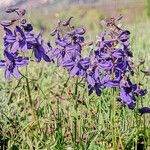
Delphinium nuttallianum
Two-Lobe Larkspur · Twolobe larkspur · Nuttall's larkspur · Low larkspur
Description
Source: leafsnapDelphinium nuttallianum is a species of larkspur known by the common names twolobe larkspur, Nuttall's larkspur, and common larkspur. It is widely distributed across western North America from California to Alberta, including mountain meadows and the majority of the sagebrush steppe, except very dry areas.The roots vary from thin to thick. The plant has a white to pink erect stem usually not exceeding half a meter in height, which may branch several times. Deeply lobed leaves are located mostly about the base of the plant. The inflorescence occupying the top end of the stem has a few widely spaced flowers on long pedicels. The sepals are long and curl backwards or fold upon themselves. They may be purple to blue or almost white. The lower petals are the same color, while the upper are often white. The spur is one or two centimeters long. The upper portion of the plant is often hairy.The species is very poisonous to livestock, especially cattle.
🌳 Besides being grown for ornament, twolobe larkspur has been used as a source of natural dye. The petals contain compounds that, when properly processed, can produce dyes in various blue and purple shades, which were traditionally valued in the textile industry. Although synthetic dyes have mostly replaced natural ones, renewed interest in eco-friendly and sustainable dye sources has brought twolobe larkspur back into the spotlight.
🎭 A heart that is open
Care Guide
💧 Water
Twolobe larkspur thrives with consistent moisture and moderate watering, avoiding waterlogged conditions. It has low tolerance for drought and benefits from being watered weekly. As an herbaceous perennial, its growth cycle depends on the availability of water, making effective rainfall management crucial for its seasonal development.
How should I water my Twolobe larkspur plant?
To ensure the health of the Twolobe larkspur, use filtered water at room temperature. Tap water may contain harmful particles. Since this plant thrives in warm environments, avoid using cold water, which can shock the system. Overhead watering can lead to foliage issues, so it's best to apply the water directly to the soil. Soak the soil completely to benefit the plant's roots, allowing them to spread and gather nutrients.
What should I do if I give my Twolobe larkspur too much water or too little water?
Both overwatering and underwatering can harm the health of your Twolobe larkspur, but overwatering is more likely to be a problem. Excessive watering can cause wilting and yellowing of stems and leaves. If overwatering continues, it can lead to diseases like root rot, mold, and mildew, which can be fatal for your plant. Underwatering is less common because the Twolobe larkspur can tolerate drought reasonably well. However, it is still possible, and if it occurs, you will notice that the leaves become brittle and brown. It is important to recognize the signs of overwatering promptly. Some diseases caused by overwatering, like root rot, cannot be fixed if you wait too long. If you see early signs, reduce your watering schedule immediately. Check the soil quality for poor drainage. If needed, replace it with a loose, well-draining potting mix. Conversely, if you observe signs of your Twolobe larkspur not receiving enough water, simply increase your watering frequency until the signs improve.
How often should I water my Twolobe larkspur? How often do I need to water my Twolobe larkspur plant?
If your Twolobe larkspur is in a pot, you can determine if it needs water by sticking your finger into the soil. If the top two to three inches of soil are dry, it is time to water it. If you have your Twolobe larkspur planted outdoors, you can use the same method to check the soil. When the top few inches of soil are dry, it is time to water it. Typically, during spring and early fall, watering once a week using this method is sufficient. However, during extremely hot weather, you may need to increase the frequency to twice or more per week. Nevertheless, mature and well-established Twolobe larkspur plants have a remarkable ability to tolerate drought.
How much water does my Twolobe larkspur plant need?
When it's time to water your Twolobe larkspur, don't be afraid to give it plenty of water. Wait until the top two to three inches of soil are dry, then water thoroughly until the soil is completely soaked. Make sure to add enough water to allow excess water to drain out through the bottom of the pot. If you don't see any excess water draining, you may not have watered enough. However, be careful not to let water accumulate in the soil, as this can be harmful to the plant. If you notice that water is not draining well from the pot, it could indicate that the soil is not draining properly, which is not good for the plant's health. If the plant is outside, receiving about 1 inch of rain per week should be enough.
How do I water my Twolobe larkspur when it's growing at different stages?
The water needs of the Twolobe larkspur can vary depending on its growth stages. In the first few years of life or after transplanting, more water is required. During this period, the plant focuses its energy on developing new roots for future growth, and these roots thrive with a bit more moisture. As the plant matures, it will require less water. Additionally, during the bloom period, extra water may be necessary as the flowers utilize a significant amount of moisture.
☀️ Light Full sun
Twolobe larkspur is a species that flourishes in full sunlight. In its native habitat it is exposed to ample sun, which promotes vigorous growth. Although it can persist with moderate sunlight, prolonged periods of low light can negatively affect its health.
What are the sunlight requirements for Twolobe larkspur?
Twolobe larkspur requires full sun, meaning it thrives best with more than 6 hours of sunlight daily. It can also survive in partial sun, receiving about 3-6 hours of sunlight. Its natural habitat exposes it to abundant sun, contributing to its robust growth. However, it is advisable to watch how sunlight moves through your garden to choose spots that provide the perfect balance for your plants, ensuring their happiness.
How can artificial lighting assist in the growth of indoor Twolobe larkspur plants?
Indoor Twolobe larkspur plants require adequate lighting for optimal growth, especially when natural sunlight is insufficient. Artificial lights, particularly LED lights that can be customized to provide specific wavelengths, offer a vital solution. For full sun plants, 30-50W/sq ft of artificial light is needed, for partial sun plants, 20-30W/sq ft is required, and for full shade plants, 10-20W/sq ft is advisable. The light source should be placed 12-36 inches above the plant, mimicking natural sunlight as closely as possible, while ensuring the plants receive 8-12 hours of light per day.
What are the symptoms of insufficient light in Twolobe larkspur?
Symptoms of insufficient light in Twolobe larkspur include small new leaves, leggy or sparse growth, faster leaf drop, slower or no new growth, lighter-colored new leaves, and symptoms related to overexposure like chlorosis, sunscald, leaf curling, wilting, and leaf scorching. These symptoms indicate the plant's struggle with inadequate light, affecting its overall health and growth.
What steps can be taken to ensure Twolobe larkspur receives sufficient sunlight?
To ensure Twolobe larkspur receives sufficient sunlight, gradually move plants to sunnier locations, ensuring at least 6 hours of direct sunlight daily. Use a south-facing window and keep curtains open for indoor plants, or consider artificial lighting if direct sunlight isn't an option. Outdoors, cautiously adjust the plant's position to gradually adapt to increased light without causing sunburn. Additionally, reducing obstructions such as pruning nearby trees can help, and for smaller plants, transplanting during their dormant period to a sunnier location with good drainage is beneficial. Note that parts of the plant already affected by insufficient sunlight may not recover, but new growth should be healthy with increased light exposure.
🌡️ Temperature 0–32.2°C
Twolobe larkspur can adjust to a wide range of temperatures, but its distribution may still be limited by various combinations of moisture and heat. It grows best in warm summer climates with sufficient rainfall or watering. Extended spells of cloudy, rainy weather or prolonged high temperatures can raise the risk of Twolobe larkspur dying. In winter, adequate protection from the cold can increase the plant's chances of survival.
💨 Humidity
🪴 Soil 6-7
🌱 Fertilizer
The best time to fertilize a Twolobe larkspur is in early spring, as it comes out of dormancy and starts active growth. Fertilization supplies essential nutrients for healthy development. Although Twolobe larkspur has relatively low fertilizer requirements, applying fertilizer annually can improve its survival and encourage better, longer-lasting flowers.
🪴 Pot & Repot
✂️ Pruning
Twolobe larkspur is a perennial plant characterized by tall, spiky blooms and lobed leaves. To encourage healthy growth and vibrant flowers, prune the dead stems in early spring and shape the plant in late spring. Be sure to clean your pruning tools to prevent the spread of disease, ensuring the plant's robust development in the following seasons.
🌿 Propagating
🐛 Diseases & pets
☠️ Toxicity
Characteristics
- Plant Type
- Herb
- Life Cycle
- Perennial
- Genus
- Delphinium
- Family
- Ranunculaceae
- Hardiness Zone
- 4
- Mature Height
- 10 cm to 52 cm
- Mature Spread
- 15 cm to 30 cm
- Leaf Color
- Green, Yellow
- Leaf Type
- Deciduous
- Flower Color
- Blue, Purple
- Flower Size
- 2.03 cm to 3.05 cm
- Bloom Time
- Late spring, Early summer, Mid summer
- Planting Time
- Autumn
- Harvest Time
- Mid summer