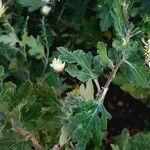
Dendranthema grandiflorum
داوودی سفید · داوودی · Florists' Chrysanthemum · Florist's daisy · Florist's chrysanthemum
Description
Source: leafsnapDendranthema grandiflorum, commonly known as chrysanthemum or mum, is a perennial flowering plant native to Asia and northeastern Europe. Belonging to the Asteraceae family, it is widely cultivated for its vibrant flowers, which come in various colors including white, yellow, pink, red, and purple. The plant typically grows to a height of 1-3 feet, featuring dark green leaves that are either lobed or toothed. Chrysanthemums are popular ornamental plants, often used for garden borders, mass planting, or as cut flowers in floral arrangements. They bloom from late summer through fall, producing large, daisy-like flowers with a central disk surrounded by petals. The flower heads can be single or double, depending on the cultivar. This plant thrives in full sun exposure and well-drained soil, with moderate watering needs. It can be propagated by dividing clumps either in spring or fall. In addition to their ornamental value, chrysanthemums have been used medicinally to treat conditions such as fever and headaches, owing to their anti-inflammatory properties. Compounds in the plant have also shown potential anti-cancer effects. Overall, Dendranthema grandiflorum is a stunning flowering plant with cultural significance in many countries around the world, including Japan, where it is regarded as a symbol of the autumn season and is locally known as "kiku."
🌳 Beyond its decorative function, the garden mum plays an unexpected role as a natural indicator of air pollution and soil toxicity. Its leaves can absorb large amounts of pollutants such as ammonia and sulfur dioxide, undergo visible changes, and thus signal levels of contamination. In addition, the petals are used in crafts and the arts to produce vibrant natural dyes for fabrics, giving them the deep colors commonly linked to autumn. These dyes are valued not only for their appearance but also as eco-friendly alternatives to synthetic dyes.
🎭 Purity, nobility and long life
Care Guide
💧 Water Every 7 days
☀️ Light Full sun
The garden mum prefers conditions that provide ample sunlight. Light is vital for the plant’s healthy growth, especially during its flowering period. Too much or too little light can impede its development. While it thrives with steady sun exposure, it can cope well with partial light.
🌡️ Temperature 5–35°C
Native to temperate regions, the garden mum does best in conditions similar to those mild climates. The preferred temperature range is 68 to 95 °F (20 to 35 ℃). Seasonal adjustments may be needed to sustain optimal growth.
💨 Humidity
🪴 Soil 6-7
🌱 Fertilizer
Early spring, when a Garden mum is coming out of dormancy and starting active growth, is the ideal time to fertilize it. Fertilization supplies essential nutrients for healthy growth. Although Garden mums have comparatively low fertilizer requirements, giving them fertilizer once a year can help them survive better and produce improved, longer-lasting flowers.
🪴 Pot & Repot 2-3 years
When repotting Garden mum, pick a pot 1-2 inches (2.5–5.1 cm) larger with good drainage. Use a potting mix that drains well. Repot in spring or fall, making sure the root ball sits slightly below the rim of the flower pot. Water thoroughly after repotting and place it in a warm spot with indirect sunlight.
✂️ Pruning
🌿 Propagating
🐛 Diseases & pets
☠️ Toxicity
Characteristics
- Plant Type
- Herb
- Life Cycle
- Perennial, Annual
- Genus
- Dendranthema
- Family
- Compositae
- Hardiness Zone
- 5-10
- Mature Height
- 15 cm to 91 cm
- Mature Spread
- 30 cm to 61 cm
- Leaf Color
- Green
- Leaf Type
- Evergreen, Deciduous
- Flower Color
- White, Yellow, Orange, Pink, Red, Purple
- Flower Size
- 3.56 cm to 4.06 cm
- Bloom Time
- Mid summer, Late summer, Early fall
- Planting Time
- Spring, Autumn, Winter
- Harvest Time
- Mid winter, Late winter