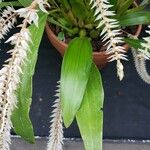
Dendrochilum glumaceum
Cat's Tail Orchid · Hay-scented orchid
Description
Source: leafsnapDendrochilum glumaceum, the hay-scented orchid or husk-like dendrochilum, was described by John Lindley in 1841. It is an elegant looking epiphytic or lithophytic dendrochilum that occurs in the Philippines and Borneo at altitudes between 700 and 2,300 m. This species possesses long feathery pendulous spikes containing two rows of pure white flowers, with yellow to orange lips, that emerge on each new growth. From each conical to ovoid pseudobulb grows an erect, single, long, oblanceolate leaf
Care Guide
💧 Water Every 7 days
Dendrochilum, often referred to as "husk-like," originates from the humid forests of Southeast Asia. It thrives in environments with high humidity and consistently moist soil. To support its lush growth, water it weekly. While typically grown indoors, it particularly benefits from increased humidity during its active growing season, which enhances both the health of the foliage and its flowering potential.
☀️ Light Partial sun
Husk-like dendrochilum naturally occurs in habitats such as forest understories or rocky areas, where it grows in natural shade. It prefers partial sun but can adjust to full sun or full shade, demonstrating its versatility and hardiness.
🌡️ Temperature 20–37.8°C
Husk-like dendrochilum does best in warm settings. It prefers temperatures that are fairly warm but not overly hot or humid. Sunlight warms the plant and encourages it to flower. Still, long periods of direct sun in summer can cause sunburn, so the sunlight it gets should be regulated during that season. The plant generally handles cold poorly, so it needs sufficient protection and warmer conditions in winter to avoid freezing.
💨 Humidity high (>60%)
This plant needs special care because it loves high humidity levels of 60-80% or more. The best way to achieve this is by placing a humidifier near the plant. Daily misting is also essential! Make sure the room has good ventilation.
🪴 Soil 5-6
🌱 Fertilizer
Proper fertilization is essential for the health and appearance of Husk-like dendrochilum. Fertilize Husk-like dendrochilum in summer, applying it once a month throughout the season. The nutrients provide energy for growth and help maintain the plant's parts. Fertilizing improves Husk-like dendrochilum's flower display, ensuring the best blooms.
🪴 Pot & Repot
When repotting a Husk-like Dendrochilum, pick a pot a bit larger with good drainage, ideally a clear orchid pot. Use an orchid-specific, fast-draining medium that includes bark or moss. Carefully clean the roots and cut away any that are dead or rotting. Repot after the plant has finished flowering, typically in spring or fall, water well after repotting, and keep it in bright, indirect light. Once repotted, avoid disturbing the roots.
✂️ Pruning
Husk-like dendrochilum benefits from light pruning in early to late spring, right after it has finished flowering. This promotes growth and helps prevent legginess. During pruning, be sure to remove dead leaves and spent flower spikes. Also, thin out the plant to ensure good airflow, which helps minimize the risk of disease. Regular pruning not only maintains the plant's ornamental appeal but also supports its overall health and vitality.
🌿 Propagating
🐛 Diseases & pets
☠️ Toxicity
Characteristics
- Plant Type
- Herb
- Life Cycle
- Perennial
- Genus
- Dendrochilum
- Family
- Orchidaceae
- Hardiness Zone
- 11
- Mature Height
- 1 cm to 2 cm
- Mature Spread
- 15 cm to 25 cm
- Leaf Color
- Green
- Leaf Type
- Evergreen
- Flower Color
- White
- Flower Size
- 1.02 cm to 1.52 cm
- Bloom Time
- Spring
- Planting Time
- Spring, Summer, Autumn
- Harvest Time
- Late spring, Early summer, Mid summer