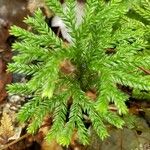
Dendrolycopodium dendroideum
Tree groundpine · Prickle tree club-moss · Prickley Tree-Club-Moss · Round-branched Tree-clubmoss · Northern Tree-clubmoss
Description
Source: leafsnapDendrolycopodium dendroideum, synonym Lycopodium dendroideum, known as tree groundpine, is a North American species of clubmoss. It is part of a complex of species colloquially known as groundpine, which taxa were formerly lumped into the species Lycopodium obscurum. The species is native to Russia and also to the colder parts of North America (all states and provinces in Canada except Nunavut; northern and east-central United States including Alaska). The genus Dendrolycopodium is accepted in the Pteridophyte Phylogeny Group classification of 2016 (PPG I), but not in other classifications, which submerge the genus in Lycopodium.Dendrolycopodium dendroideum prefers humus-rich, sandy, moist but not completely saturated soils. It is very similar to D. obscurum except for side shoots that are round in cross-section rather than flat, and having leaves all the same size.
Care Guide
💧 Water
Treelike clubmoss originates from cool, temperate forests and thrives in consistently moist soil, though it can tolerate short dry periods. To ensure its health, it's important to water it weekly. As an evergreen plant, treelike clubmoss needs regular hydration throughout the year to maintain its vibrant foliage, whether it is grown indoors or outdoors.
☀️ Light Partial sun
Treelike clubmoss favors moderate sun exposure, thriving where light is neither too intense nor too scarce, a pattern that points to its origin in areas abundant with dappled light. Excessive sun can be harmful, while very low light levels can impede its growth.
What are the sunlight requirements for Treelike clubmoss?
Treelike clubmoss requires partial sun, about 3-6 hours of sunlight, to thrive best. It can also grow in full shade, which means it gets less than 3 hours of sunlight. The plant prefers environments where the light is not too harsh nor too limited, as excessive sun can cause harm while very low light levels may impede its growth. It's important to observe how sunlight moves through your garden to pick spots that offer a balance of light and shade, ensuring the plant's happiness.
How can indoor plants like Treelike clubmoss benefit from artificial lighting?
Indoor plants, including Treelike clubmoss, require adequate lighting for optimal growth. When natural sunlight is insufficient, especially in winter or in less sunny spaces, artificial lights serve as a crucial solution. LED lights are recommended because they can provide specific wavelengths of light needed by plants. Full sun plants need 30-50W/sq ft, partial sun plants need 20-30W/sq ft, and full shade plants need 10-20W/sq ft of artificial light. The light source should be placed 12-36 inches above the plant, and most plants need 8-12 hours of light per day.
What are key symptoms of light deficiency in Treelike clubmoss?
When Treelike clubmoss grows under insufficient light, it may exhibit symptoms such as smaller new leaves compared to older ones, leggy or sparse growth, a tendency for faster leaf drop, slower or no new growth, and lighter-colored new leaves. Additionally, excessive sunlight can lead to chlorosis (leaves turning yellow), sunscald, leaf curling, wilting, and leaf scorching. These symptoms indicate a lack of chlorophyll and essential nutrients or damage due to intense sunlight exposure.
How should you manage Treelike clubmoss plants experiencing light-related issues?
To optimize plant growth when light conditions are not ideal, gradually move your Treelike clubmoss to sunnier spots each week until they receive 3-6 hours of direct sunlight daily. If the plant is large or not easily movable, consider using artificial light, keeping a lamp on for at least 8 hours daily or investing in grow lights. For outdoor plants, avoid sudden changes to prevent sunburn. Removing obstructions like branches can improve sunlight access, and transplanting smaller plants during their dormant period can ensure better light exposure. It is important to note that parts of the plant that have been affected by insufficient sunlight may not recover, but new growth will be healthy after improving light conditions.
🌡️ Temperature 0–32.2°C
Treelike clubmoss can tolerate a wide range of temperatures, but its distribution can still be restricted by various combinations of moisture and heat. It grows best in warm summer conditions with sufficient rainfall or watering. Extended periods of cloudy, rainy weather, as well as prolonged high temperatures, can increase the chance of Treelike clubmoss dying. In winter, adequate protection from cold can improve the plant's chances of survival.
💨 Humidity
🪴 Soil 4-6
🌱 Fertilizer
One fertilizer application in spring is generally enough for Treelike clubmoss, though repeated feedings can maximize growth. Apply fertilizer every one to one and a half months. Fertilizing improves the leaves' appearance and function, maintaining consistent color and a healthy texture. It also encourages root development and nutrient uptake, supporting long-term plant health.
🪴 Pot & Repot
✂️ Pruning
Treelike clubmoss grows best with minimal pruning, which is ideally done from early to late spring to encourage growth. To promote healthy development, remove any dead stems and shape the plant to allow for better airflow. Using clean, sharp tools will help prevent infections and support the robust health and vitality of treelike clubmoss.
🌿 Propagating
🐛 Diseases & pets
☠️ Toxicity
Characteristics
- Plant Type
- Herb
- Life Cycle
- Perennial
- Genus
- Dendrolycopodium
- Family
- Lycopodiaceae
- Hardiness Zone
- 3-7
- Mature Height
- 10 cm to 30 cm
- Mature Spread
- 10 cm to 20 cm
- Leaf Color
- Dark Green
- Leaf Type
- Evergreen
- Flower Size
- 2.03 cm to 4.06 cm
- Planting Time
- Spring, Autumn
- Harvest Time
- Late summer, Early fall, Mid fall
- Native Area
- Russia, Canada, United States, Japan, Koppen, South Korea, China