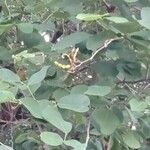
Derris trifoliata
Three-leaf derris · Threeleaf derris
Description
Source: leafsnapDerris trifoliata is a plant species in the genus Derris, Family - Leguminosae It is known as "Karanjvel" in Marathi - local language of Maharashtra, India. It is a large climber found commonly in coastal swamps of Konkan (India). It is 3-5 meters long. Its leaves are alternate, pinnate, 12-20 cm; leaflets 5, ovate, 6-10 com, acuminate, rounded at base. Flowers are 1 cm in size, in axillary racemes 8-15 cm. Pods are 3-4 cm, flat, pale yellow in color. The rotenoid 6aα,12aα-12a-hydroxyelliptone can be found in the stems of D. trifoliata.The larvae of Hasora hurama feed on D. trifoliata. Gallery:
Care Guide
💧 Water
☀️ Light Full sun
Three-leaf derris is native to open habitats, such as sunlit meadows and the edges of forests, which supply plenty of light. It performs best in full sun but can also tolerate partial sun, adapting well to a range of light conditions.
What are the sunlight requirements for Three-leaf derris?
Three-leaf derris thrives in open environments and prefers full sun, requiring more than 6 hours of sunlight daily, but it can also tolerate partial sun, needing about 3-6 hours of sunlight. Ensuring the right balance of light and shade is crucial for the happiness of your plants. It's important to watch how sunlight moves through your garden to choose spots that provide the perfect conditions for your Three-leaf derris.
Can Three-leaf derris adapt to different sunlight conditions?
Yes, Three-leaf derris is quite adaptable to various sunlight conditions. Originating from sunny meadows and forest edges, it thrives in full sun but can also tolerate partial sun well. This adaptability makes it suitable for a range of environments, ensuring that with the right care, it can grow healthily in both natural and artificial lighting conditions.
How do I provide adequate lighting for indoor Three-leaf derris?
Indoor Three-leaf derris plants require adequate lighting to grow optimally. When natural sunlight is insufficient, artificial lighting can be a vital solution. LED lights are recommended because they can be customized to provide specific wavelengths needed by plants. For full sun plants, 30-50W/sq ft is needed; partial sun plants require 20-30W/sq ft, and full shade plants need 10-20W/sq ft. The light source should be placed 12-36 inches above the plant to mimic natural sunlight, and most plants benefit from 8-12 hours of light per day.
What are some symptoms of light deficiency in Three-leaf derris?
Symptoms of light deficiency in Three-leaf derris include small leaves, leggy or sparse growth, faster leaf drop, slower or no new growth, and lighter-colored new leaves. Chlorosis, or the loss of green color in leaves, can also occur, indicating a lack of chlorophyll and essential nutrients. Sunscald, leaf curling, wilting, and leaf scorching are symptoms associated with excessive sunlight exposure, which can adversely affect the plant's health.
What solutions can help Three-leaf derris with insufficient sunlight?
To address insufficient sunlight for Three-leaf derris, gradually move your plant to a sunnier location, ensuring it receives at least 6 hours of direct sunlight daily. Use a south-facing window and keep curtains open during the day for maximum exposure. If moving the plant is not feasible, consider using artificial light, keeping a lamp on for at least 8 hours daily, or investing in professional plant grow lights. For outdoor plants, avoid sudden changes in light intensity to prevent sunburn. Prune obstructing branches or consider transplanting smaller plants to sunnier locations for ample sunlight and good drainage. Remember, parts of the plant that have been affected by insufficient sunlight may not recover, but new growth will be healthy with increased light exposure.
🌡️ Temperature 20–37.8°C
Three-leaf derris comes from tropical areas, where the weather is usually warm and humid. As a result, it is well suited to high temperatures and moisture. It does not tolerate sudden temperature swings and prefers a constant temperature, so avoiding temperature fluctuations indoors is important. It generally cannot endure cold and needs higher temperatures to grow. If the temperature falls too low, the plant may stop growing or even die.
💨 Humidity
🪴 Soil 6-7
🌱 Fertilizer
Fertilization is essential for the care of Three-leaf derris. Regular feeding during the growing season preserves the energy needed for its showy leaves and supports overall growth. Skipping fertilization can cause unhealthy foliage, reduced ornamental value, and stunted or weak growth that is prone to breaking.
🪴 Pot & Repot
✂️ Pruning
The three-leaf derris has leaves divided into three parts and benefits from pruning in early spring before new growth begins. To improve air circulation, prevent disease, and shape the plant, remove any dead branches. Regular maintenance helps maintain the size and beauty of the three-leaf derris, promoting healthier growth in the upcoming season.
🌿 Propagating
🐛 Diseases & pets
☠️ Toxicity
Characteristics
- Plant Type
- Vine
- Life Cycle
- Perennial
- Genus
- Derris
- Family
- Fabaceae
- Hardiness Zone
- 10-12
- Mature Height
- 10.06 m
- Mature Spread
- 2.13 m to 4.88 m
- Leaf Color
- Green
- Leaf Type
- Deciduous
- Flower Color
- White, Pink
- Flower Size
- 1.02 cm
- Bloom Time
- Late spring, Summer, Early fall
- Planting Time
- Spring, Summer, Autumn
- Harvest Time
- Late summer, Fall
- Native Area
- Sri Lanka, India, Malaysia, South Africa, Philippines, Madagascar, Bangladesh, Laos, Fiji, Kenya, Tanzania, Brunei, China, Indonesia, Cambodia, Vietnam, Mozambique, Myanmar, Japan, Eswatini, Singapore, Thailand