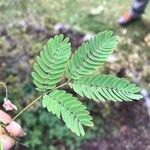
Desmanthus virgatus
Desmanthus · Wild Tantan · Prostrate bundleflower · Dwarf koa · Slender mimosa
Description
Source: leafsnapDesmanthus virgatus, commonly known as wild mimosa or tick clover, is a perennial shrub belonging to the Fabaceae family. Native to South America, it has also been introduced and naturalized in many other parts of the world. The plant typically grows to a height of 1-2 meters and has a spreading habit with multiple stems. Its bipinnate leaves feature small leaflets that are sensitive to touch, folding up when disturbed. The flowers of Desmanthus virgatus are small and come in white or pink hues. They are arranged in clusters at the ends of branches and bloom from late summer to fall, attracting bees and other pollinators. The plant prefers well-drained soils but can thrive in a wide range of soil types, including sandy soils. It grows best in full sun exposure but can also tolerate partial shade. Desmanthus virgatus serves several purposes: it is popular as an ornamental plant for landscaping due to its attractive foliage and flowers, and it is also used for soil stabilization thanks to its deep root system that helps prevent erosion on steep slopes. Additionally, Desmanthus virgatus has traditional medicinal uses. Indigenous people in South America have used it to treat various ailments such as fever, coughs, and diarrhea. Overall, Desmanthus virgatus is a versatile and attractive shrub with multiple uses, making it an important species both ecologically and economically in regions where it occurs naturally or has been introduced through human activities like agriculture or landscaping.
Care Guide
💧 Water Every 7 days
The wild tantan is well-suited to semi-arid regions and can thrive in dry conditions due to its remarkable drought tolerance. Though it can survive with minimal water, providing weekly watering helps support its growth. This plant is often grown outdoors and is perfect for xeriscaping, as its low water requirements make it an excellent choice for conservation efforts.
How should I water my Wild tantan plant?
To ensure the health of the Wild tantan plant, it is best to use filtered water at room temperature when watering. Tap water may contain harmful particles that can affect the plant. Keep in mind that the Wild tantan plant is accustomed to a warm environment, so using cold water can be a shock to its system. Additionally, overhead watering should be avoided as it can cause issues with the foliage. Instead, apply the filtered room temperature water directly to the soil until it is completely soaked. This helps to moisturize the roots and allows them to continue spreading through the soil to collect necessary nutrients.
What should I do if I give my Wild tantan too much or too little water?
Overwatering is a common issue that can harm your Wild tantan. It causes the stems and leaves to wilt and turn yellow. Overwatering can also lead to diseases like root rot, mold, and mildew that can kill your plant. Underwatering is less common but can still happen. When underwatering occurs, the leaves become brittle and brown. It's important to notice signs of overwatering early on because some diseases, like root rot, can't be fixed if you wait too long. Reduce your watering schedule if you see signs of overwatering and replace poorly draining soil with a well-draining potting mix. If your Wild tantan isn't getting enough water, simply water more regularly until the signs of underwatering go away.
How frequently do I need to water my Wild tantan?
If your Wild tantan plant is in a pot, the best way to check if it needs water is by sticking your finger into the soil. If the top two to three inches of soil are dry, it's time to water it. For outdoor plants, you can use the same method. If the first few inches of soil are dry, it needs water. Usually, in spring and early fall, watering once a week is sufficient. However, during extremely hot weather, you may need to water it twice or even more per week. Nonetheless, mature and well-established Wild tantan plants can handle drought well.
How much water does my pet Wild tantan require?
To effectively water your Wild tantan plant, be generous with the amount of water you provide. Make sure the top two to three inches of soil have dried out before watering, and then give it a good, thorough soaking. The water should be enough to fully saturate the soil and even flow through the drainage holes at the bottom of the pot. If you don't see water draining out, you may have underwatered it. However, be careful not to let water accumulate inside the soil, as this can harm the plant. On the other hand, if water isn't draining properly, it could mean your soil doesn't drain well, which is bad for the plant's health. Finally, if the plant is outside, one inch of rain per week should be enough.
How do I give water to my Wild tantan plants as they grow?
The water requirements of the Wild tantan can vary depending on its growth stages. When the plant is in its early years or has been recently transplanted, it will require more water than usual. During these stages, the Wild tantan expends a lot of energy developing new roots to support future growth. These roots perform best with slightly higher moisture levels compared to a more mature phase. As the plant progresses through a few seasons, it will require less water. Additionally, during the bloom period, the Wild tantan may need extra water as the flower development process necessitates significant moisture.
☀️ Light Full sun
Wild tantan, a perennial herbaceous plant, is native to open environments, frequently flourishing in meadows and grasslands. Although it prefers full sun, it can still survive in places with partial sun.
🌡️ Temperature 15–32.2°C
The wild tantan naturally grows in environments with temperatures fluctuating between 59 and 89.6 °F (15 to 32 ℃). It flourishes under these moderate weather conditions. Seasonal modifications might be needed to replicate this indigenous range in varying climates.
What is the native climate for wild tantan?
Wild tantan is native to climates with temperatures ranging between 59 to 89.6 °F (15 to 32 °C), thriving in these temperate conditions. To grow wild tantan in a different climate, seasonal adjustments may be necessary to mirror its native temperature range. Wild tantan possesses strong cold resistance, making special frost protection measures usually unnecessary during the winter. However, if winter temperatures are expected to drop below -10°C, cold protection through materials such as soil or straw is important. Abundant watering before the first freeze in autumn, ensuring the soil remains moist and enters a frozen state, helps prevent drought and water scarcity for the plant during winter and early spring.
How should wild tantan be cared for in low temperatures?
Wild tantan is notably cold-tolerant and thrives best when temperatures remain above 15°C. During winter, it is advised to keep the plant's environment above -5°C. Exposure to temperatures below -10°C might not show immediate changes during the winter, but there could be a decrease in sprouting, or in some cases, no sprouting during the spring. In the spring, it is recommended to remove any parts of the plant that have failed to sprout as a part of its care regimen.
What should be done if wild tantan experiences high temperatures?
In the summer months, it is crucial to ensure that wild tantan's environment does not exceed 32°C. Should temperatures rise above 35°C, the plant's leaves may become lighter in color, exhibit signs of curling, become susceptible to sunburn, and in severe instances, the entire plant may wilt and dry out. To mitigate these effects, it is advised to trim away any sunburned and dried-up parts, relocate the plant to a shadier location to escape the midday and afternoon sun or utilize a shade cloth. Furthermore, watering the plant in the morning and evening to maintain soil moisture is beneficial.
💨 Humidity
🪴 Soil 6-7
🌱 Fertilizer
For Wild tantan, a one-time application of fertilizer in spring is generally adequate. However, to optimize growth, consider feeding it several times. Apply fertilizer once every month to a month and a half. Such fertilization enhances not only the look and function of the leaves – ensuring stable color and good texture – but also stimulates the growth of roots and absorption of nutrients, contributing to the longevity of the plant's health.
🪴 Pot & Repot
✂️ Pruning
The wild tantan is a resilient, leguminous shrub known for its feathery leaves and spherical flowers. To encourage better health and blooming, prune the plant in early to late spring. Focus on removing weak branches to enhance air circulation. Making clean cuts will help prevent disease, leading to a tidier and healthier plant.
🌿 Propagating
🐛 Diseases & pets
☠️ Toxicity
Characteristics
- Plant Type
- Herb, Shrub
- Life Cycle
- Perennial
- Genus
- Desmanthus
- Family
- Fabaceae
- Hardiness Zone
- 8
- Mature Height
- 1.52 m to 3.05 m
- Mature Spread
- 0.49 m to 1.52 m
- Leaf Color
- Green
- Leaf Type
- Deciduous
- Flower Color
- White
- Flower Size
- 0.51 cm
- Bloom Time
- Summer, Early fall, Mid fall
- Planting Time
- Spring, Autumn
- Harvest Time
- Late summer, Fall, Early winter
- Native Area
- Belize, Honduras, Mexico, Guatemala, Peru, Panama, Jamaica, Colombia, Bahamas, Cuba, Bolivia, Venezuela, Brazil, Guyana, El Salvador, Nicaragua, Ecuador, Costa Rica