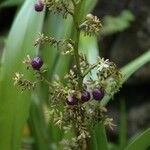
Dianella sandwicensis
'uki'uki · Uki'uki
Description
Source: leafsnapDianella sandwicensis, commonly known as Hawaiian blueberry or pōhuehue, is a perennial plant species native to Hawaii. It belongs to the Asphodelaceae family and can grow up to 3 feet tall. The plant features long, narrow, bluish-green leaves that can reach up to 2 feet in length. It also produces small, blue or purple berries that are edible, although they are not commonly consumed. Dianella sandwicensis thrives in well-drained soils and partial shade but can also tolerate full sun exposure. It is a hardy plant that requires minimal maintenance once established and is drought-tolerant. The Hawaiian blueberry holds cultural significance in Hawaii. Traditionally, native Hawaiians used it for medicinal purposes to treat various ailments such as fever, stomachaches, and headaches. Beyond its medicinal properties, Dianella sandwicensis also plays an important ecological role by providing habitat for various bird species, including the Hawaiian honeycreeper. In summary, Dianella sandwicensis is a beautiful ornamental plant with cultural significance in Hawaii, and it also offers ecological benefits.
Care Guide
💧 Water Every 7 days
'Uki'uki thrives in tropical conditions and prefers soil that is consistently moist yet well-drained. It should be watered once a week. Although 'uki'uki can be grown indoors, it is better suited for outdoor cultivation where it can benefit from natural rainfall. This means you may need to carefully adjust your irrigation schedule to accommodate the plant's outdoor needs.
☀️ Light Partial sun
'uki'uki is native to habitats like forest understories or rocky areas, where it grows in natural shade. It prefers partial sun but can adapt to full sun or full shade, showing its versatile and hardy nature.
🌡️ Temperature 20–37.8°C
'uki'uki comes from tropical areas, where the climate is generally warm and humid. As a result, it is well suited to high temperatures and humidity. It does not tolerate sudden temperature changes and prefers a stable thermal environment, so it is important to avoid temperature fluctuations indoors. It usually cannot withstand cold temperatures and requires warmer conditions for growth. If the surrounding temperature falls too low, the plant may stop growing or even die.
What is 'uki'uki?
'Uki'uki is a plant known by its botanical name, Dianella sandwicensis. It is a species recognized for its particular characteristics and significance in the regions where it is native.
💨 Humidity
🪴 Soil 6-7
🌱 Fertilizer
Proper fertilization is essential for 'uki'uki's health and appearance. Fertilize 'uki'uki during summer, repeating the treatment monthly throughout the season. Nutrients provide energy for growth and help maintain the plant's parts. Fertilization improves 'uki'uki's flower display, ensuring the best blooms.
🪴 Pot & Repot
✂️ Pruning
'Uki'uki is a resilient, clump-forming plant characterized by its strap-like leaves and small blue flowers. To keep it healthy, prune the plant in early spring. This helps remove dead foliage, promotes new growth, and improves air circulation. Be sure to use clean, sharp tools during pruning to minimize damage and encourage vigorous blooming, all while maintaining a compact shape.
🌿 Propagating
🐛 Diseases & pets
☠️ Toxicity
Characteristics
- Plant Type
- Herb
- Life Cycle
- Perennial
- Genus
- Dianella
- Family
- Asphodelaceae
- Hardiness Zone
- 9-11
- Mature Height
- 30 cm to 91 cm
- Mature Spread
- 61 cm to 91 cm
- Leaf Color
- Green, Dark Green
- Leaf Type
- Evergreen
- Flower Color
- Lavender
- Flower Size
- 1.02 cm to 2.03 cm
- Bloom Time
- Late spring, Summer
- Planting Time
- Spring, Autumn
- Harvest Time
- Late summer, Fall