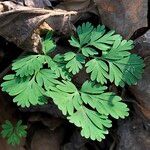
Dicentra cucullaria
Dutchman's breeches · Turkey-corn · Dutchman's Britches · Soldier's Cap
Description
Source: leafsnapDicentra cucullaria, commonly known as Dutchman's breeches, is a perennial herbaceous plant native to eastern North America. It is part of the Papaveraceae family and is distinguished by its delicate white or pinkish flowers that resemble pantaloons. The plant typically grows up to 30 cm in height and has finely divided leaves that stem from a basal rosette. Dicentra cucullaria thrives in moist, well-drained soils in shaded woodland areas and blooms from March to May. The flowers are pollinated by bees and butterflies, while the seeds are dispersed by ants. Native American tribes have traditionally used this plant for medicinal purposes to treat ailments such as skin rashes, toothaches, and respiratory problems. However, it should be noted that Dicentra cucullaria contains toxic alkaloids that can cause skin irritation if not handled properly. Overall, Dicentra cucullaria is a charming addition to any woodland garden, with its distinctive pantaloon-shaped flowers and delicate foliage.
🌳 Dutchman's breeches is a popular perennial plant for partially shady gardens. This hardy plant is resistant to diseases and pests, including rabbits. It thrives in woodland and coastal gardens, where it serves as an excellent ground cover or edging plant. Additionally, it brings vibrant color to slopes and banks during the spring and summer months.
🎭 Romantic love and purity
Care Guide
💧 Water
☀️ Light Partial sun
🌡️ Temperature 0–32.2°C
💨 Humidity
🪴 Soil 6-7
🌱 Fertilizer
🪴 Pot & Repot
✂️ Pruning
🌿 Propagating
🐛 Diseases & pets
☠️ Toxicity
Characteristics
- Plant Type
- Herb
- Life Cycle
- Perennial
- Genus
- Dicentra
- Family
- Papaveraceae
- Hardiness Zone
- 3-8
- Mature Height
- 15 cm to 46 cm
- Mature Spread
- 15 cm to 20 cm
- Leaf Color
- Green, Blue
- Leaf Type
- Deciduous
- Flower Color
- White, Pink
- Flower Size
- 2.54 cm
- Bloom Time
- Mid spring, Late spring
- Planting Time
- Spring
- Harvest Time
- Late spring, Early summer
- Native Area
- Eastern North America