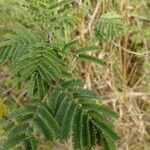
Dichrostachys cinerea
Sicklebush · Marabou-thorn · Aroma · Marabu · Chinese lantern tree
Description
Source: leafsnapDichrostachys cinerea, known as sicklebush, Bell mimosa, Chinese lantern tree or Kalahari Christmas tree (South Africa), is a legume of the genus Dichrostachys in the family Fabaceae.Other common names include omubambanjobe (Tooro Uganda), acacia Saint Domingue (French), el marabú (Cuba), " Mpangara" (Shona), Kalahari-Weihnachtsbaum (German of former South West Africa), kéké or mimosa clochette (Réunion).
Care Guide
💧 Water
Aroma thrives in semi-arid environments with minimal rainfall and demonstrates a high tolerance for drought conditions. It generally needs watering only once every three weeks. In warmer climates, when grown outdoors, applying mulch can help retain soil moisture during hot periods, effectively supporting its low water requirements.
What's the best way to water my Aroma?
To promote excellent root development, it is advisable to place a garden hose at the base of the plant. Avoid spraying the leaves directly, as this can lead to more watering needs if the plant is exposed to direct sunlight outdoors. You can also use bubblers to moisten the roots of each plant individually. Soaker hoses that cover the whole garden or bed can be helpful when adding or removing plants, as they encourage deeper root growth. Remember to drain any excess water and allow the soil to dry before watering again. Watering at ground level is recommended to prevent diseases. On a sunny day, consider spraying the entire bush with water. Whether your plant is potted or in the ground, keep in mind that Aroma prefers deep watering rather than light sprinkling.
What do I need to do if I give Aroma too much or too little water?
If an Aroma plant is overwatered, it may develop yellow leaves that eventually fall off and wilt. The plant may appear dull and unhealthy, with mushy stems as well. When these signs occur, it's best to adjust your watering schedule as needed. On the other hand, wilting can also be a sign of underwatering. In this case, the leaves may become crispy and dry, while overwatered leaves will be soft and wilted. If the soil is dry and simply watering isn't enough, give the plant a thorough watering. However, even with enough water, the Aroma plant may still have dry, yellow leaves for a few days due to root damage. Once it recovers, the yellowing leaves will stop. When keeping an Aroma plant indoors, always check the moisture levels in the pot and avoid overwatering. If you notice black spots, allow the soil to dry out by refraining from watering for a few days. Overwatering can lead to root rot, so if you see discolored and slimy roots, consider transferring the plant to a different pot. It's important to prevent root rot by ensuring the soil doesn't become too soggy. When planting the Aroma outdoors, dig a little deeper. If you feel the soil is too dry while checking with your fingers, it may indicate underwatering. Adequate watering is necessary for the plant to recover.
How often do I need to water my Aroma?
The Aroma plant prefers deep and infrequent watering, especially when planted in pots. Since the water storage in pots is limited and the soil dries out faster, it is recommended to soak the plants in a gallon of water each time. In cold regions, watering is needed every 3 to 5 days. It is best to water the plant early in the morning when the soil is dry, both indoors and outdoors. You can also check the soil inside to determine if watering is necessary. If the top 2-3 inches of soil are dry, it's time to give the plant a full watering. On hot days, check the moisture level daily as the heat can quickly dry out the soil in pots. If you have a garden, irrigation of the soil is also necessary. In hot climates, watering once a week is recommended. However, only water if you notice that about 2 to 3 inches of soil have become too dry, and be mindful of excess rainwater to prevent root rot. Aromas generally grow during spring and fall, so when they are outdoors, applying mulch about 3 to 4 inches deep can help conserve more water. Sandy soil requires more frequent watering, while clay soil needs less frequent watering to avoid root rot. To keep track of watering, mark the date on a calendar and observe the leaves for any drooping, which may indicate the need for watering.
How much water should I add to my Aroma?
For Aroma, it's generally recommended to give it about a gallon of water on a regular schedule. When it comes to potted plants, water them deeply until you see water dripping out of the bottom of the pot. Wait for the soil to dry before watering again. You can use a water calculator or a moisture meter to keep track of how much water you've given your plant in a week. During the flowering period, make sure to provide plenty of water, but allow the moisture to evaporate afterwards to avoid root rot. If Aroma is planted outdoors and there is sufficient rainfall, you may not need to water it additionally. However, when Aroma is young or newly planted, it should receive 1-2 inches of rain per week. As Aroma matures, it can rely solely on rainfall. Only in hot weather or when there has been no rainfall for 2-3 weeks should you consider giving Aroma a thorough watering during cooler parts of the day to prevent damage from excessive heat. Additional watering will be necessary during prolonged dry spells.
Should I water my Aroma plant more or less depending on the time of year or the weather?
The Aroma plant needs water from rain when it's outdoors, but if the weather is consistently dry, you'll need to water it. During the spring and fall, keep the soil moist but not soggy, alternating between dry and moist conditions. In the summer, hot weather and lack of rain may cause water to evaporate quickly, so water more frequently to keep the soil moist. During winter, the Aroma needs less water because it drops its leaves and goes dormant. Use well-draining soil and terracotta pots to help water evaporate quickly. Once the Aroma starts growing leaves in spring, you can rely on fall and winter rains, skipping watering. In spring, encourage the Aroma to grow and bloom as temperatures warm up. Good drainage is crucial, especially in winter, to avoid ponding. If the Aroma is in a pot, water it well, particularly during summer, but ensure there's adequate drainage to prevent cold and wet roots. Deeply soak the root system once or twice a week, avoiding shallow sprinkles that reach the leaves. Don't let the Aroma dry out completely in fall or winter, even during dormancy. Make sure the soil drains well to prevent the plant from sitting in water for too long, which can be fatal during winter. Applying mulch can help reduce stress, conserve water, and promote healthy blooms.
☀️ Light Partial sun
Aroma prefers sites that receive sun for part of the day, though it can also tolerate being in direct sun all day. Both too little and too much light can impede its strong growth. It comes from places where sunlight is intermittent and is adapted to a range of light conditions.
What are the sunlight requirements for Aroma plants?
Aroma plants enjoy locations that receive sunlight for part of the day and can also thrive in conditions where they are exposed to full sun all day long. These plants need partial sun, which means about 3-6 hours of sunlight, or full sun, which is more than 6 hours of sunlight daily. It's crucial to observe how sunlight moves through your garden to find the perfect balance of light and shade, ensuring the plants' well-being.
How can artificial lighting benefit indoor Aroma plants?
When natural sunlight isn't sufficient, especially during winter or in less sunny spots, artificial lighting becomes essential for the growth of indoor Aroma plants. LED lights are often recommended because they can be tailored to provide specific wavelengths needed by plants. For full sun plants, 30-50W per square foot is advisable; partial sun plants require 20-30W per square foot, while full shade plants need 10-20W per square foot. The light source should be positioned 12-36 inches above the plant, mimicking natural sunlight conditions, and plants generally need 8-12 hours of light per day.
What are common symptoms of light deficiency in Aroma plants?
Aroma plants exhibit several symptoms when they suffer from insufficient light. These include smaller new leaves, leggy or sparse growth, premature leaf drop, delayed or halted growth, and pale or irregularly colored new leaves. Chlorosis, or the yellowing of leaves due to a lack of chlorophyll, can occur, as well as symptoms of overexposure like sunscald, leaf curling, wilting, and leaf scorching which indicate damage from excessive sunlight.
What are the recommendations for managing Aroma plants with insufficient sunlight?
For indoor Aroma plants with insufficient light, it's recommended to gradually shift them to sunnier spots each week until they achieve 3-6 hours of direct sunlight daily. If the plant is large or hard to move, consider using artificial light, keeping a lamp on for at least 8 hours daily or using professional plant grow lights. Outdoors, gradually adapt your plants to sunnier conditions to prevent sunburn. For plants blocked by obstructions like trees, consider pruning to allow more sunlight or transplanting to a location with better light and drainage, particularly during the plants' dormant period.
🌡️ Temperature 15–37.8°C
Aroma naturally thrives in environments with temperatures ranging from 59 to 100.4 °F (15 to 38 ℃). It favors milder climates but can accommodate seasonal temperature shifts. Altering care for extreme seasons is not necessary.
What is the ideal temperature range for Aroma?
Aroma, scientifically known as Dichrostachys cinerea, thrives in environments with a temperature range from 59 to 100.4 °F (15 to 38 °C). It loves mild climates and can adapt to seasonal temperature changes. Aroma is highly heat-tolerant, whereas cold conditions can be harmful. It is not necessary to alter care drastically through extreme seasons, but maintaining temperatures above 15°C during winter aids its growth, while temperatures nearing -5°C can be harmful.
What should I do with Aroma during autumn and winter?
In autumn, it is advisable to bring Aroma plants that were grown outdoors inside your home to protect them from the cold. Place them near a bright window but keep them away from direct heaters to avoid damage. Ensuring the temperature stays above 15°C during winter is critical for the plant's health. This helps avoid the detrimental effects of cold temperatures.
How does Aroma react to low temperatures and what are the solutions?
Aroma prefers warm temperatures and does not tolerate cold well. When the temperature falls below 15°C, it may struggle, and exposure to temperatures below -10°C can result in leaves lightening in color. After frost damage, you might notice browning or blackening leaves along with wilting and drooping. To address this, trim off frost-damaged parts and move the plant to a warm, indoor space away from cold drafts. Placing it near a south-facing window ensures it gets enough sunlight, but avoid locations near heaters or air conditioning vents to prevent the air from becoming too dry.
How does Aroma respond to high temperatures and what should be done?
In high temperatures, particularly above 38°C, Aroma's leaves might lighten in color, increasing the risk of sunburn when the temperature exceeds 43°C. To manage this, trim away the sunburned and dried parts of the plant. Relocate Aroma to a spot that receives shade during the midday and afternoon sun to protect it. Additionally, ensure the soil remains moist by watering the plant in the morning and evening.
💨 Humidity
🪴 Soil 6-7
🌱 Fertilizer
The best time to fertilize an Aroma is in early spring when it breaks dormancy. This encourages overall growth and the development of flowers. Fertilizing improves the foliage, stems, and branches, and supports the production of large, vibrant, long-lasting flowers. It also helps transport nutrients from the roots to the flowers and enhances the plant’s health and resistance to disease.
Why should I put fertilizer on my Aroma?
Fertilization plays a crucial role in promoting the overall health and well-being of your Aroma plant. By providing the necessary energy and nutrients, fertilization leads to the development of a lush foliage and strong stems and branches. However, it is the flowers of the Aroma plant that hold great value for gardeners. Fortunately, fertilization also enhances the production of large, vibrant, and long-lasting flowers. This is because the appropriate fertilizer facilitates the efficient transfer of nutrients from the roots to the flowers through the stems. Furthermore, proper fertilization contributes to the overall robustness of the plant, making it more resilient against diseases.
When should I fertilize my Aroma plant?
The best time to fertilize an Aroma is in early spring when it is coming out of its dormant phase and getting ready to bloom. This will provide the plant with energy for growth and flower development. It is also beneficial to give it another feeding in the fall, although it doesn't need to be as much as the first one. Some people choose to fertilize the Aroma while planting, but it's not always necessary.
When is the best time to not add fertilizer to my Aroma?
During the winter, Aroma plants do not require fertilization as they are in a dormant phase and do not need much energy from the soil for new growth. Fertilizing during this time can result in negative effects from overfertilization. The two main times for feeding Aroma plants are in early spring and fall. This means that during most of the spring and summer, fertilization is not necessary. It is also advisable to avoid feeding the plant if it is experiencing excessively hot or dry conditions.
What kind of fertilizer should I use for my Aroma?
Using a general-purpose fertilizer with even amounts of nitrogen, phosphorus, and potassium is usually okay. However, Aroma plants tend to thrive with a specific type of fertilizer. Generally, nitrogen and phosphorus are the most important nutrients for Aroma plants, so the fertilizer should have higher levels of these compared to potassium. A fertilizer with an N-P-K ratio of 10-10-8 or something similar should work well. Additionally, applying organic material like compost at least once a year can be beneficial. If fertilizer is chosen, granular fertilizer is commonly used for Aroma plants.
How can I give my Aroma plant food?
Fertilizing your Aroma plant is a simple task that any gardener, even those with minimal experience, can do. To apply granular fertilizer, just sprinkle it on the soil after moistening it with water. You can also improve the soil by adding organic material like compost or manure. To do this, place the material on top of the soil and gently work it into the first few inches using a hand rake, being careful not to disturb the roots.
🪴 Pot & Repot
✂️ Pruning
Aroma is a thorny shrub with bi-colored flowers that can become invasive. To manage this plant, it is important to prune it in early spring. Start by removing any dead branches, then thin out the plant to improve air circulation. Regular pruning helps keep the shrub at a manageable height and reduces its invasiveness. Be sure to use sharp, clean tools to prevent the spread of disease.
🌿 Propagating
🐛 Diseases & pets
☠️ Toxicity
Characteristics
- Plant Type
- Tree, Shrub
- Life Cycle
- Perennial
- Genus
- Dichrostachys
- Family
- Fabaceae
- Hardiness Zone
- 8-12
- Mature Height
- 2.44 m to 7.32 m
- Mature Spread
- 0.3 m to 1.52 m
- Leaf Color
- Green
- Leaf Type
- Deciduous
- Flower Color
- Pink
- Flower Size
- 7.62 cm to 10.16 cm
- Bloom Time
- Late spring, Summer
- Planting Time
- Spring, Summer, Autumn
- Harvest Time
- Late summer, Fall
- Native Area
- Sri Lanka, Libya, Somalia, Djibouti, United Arab Emirates, Madagascar, Eritrea, Pakistan, Nigeria, Kenya, Uganda, Tanzania, Iraq, Cameroon, Brazil, Oman, Ghana, Ethiopia, Qatar, Saudi Arabia, Malawi, Tunisia, South Africa, Zambia, Sudan, China, Afghanistan, Israel, Togo, Papua New Guinea, Eswatini, Algeria, Kuwait