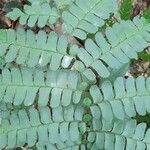
Didymochlaena truncatula
Mahogany fern
Description
Source: leafsnapDidymochlaena truncatula, commonly known as the Mahogany Fern or Shield Fern, is a distinctive fern species belonging to the Polypodiaceae family. This plant, native to the tropical regions of Africa, Asia, and Australia, can grow up to 1 meter in height. The fronds of Didymochlaena truncatula are dark green with a glossy texture, forming a triangular shape with pointed tips. These fronds can reach up to 60 cm in length and emerge from an underground rhizome that produces new growth annually. The Mahogany Fern thrives in moist soil conditions with good drainage, making it an ideal choice for tropical gardens, indoor settings, terrariums, or greenhouses. It grows best in partial shade or filtered sunlight. Traditionally, indigenous people in Africa and Asia have used Didymochlaena truncatula for its anti-inflammatory properties. Additionally, its unique appearance makes it a popular ornamental plant. In summary, Didymochlaena truncatula is a fascinating fern species that enhances any setting with its beauty and interesting foliage, while also offering potential health benefits through traditional medicinal uses.
Care Guide
💧 Water Every 7 days
The mahogany maidenhair fern, native to the damp and shaded floors of forests, flourishes in environments with high humidity and consistent moisture. To keep it healthy, water the plant twice a week, making sure the soil stays evenly moist but not overly saturated. Regular misting can help mimic the plant's natural tropical habitat, adding to its attractiveness as an indoor plant.
What should I do if I give my Mahogany maidenhair plant too much or too little water?
The Mahogany maidenhair can be overwatered if you leave it in excessive water or use a planter without drainage holes. This leads to the roots being unable to absorb nutrients and moisture, and increases the risk of fungal or bacterial diseases. Signs of overwatering include wilted and yellow leaves, drooping stems, and soft or mushy texture. However, it's important to double-check for other causes, as similar symptoms may arise from different issues. On the other hand, underwatering is a common issue with the Mahogany maidenhair. Unless a self-watering planter is used, it's crucial to regularly check the moisture level. In dry conditions, the plant's appearance can quickly change from lush and green to brown and crispy. In severe cases, all fronds may appear dead, but if some roots are healthy, the plant can be saved. Prune off all dry and dead stems, thoroughly water the plant, and place it back in its usual spot. With proper care, the plant can recover and start growing new fronds, although it may take several months to reach its initial size.
How should I water my Mahogany maidenhair correctly?
To take care of your Mahogany maidenhair plant, it's important to keep the soil consistently moist. This means watering it every one or two days, as its native environment requires. You should never let the plant dry out, so when the top layer of soil starts feeling slightly dry, it's time to water again. Ensure that you thoroughly saturate the soil until water drains from the bottom of the pot. After the excess water has drained out, remember to discard it to prevent the pot from sitting in a puddle. Following this watering method will help you maintain the right level of moisture for the soil without letting it become too dry.
What things do I need to think about when watering my Mahogany maidenhair?
The frequency of watering your Mahogany maidenhair plant depends on the humidity levels in the air. If the air is humid, you'll need to water it less often because the water evaporates more slowly. To prevent the plant from drying out quickly, avoid placing it near heating or cooling vents. Instead, choose a draft-free location. These ferns prefer indirect sunlight and temperatures between 55-80 degrees F (13-27 degrees C), so keeping them in a warm and sunny spot like a windowsill can cause them to dehydrate quickly. Rainwater or distilled water is ideal for this plant, but tap water usually works fine in most places. Some minerals and chemicals in tap water can cause brown leaf tips, which is particularly problematic for this delicate plant with thin leaves. Using small pots can also lead to issues because they hold less potting medium and dry out faster. It's best to give this plant more space in the pot compared to other houseplants. Consider using a self-watering planter for your Mahogany maidenhair. These pots have a wicking system that continuously supplies water from a central reservoir, keeping the soil consistently moist. This type of pot not only reduces the need for frequent watering but also benefits the roots by providing a constant water supply instead of fluctuating between dry and wet conditions.
☀️ Light Full shade
The mahogany maidenhair generally prospers in medium sun exposure, having originated from regions where sunlight is naturally diffused through a canopy. If exposed to too much sun, the leaves may burn, whereas lack of adequate light could impede its growth. While it has a varying degree of tolerance for low-light conditions, it prefers a steady and moderate exposure during its various developmental phases.
What kind of sunlight does Mahogany maidenhair require?
To help Mahogany maidenhair thrive, it requires a moderate amount of indirect light. The optimal growing conditions are often provided by filtered light from a tree canopy. It's important to note that this plant should not be exposed to more than three hours of light per day. If it receives too much light (exceeding three hours) or if the light is too direct, it can potentially get burned, dry out, and ultimately die.
Should I keep Mahogany maidenhair away from the sun?
To prevent sun damage, it is important to limit sun exposure for your Mahogany maidenhair. Avoid sudden moves from indirect to direct sunlight, as it can be harmful. Morning and afternoon sun are usually better tolerated than midday sun, which is the hottest and can harm the plant quickly. When growing indoors, avoid placing the plant in direct light from a window. Instead, choose a spot with some indirect light. It is best to find the right amount of sun exposure from the beginning, whether indoors or outdoors. However, if your Mahogany maidenhair is receiving too much light, immediately relocate its container or find a more shaded area to transplant it.
What will happen if Mahogany maidenhair doesn't get enough sunlight?
The Mahogany maidenhair is a plant that can thrive with minimal light, but it still requires a few hours of light for healthy growth. Without this indirect light, the plant may lose its foliage color and experience stunted growth. However, because the Mahogany maidenhair prefers shady conditions, it is less likely to suffer from lack of sunlight compared to too much sunlight.
Does Mahogany maidenhair need sunlight in a certain way as it grows?
Mahogany maidenhair has consistent low light needs throughout its life span, except when it is young. At any growth stage, excessive or sudden direct light can damage it, but young or recently transplanted plants are especially vulnerable.
How many hours of sunlight per day should Mahogany maidenhair get to grow well?
To ensure optimal growth, Mahogany maidenhair plants require no more than three hours of indirect light per day. Any amount of light exceeding this can be detrimental to these shade-loving plants. They flourish in the forest understory, where they have adapted to conduct photosynthesis with limited daily sunlight.
🌡️ Temperature 20–37.8°C
Mahogany maidenhair naturally thrives in conditions with temperatures ranging from 68 to 100 °F (20 to 38 ℃). It tends to prefer somewhat warmer climates. It is not necessary to adjust the temperatures seasonally, as the plant does well within this temperature range.
What temperatures should you keep your Mahogany maidenhair at to keep it healthy?
Here are three tips to help you take care of your plants: 1. Keep your plants away from windows during colder months: Cold air can leak into your home through cracks in the windows, and any plants placed near them will be affected. Move tropical plants to an area with bright but indirect light, while avoiding potential drafts. 2. Watch out for dry patches, which may indicate too much sunlight or heat: If you notice white or scorched leaves, your plant may be getting too much heat or sunlight. This can lead to dehydration and hinder growth. Dry spots can spread and eventually cause your plants to die if left unaddressed. 3. Be cautious of frost: Colder temperatures and frost can damage plants by disrupting their water circulation. This can lead to a lack of moisture in the stems and leaves. Look out for signs of hydrosis (a water-soaked appearance) and if the issue persists, the plant may shrivel and turn dark brown or black, eventually leading to death.
What temperature does Mahogany maidenhair like best?
To help your tropical plants thrive, it's best to maintain a temperature range of 75℉ to 90℉ (25-32℃). While different species can tolerate temperatures outside this range, sticking within a few degrees of these limits will ensure optimal growth. However, there are extreme temperature limits to be aware of. Anything below 50℉ (10℃) or above 95℉ (35℃) can hinder growth and cause issues with the leaves and stems. Low temperatures are particularly damaging, as even a light frost can lead to the death of your tropical plants. In fact, cellular death can occur rapidly, with some species dying within 12 to 24 hours.
Does the mahogany maidenhair plant need different temperatures at different stages of growth?
Mahogany maidenhair doesn't need changes in temperature to grow, but it's important to keep the temperature consistent. Fluctuations in temperature can slow down its growth at any phase, so it's best to maintain a controlled environment. The ideal temperature range for this plant is between 75℉ and 90℉ (25-32℃), with a focus on staying above the lower limit. Going above 90℉ (32℃) is not ideal, but it won't harm the plant too much since it's a tropical species. However, going below 50℉ (10℃), especially 40℉/5℃, will start damaging this plant that loves heat.
Does the mahogany maidenhair plant require different temperatures during different seasons?
Mahogany maidenhair is a plant that doesn't require different temperatures for different growing seasons. The most important aspect of seasonal care is to maintain the environment within the optimal temperature range. To achieve this, it is recommended to keep the plant indoors, as it allows for better temperature control regardless of the outdoor climate. In terms of light, tropical species like mahogany maidenhair prefer a partial side level of sun exposure. This means that any sunlight they receive should be dappled or filtered, and bright but indirect light is the best option for indoor growth. It is important to avoid excessive direct sunlight, as it can harm the plant's leaves and hinder its growth potential.
How can I make sure my Mahogany maidenhair stays at the right temperature?
To maintain the ideal temperature for Mahogany maidenhair, pay attention to both the climate and humidity. Ideally, keep each species in a room with climate control, mimicking its natural habitat. Monitor the humidity levels too, as they directly affect the temperature. You can increase humidity by using a humidifier or misting the leaves. If growing outside, it may be challenging to maintain the right temperature and humidity. In such cases, bringing the plant indoors is the best option. Indoor growing spaces offer better climate control, allowing the plant to thrive.
💨 Humidity high (>60%)
This plant needs special care because it loves high humidity levels of 60-80% or more. The best way to achieve this is by placing a humidifier near the plant. Daily misting is also essential! Make sure the room has good ventilation.
🪴 Soil 5-6
🌱 Fertilizer
To ensure optimal growth for mahogany maidenhair, apply a high-nitrogen fertilizer monthly during the growing season. Use it at half-strength to prevent root burn. In winter, reduce fertilization to avoid overfeeding. Before applying the fertilizer, dilute it and water the soil to promote even nutrient uptake.
Why is it important to add fertilizer to my Mahogany maidenhair plant?
Fertilizing your Mahogany maidenhair is important for a few reasons. Firstly, it provides your plant with the necessary nutrients to promote healthy new growth. Additionally, these extra nutrients also help maintain the vitality of the existing growth, while aiding in protecting your plant from diseases and pests.
What's the best time to put fertilizer on my Mahogany maidenhair?
The feeding schedule for Mahogany maidenhair depends on its location. While it is not a highly demanding plant, it does need some extra nutrients. Outdoor plants only need to be fertilized once in the spring, whereas indoor specimens should be fed on a monthly basis from spring to summer.
When should I not add fertilizer to my Mahogany maidenhair?
To ensure healthy growth, remember not to fertilize Mahogany maidenhair during late autumn or hot and dry periods. Fertilizing during these times can cause excessive growth before winter or stimulate growth that requires more water than available. It is better to apply fertilizer earlier in the season when temperatures are cooler. Additionally, be mindful that Mahogany maidenhair may absorb fertilizer from neighboring plants or lawns, so avoid unintentionally providing double the amount of fertilizer to ferns.
What kind of fertilizer should I use for my Mahogany maidenhair?
When choosing a fertilizer for Mahogany maidenhair, you have a few options to consider. The choice of fertilizer depends on whether the plant is growing indoors or in the garden. If it's outdoors, using a layer of mulch or compost will help the plants thrive. On the other hand, for indoor plants, an ideal fertilizer would have an N-P-K ratio of 3-1-2. However, in some cases, a general-purpose fertilizer with an even blend of nutrients can also be effective. Regardless of the type of fertilizer used, it's important to make sure that the ratio number representing the volume of each nutrient is at 3 or lower.
How do I give my Mahogany maidenhair plant plant food?
There are different ways to fertilize Mahogany maidenhair based on where it is growing. For outdoor garden plants, it's best to add a layer of mulch or compost to the soil, making sure it is around the base of the plant. On the other hand, indoor plants do well with a diluted liquid fertilizer applied before watering, usually on a monthly basis in the spring and summer.
🪴 Pot & Repot 2-3 years
Repot your mahogany maidenhair every 2 to 3 years in the spring. Use a wider, breathable container and a peat-based potting mix. After repotting, be sure to provide proper care by watering regularly and placing it in indirect light, as the plant is sensitive to changes. This will encourage healthy, bushy growth from its long fronds.
✂️ Pruning
The mahogany maidenhair boasts delicate, fern-like fronds. To keep the plant healthy and attractive, prune it in early spring to remove any dead fronds. This not only improves air circulation and light penetration but also encourages bushier growth. Remember to clean your pruning tools to prevent disease, ensuring the plant’s aesthetics and vigor, while enhancing its ornamental value.
🌿 Propagating
🐛 Diseases & pets
☠️ Toxicity
Characteristics
- Plant Type
- Fern
- Life Cycle
- Perennial
- Genus
- Didymochlaena
- Family
- Polypodiaceae
- Hardiness Zone
- 9-11
- Mature Height
- 61 cm to 91 cm
- Mature Spread
- 61 cm to 91 cm
- Leaf Color
- Green, Blue, Red
- Leaf Type
- Evergreen
- Planting Time
- Spring, Summer, Autumn
- Native Area
- Belize, India, Angola, Mexico, Guatemala, Vanuatu, Rwanda, Dominican Republic, Nigeria, Kenya, Uganda, Tanzania, Zimbabwe, Fiji, Uruguay, Cuba, Paraguay, Indonesia, Haiti, Argentina, Cameroon, Burundi, Mozambique, Venezuela, Brazil, Ethiopia, Suriname, Malawi, Honduras, Peru, South Africa, Philippines, Colombia, Bolivia, Vietnam, Myanmar, Guyana, Nicaragua, Ecuador, Costa Rica, Thailand