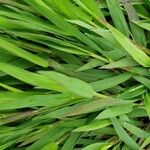
Digitaria sanguinalis
پنجه کلاغی · مَرغ · Common Crabgrass · Hairy crabgrass · Hairy finger grass
Description
Source: leafsnapDigitaria sanguinalis, commonly known as hairy crabgrass, is an annual grass species in the Poaceae family. Although it is native to North America, it has now spread worldwide. The plant can reach a height of up to 60 cm and has a spreading growth habit with stems that are hairy and flattened at the base. The leaves of Digitaria sanguinalis are long and narrow with pointed tips, measuring up to 15 cm in length. They are arranged alternately along the stem and have a rough texture due to small hairs on their surface. From June through September, the plant produces small green flowers that grow in clusters at the end of long stems. These flowers give way to tiny seeds that can be dispersed by wind or animals. Hairy crabgrass is considered an invasive weed due to its ability to quickly colonize disturbed areas such as lawns, gardens, fields, and roadsides. It competes with other plants for nutrients and water, which can lead to the displacement of native species. Despite its invasive nature, Digitaria sanguinalis has some medicinal properties. It has been traditionally used by Native Americans to treat diarrhea and dysentery, but it should only be used under medical supervision, as improper use may cause side effects. Overall, this plant has both positive (medicinal) and negative (invasive) aspects, depending on how it is utilized and managed.
🌳 Although often considered an invasive weed, hairy crabgrass demonstrates noteworthy potential in phytoremediation. Its extensive root network enables the plant to stabilize and enhance the structure of contaminated soils, making it a useful agent in reclaiming areas affected by heavy metals and other pollutants. This ability has drawn interest from researchers investigating cost-effective, environmentally friendly soil remediation techniques.
Care Guide
💧 Water Every 3 days
Hairy crabgrass is well-suited to warm climates and exhibits moderate tolerance to drought. It prefers to be watered twice a week and also benefits from natural rainfall. Its growth cycle is closely linked to water availability, thriving when it receives enough hydration during its active growth periods.
What should I do if I give my Hairy crabgrass too much or too little water?
Proper watering is crucial for the health and performance of this beautiful ornamental grass. When planted in the ground, watering issues can generally be resolved, but in a container, excessive or insufficient water can quickly cause Hairy crabgrass to die. If Hairy crabgrass does not receive the right amount of water, its growth may cease. Overwatering can lead to yellow leaves with brown tips, while underwatering can result in drooping leaves, weak seed head production, and browned leaves. If you suspect that your Hairy crabgrass has been improperly watered, first determine whether it is receiving too much or too little water. If it is being overwatered, immediately stop watering and give the soil time to dry out, which can take several weeks, before assessing if more water is needed. For Hairy crabgrass receiving insufficient water, simply provide a deep watering and observe if it shows signs of improvement. Remember that watering deeply is generally better than frequent shallow waterings, as it encourages the growth of deep roots, enhancing drought resistance and reducing watering-related problems.
How frequently should I give water to my Hairy crabgrass?
The watering requirements of Hairy crabgrass depend on its planting location. As a general rule, this grass should be watered once a week. In hot climates, watering once or twice a week during summer might be necessary. In moderate climates, watering once every seven days or more may suffice. In containers, grass usually needs more frequent watering compared to grass planted in the ground. However, the watering frequency also depends on whether the grass is in full sun or part shade. Shaded grasses require less watering than those in the ground. When watering Hairy crabgrass, it should only be done when the soil is dry. To determine if the soil is dry, you can press your finger a couple of inches into it or weigh the grass in a pot using a portable scale. When the roots lack water, the blades may appear folded and thinner than usual. Despite this grass's drought tolerance, regular and deep watering will result in a beautiful color. Hairy crabgrass naturally grows in open scrubland, enduring extreme heat, bright sun, and sporadic rainfall. However, it still needs care and attention, even with its hardiness. Gardeners agree that this grass thrives best with consistent water. When newly planted, Hairy crabgrass requires more frequent watering until its roots are established. For potted grass, the soil dries out quickly, especially if the pot is exposed to hot, direct sun throughout the day. Testing the soil every 3 to 4 days and watering only when it feels dry is recommended. Crabgrass in the ground generally needs less watering, but it also depends on the soil type. Heavy clay soil holds moisture for longer periods and might feel dry at the surface while still retaining enough moisture below. Sandy soils with quick drainage will require more frequent watering.
What should I be cautious about when watering my Hairy crabgrass in various seasons, climates, or during different growing stages?
To gauge if you are watering your grass enough, observe its growth rate. Hairy crabgrass tends to double in size within a year, especially during the hottest months. If the weather is hot but the grass is not growing vigorously, it may indicate the need to adjust your watering schedule. In winter, you might get by with watering once a month, but it is still important to check the soil for moisture. During the warmest months, the grass will require more water during its growth cycle. However, water demand will significantly decrease in winter and cooler months. A crucial point to remember about Hairy crabgrass is that the soil it's planted in should be allowed to completely dry out before watering.
☀️ Light Full sun
Hairy crabgrass prefers full, unobstructed sun but can also tolerate partial shade. It comes from environments with abundant sunlight. Variation in light affects its growth: excessive sun can bring on drought stress, while insufficient light produces leggy, weak growth.
What are the sunlight requirements for hairy crabgrass?
Hairy crabgrass requires full sun, which is above 6 hours of sunlight daily, to thrive best. It can also adapt to partial sun conditions, about 3-6 hours of sunlight. Understanding how sunlight moves through your garden helps in choosing the optimal spots for planting, providing the right balance of light and shade to ensure the plants' health. Note the warning to watch how sunlight gracefully moves through your garden, allowing for the selection of spots that provide an ideal balance of light and shade for plant happiness.
How does varied light exposure affect hairy crabgrass?
Varied light exposure significantly affects the growth of hairy crabgrass. While the plant thrives best under unobstructed sun exposure, adapting to its origins in sunny habitats, too much sunlight can lead to potential drought stress. Conversely, insufficient light causes leggy, weak growth. For indoor plants lacking natural sunlight, especially during winter or in less sunny spaces, artificial lighting is crucial. It ensures optimal growth by providing necessary light intensity and duration, mimicking natural sunlight conditions effectively.
What are the recommendations for artificial lighting with indoor plants?
For indoor plants, adequate lighting is essential, particularly when natural sunlight isn't enough. LED lights are recommended due to their ability to be customized for the specific light wavelengths plants need. Full sun plants require 30-50W per square foot of artificial light, partial sun plants need 20-30W per square foot, and full shade plants require 10-20W per square foot. Place the light source 12-36 inches above the plant and mimic natural daylight hours, with most plants needing 8-12 hours of light daily to promote faster and healthier growth.
What are common symptoms of light deficiency in hairy crabgrass when grown indoors?
Hairy crabgrass may exhibit several symptoms of light deficiency when grown indoors, including smaller new leaves, leggy or sparse growth, faster leaf drop, slowed or halted growth, paler new leaves, and specific conditions like chlorosis, sunscald, leaf curling, wilting, and leaf scorching. These symptoms reflect the plant’s struggle with inadequate light exposure, either from receiving too much or too little sunlight, affecting its overall health and growth.
What solutions are available for managing light exposure in hairy crabgrass?
To manage light exposure for hairy crabgrass effectively, gradual adjustments are key. For indoor plants, gradually moving them to sunnier locations until they receive at least 6 hours of direct sunlight daily is advisable. Utilize south-facing windows and consider artificial lighting for additional support. Outdoors, avoid sudden light intensity changes to prevent sunburn. Observing the environment and reducing obstructions like branches can provide better sunlight access. For smaller plants, transplanting during their dormant period ensures ample sunlight and good drainage, promoting healthy growth in new environments.
🌡️ Temperature 0–37.8°C
Hairy crabgrass comes from temperate regions, so it favors moderate climates. It generally grows best at temperatures between 20 and 38 ℃ (68 to 100.4 °F). Seasonal measures may be needed to keep conditions within this temperature range.
What is the optimal growth temperature range for Hairy crabgrass?
Hairy crabgrass, also known as Digitaria sanguinalis, thrives in temperate environments, with an optimal growth temperature range between 20 to 38°C (68 to 100.4°F). This preference indicates that the plant does best in moderate climates, and seasonal adjustments may be required to maintain this temperature range for optimal growth.
Does Hairy crabgrass require special frost protection measures during winter?
Hairy crabgrass possesses strong cold resistance, which generally eliminates the need for special frost protection measures during the winter season. However, in extreme cases where winter temperatures are expected to plummet below -40°C, it's crucial to implement cold protection strategies. These can include covering the plant with insulating materials such as soil or straw. Moreover, it's advisable to water the plant abundantly before the first freeze in autumn to keep the soil moist and help prevent drought and water scarcity during the winter and early spring.
How does low temperature affect Hairy crabgrass and what are the solutions?
Low temperatures can impact Hairy crabgrass differently depending on how low the temperature drops. While the plant is cold-tolerant and typically thrives best in conditions above 20°C, maintaining a temperature above 0°C during winter is crucial. If temperatures fall below -40°C, the plant may not exhibit noticeable changes during the winter, but there could be a decrease in sprouting or even a complete lack of sprouting come springtime. The recommended solution in spring is to remove any parts of the plant that have failed to sprout.
How does high temperature affect Hairy crabgrass and what are the solutions?
During the summer, it's crucial to ensure that the temperature surrounding Hairy crabgrass does not exceed 38°C. If the temperature rises above 43°C, the plant's leaves may turn lighter in color, become prone to curling, suffer from sunburn, and in severe cases, the plant may wilt and dry out completely. To mitigate these effects, trim away the sunburned and dried-up parts of the plant. Moving the plant to a shaded area during the midday and afternoon sun or using a shade cloth can offer protection. Additionally, watering the plant in the morning and evening helps keep the soil moist, which is beneficial for the plant's wellbeing.
💨 Humidity dry (<40%)
This plant prefers dry conditions, so don't mist it. However, watering it less often can also thrive in higher humidity.
🪴 Soil 6-7
🌱 Fertilizer
🪴 Pot & Repot
✂️ Pruning
🌿 Propagating
🐛 Diseases & pets
☠️ Toxicity
Characteristics
- Plant Type
- Grass
- Life Cycle
- Annual, Biennial
- Genus
- Digitaria
- Family
- Poaceae
- Hardiness Zone
- 2-11
- Mature Height
- 10 cm to 76 cm
- Mature Spread
- 30 cm
- Leaf Color
- Green, Blue
- Leaf Type
- Deciduous
- Flower Color
- Green, Yellow, Red, Brown
- Flower Size
- 2.54 cm
- Bloom Time
- Early summer, Mid summer
- Planting Time
- Spring
- Harvest Time
- Mid summer, Late summer
- Native Area
- Sweden, Austria, Romania, Bulgaria, Poland, Greece, Russia, Germany, Portugal, Italy, Spain, Switzerland, France, Albania, Hungary, Belgium, Netherlands