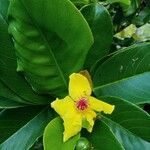
Dillenia alata
Golden guinea tree · Red beech
Description
Source: wikipedia (CC BY-SA)Dillenia alata, commonly known as red beech, golden guinea flower or golden guinea tree, is a tree in the Dilleniaceae family, found in New Guinea, and the Northern Territory and Queensland in Australia. It has found some popularity as an ornamental for tropical parks and large gardens due to its colourful flowers and fruit.
Care Guide
💧 Water
The golden guinea tree is well-suited to dry conditions and can endure droughts. It thrives with moderate moisture and benefits from being watered every two weeks. Maintaining consistent soil moisture is particularly important for its active growth, especially in warmer climates.
☀️ Light Full sun
The Golden guinea tree is native to open habitats, like sunny meadows and forest edges, which offer abundant light. It thrives in Full Sun but will also tolerate Partial Sun, adapting well to different sunlight conditions.
🌡️ Temperature 20–37.8°C
The golden guinea tree comes from tropical areas, where the climate is generally warm and humid. Consequently, it is well adapted to high temperatures and humidity. It is sensitive to sudden temperature changes and prefers a stable thermal environment, so it is important to prevent temperature fluctuations indoors. It typically cannot tolerate cold and needs higher temperatures to grow. If the ambient temperature falls too low, the plant may stop growing or even die.
💨 Humidity
🪴 Soil 5-7
🌱 Fertilizer
The best time to fertilize a Golden guinea tree is in early spring when it comes out of dormancy. This supports overall growth and the development of flowers. Fertilization improves the foliage, stems, and branches, and encourages large, vibrant, long-lasting blooms. It helps transfer nutrients from the roots to the flowers and increases the plant’s health and resistance to disease.
🪴 Pot & Repot
✂️ Pruning
The golden guinea tree is known for its vibrant yellow flowers and broad, glossy leaves. To maintain its health and appearance, prune the tree from early to late winter by removing any dead branches to improve air circulation. Light trimming helps maintain a compact shape, enhances flowering, and prevents structural problems.
🌿 Propagating
🐛 Diseases & pets
☠️ Toxicity
Characteristics
- Plant Type
- Tree
- Life Cycle
- Perennial
- Genus
- Dillenia
- Family
- Dilleniaceae
- Hardiness Zone
- 10-12
- Mature Height
- 11.89 m
- Mature Spread
- 6.1 m
- Leaf Color
- Dark Green
- Leaf Type
- Evergreen
- Flower Color
- Yellow
- Flower Size
- 6.35 cm to 8.89 cm
- Bloom Time
- Late spring, Summer
- Planting Time
- Spring
- Harvest Time
- Late summer, Fall