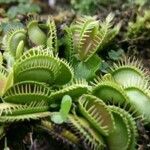
Dionaea muscipula
Venus fly trap · Venus flytrap · Venus's flytrap · Venus-fly-trap · Dionea "Pink Venus"
Description
Source: leafsnapDionaea muscipula, commonly known as the Venus flytrap, is a carnivorous plant native to the wetlands of North and South Carolina in the United States. This small plant, which can reach up to 5 inches in diameter, features leaves modified into traps with sensitive trigger hairs. When an insect or other small prey touches these hairs, the trap snaps shut within half a second, ensnaring and ultimately digesting its prey. The Venus flytrap thrives in moist soil with good drainage and requires plenty of sunlight. Due to its unique appearance and fascinating carnivorous behavior, it is commonly grown as both an indoor and outdoor ornamental plant. However, due to habitat loss from development and poaching for commercial purposes, Dionaea muscipula has been listed as vulnerable by the International Union for Conservation of Nature (IUCN). It is crucial for us to not only appreciate this unique species but also to actively contribute to its conservation.
💡 The Venus flytrap is a fascinating insect-eating plant. It has a very short stem and leaves with a trap at the top that resembles a shellfish. This trap secretes a sweet substance similar to honey. When an insect lands on it, the trap snaps shut at an impressive speed, capturing the insect. The plant then digests and absorbs the nutrients from its prey.
🌳 The venus flytrap's distinctive predatory strategy offers potential for biological pest control. Because it can capture and digest insects, it has been suggested that the venus flytrap might be used as a natural way to lower pest populations in agricultural environments, though its practical use has not yet been widely implemented. Studies on how these plants could be incorporated into pest management approaches are ongoing, highlighting an interesting overlap of ecology, agriculture, and biotechnology.
🎭 Inborn wisdom and deceptive hell
Care Guide
💧 Water Every 3 days
The Venus flytrap thrives in moist, humid environments and needs consistent moisture without becoming waterlogged. To sustain its insect-capturing capabilities, it should be watered twice a week, particularly during its active growing season. These conditions make it well-suited for indoor cultivation, where its natural habitat can be effectively mimicked.
How should you water your Venus flytrap in the best way?
1. Choose a pot with good drainage holes, and place it in a plastic dish or tray. 2. Fill the dish with about a third to half an inch of water, which will be drawn up by the plant's roots as the soil dries out. 3. Avoid letting the dish dry out completely, and adjust the amount of water based on how quickly the plant absorbs it. 4. If you're using terra cotta pots, which tend to let water seep through, place the pot inside a larger one and pour water only into the outer pot. This will filter out dissolved solids. 5. The mineral content of the water is crucial. If possible, collect rainwater for your Venus flytrap, as it's the safest option. Alternatively, distilled water or water from a reverse osmosis system work well. 6. Purified water can also be used, but make sure it falls within the range of minerals that the Venus flytrap can tolerate. 7. If you're using tap water, ensure that it contains less than 50 parts per million of dissolved solids. You can purchase a meter to measure this inexpensively. 8. To eliminate chlorine, fill your watering device 24 hours before using it. This will allow the chlorine to dissipate from the water.
What should I do if I give too much or too little water to a Venus flytrap?
When a Venus flytrap is overwatered, you may notice brown spots on the undersides of the leaves, white mold in the soil, and a wilted appearance. This happens because the plant is unable to take in water through its stem. Overwatering can also lead to root rot. If you notice rotten roots and a bad smell, it's recommended to remove the plant from the soil, rinse it with distilled water, trim away the rotten roots and affected leaves, rinse it again with distilled water, and replant it in fresh soil. In contrast, when a Venus flytrap is underwatered, the leaves may become brittle. To address this, cut away any affected leaves, ensure the soil is damp, and mist the leaves. Although the plant will gradually recover by resuming watering as soon as possible, its roots may be damaged and cause the short-term drying of yellow leaves.
How frequently should I give water to my Venus flytrap?
The tray method is the most common way to water insectivorous plants. To do this, pot the Venus flytrap in a container with multiple drainage holes and place it in a tray filled about one-third with water. This allows the plant to draw water naturally as the soil dries. Make sure to add water promptly when the water level drops, and avoid letting the tray dry out completely. By doing this, you can get a better idea of how often the plants should be watered. Venus flytraps are native to humid environments, so finding the right balance in watering is important. During active seasons such as spring and autumn, make sure not to let the soil dry out completely. In these seasons, water the Venus flytrap 2-3 times per week. In summer, when more frequent watering is needed, make sure to keep the soil moist. However, during winter and early spring, the Venus flytrap goes dormant. It's important to adjust the watering routine during this time to avoid harming the plant. Allow some of the soil to dry out and let the water level in the tray decrease for a few days before adding more water. If you live in a naturally dry environment, misting the Venus flytrap in addition to regular watering may be necessary to replicate its natural humid conditions. It is best to do this in the morning. Proper water spraying is especially important in areas with dry environments.
How much water does my Venus flytrap require?
The Venus flytrap, a carnivorous plant prized as a houseplant, thrives in a humid environment. To successfully care for one, you must recreate its native growing conditions, which involve maintaining high humidity levels. If you live in a place with naturally high humidity, you can grow them outdoors in a bog garden, providing a unique habitat for humidity-loving plants. However, most people prefer to grow Venus flytraps as houseplants. To ensure proper care, use a pot that retains moisture, such as plastic or a self-watering pot. The tray method is the most effective way to water these insectivorous plants. Keep the water level in the tray pots above the small hole at the bottom, replenishing it before it dries out. The amount of water added should prevent the pots from drying out completely and support the healthy growth of your Venus flytrap.
Do I need to water a Venus Flytrap in a special way if I plant it indoors instead of outdoors?
When growing Venus flytraps indoors, the amount of water needed is generally less because they receive less sunlight. However, the more light they receive, the more water they will need to grow. To keep them healthy, it is important to provide adequate light and water. Additionally, maintaining a humid environment is essential for indoor plants. One option to achieve this is to grow Venus flytraps in a terrarium or as part of a plant display in an aquarium, as the encased sides will help keep the humid air from escaping. It is important to ensure good circulation is maintained in this setup.
☀️ Light Full sun
The venus flytrap needs predominant exposure to sunlight for optimal growth, though it can tolerate moderate sun. Native to habitats with clear skies and significant sun exposure, it maintains this preference through every stage of growth. Too much or too little light can harm its health, causing stunted growth or pale coloration.
What are the sunlight requirements for a Venus flytrap?
The Venus flytrap thrives in environments with substantial sun exposure, necessitating dominant exposure to the sun's rays for optimal growth. It can, however, accommodate moderate sunshine. This plant has an affinity for clear skies and significant sun exposure, a trait it retains across all growth stages. The Venus flytrap requires more than 6 hours of sunlight for 'Full sun' conditions and about 3-6 hours for 'Partial sun' situations. Ensure you monitor the movement of sunlight through your garden to find spots offering the right light and shade balance, ensuring your plants' well-being.
How does insufficient or excessive light affect Venus flytrap?
The health of a Venus flytrap can be adversely impacted by both excessive and insufficient light. Inadequate sunlight can lead to symptoms like leggy or sparse growth, slower or halted new growth, lighter-colored new leaves, chlorosis, sunscald, leaf curling, wilting, and leaf scorching. These conditions denote various stress responses to poor lighting, including stretched growth to capture more light, chlorophyll breakdown, defense mechanisms against excessive sunlight, and reduced photosynthetic capacity. Conversely, excessive sunlight can damage the plant, causing symptoms like chlorosis, sunscald, wilting, and leaf scorching.
What solutions are available for Venus flytraps experiencing light-related issues?
For Venus flytraps facing light-related growth issues, several solutions are recommended. Indoors, gradually move plants to sunnier locations each week until they receive at least 6 hours of direct sunlight daily, utilizing a south-facing window and keeping curtains open for maximum exposure. If the plant is large or not easily movable, consider using artificial light, keeping a lamp on for at least 8 hours daily or investing in professional grow lights. Outdoors, adapt plants to sunlight gradually to prevent sunburn, and prune or transplant to reduce obstructions and ensure ample sunlight and good drainage. Note that parts of the plant affected by insufficient sunlight may not recover, but new growth will be healthy post-adjustment.
How can artificial lighting support Venus flytrap growth?
Artificial lighting can play a crucial role in supporting Venus flytrap growth, especially when natural sunlight is insufficient. Indoor plants can benefit greatly from adequate artificial lighting, particularly in winter or less sunny locations. LED lights are favored for their ability to provide specific wavelengths needed by plants. For full sun plants, 30-50W/sq ft of light is needed; partial sun plants require 20-30W/sq ft, and full shade plants need 10-20W/sq ft. The light source should be placed 12-36 inches above the plant, mimicking natural sunlight's distance, and ensuring plants receive 8-12 hours of light per day to simulate natural daylight hours.
🌡️ Temperature 10–35°C
The Venus flytrap originates from subtropical wetlands that feature mild temperatures. Ideal conditions are 68 to 95°F (20 to 35℃). Seasonal adjustments may be needed, especially in cooler climates.
What are the essential care tips for Venus flytrap?
Venus flytrap, also known scientifically as Dionaea muscipula, thrives in subtropical wetlands and prefers mild temperatures, ideally between 68 to 95\u00b0F (20 to 35\u00b0C). For optimal growth, maintaining temperatures above 20\u00b0C during the winter is beneficial, while ensuring the minimum temperature remains above freezing to prevent damage. In cooler climates or when the outdoor temperature approaches -5\u00b0C (25\u00b0F) in winter, it's advisable to bring the Venus flytrap indoors or provide protection using a temporary greenhouse or wrapping materials like plastic film or fabric.
How should I care for my Venus flytrap during low temperatures?
Venus flytrap has a moderate tolerance to low temperatures and thrives best when the temperature is maintained between 20\u00b0C and 35\u00b0C. During winter, ensure the temperature stays above 0\u00b0C to prevent freezing damage. If the temperature falls below -25\u00b0C, the leaves may darken, and the plant can suffer from water-soaked necrosis, wilting, and drooping, with a gradual turn to brown. To protect your plant, trim away the frost-damaged parts and immediately move it to a warm environment indoors or set up a makeshift greenhouse. Ensure it receives ample sunlight by placing it near a south-facing window or provide supplemental lighting if necessary.
What should I do if my Venus flytrap experiences high temperatures?
Venus flytrap should be kept below 35\u00b0C during summer to avoid stress from high temperatures. If the temperature exceeds 41\u00b0C, the plant's growth may slow, leaves may lighten in color, and it becomes more susceptible to sunburn. To mitigate damage, trim away sunburned and dried-up parts, move the plant to a shaded location away from the harsh afternoon sun, and water it in the morning and evening to maintain soil moisture.
💨 Humidity high (>60%)
This plant needs special care because it loves high humidity levels of 60-80% or more. The best way to achieve this is by placing a humidifier near the plant. Daily misting is also essential! Make sure the room has good ventilation.
🪴 Soil 4-5
🌱 Fertilizer
🪴 Pot & Repot 2-3 years
When repotting a Venus flytrap, choose a pot 1–2 inches (2.5–5.1 cm) larger with ample drainage. Use a well-draining potting mix. Repot in spring or fall, ensuring that the root ball is slightly lower than the rim of the flower pot. Water thoroughly after repotting and place in a warm spot with indirect sunlight.
✂️ Pruning
The Venus flytrap requires only minimal pruning. Focus on removing dead leaves and flower stalks from early to late spring. This practice promotes growth, prevents fungal infections, and improves air circulation. To avoid damaging the traps and to maintain optimal health, handle the plant carefully and use sterilized tools.
🌿 Propagating
🐛 Diseases & pets
☠️ Toxicity
The Venus flytrap is non-toxic to humans and pets. If you manage to stick your finger or any part inside, the trap is not strong enough to harm you. However, it’s best to refrain from triggering the trap with anything other than insects. Venus flytrap only has a limited number of times it can open and close, so sticking anything in the trap wastes its energy.
Characteristics
- Plant Type
- Herb
- Life Cycle
- Perennial, Annual
- Genus
- Dionaea
- Family
- Droseraceae
- Hardiness Zone
- 6-10
- Mature Height
- 10 cm to 15 cm
- Mature Spread
- 15 cm to 20 cm
- Leaf Color
- Green, Red, Yellow, Gold
- Leaf Type
- Evergreen
- Flower Color
- White
- Flower Size
- 3.05 cm
- Bloom Time
- Early summer, Mid summer
- Planting Time
- Spring, Summer, Autumn
- Harvest Time
- Mid summer
- Native Area
- The Carolinas