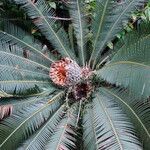
Dioon edule
Edible-seed cycas · Chestnut dioon · Mexican Cycad · Virgin's palm · Cycad
Description
Source: leafsnapDioon edule is a species of cycad belonging to the family Zamiaceae. Native to Mexico, it is found in the states of Tamaulipas, San Luis Potosí, Hidalgo, Querétaro, and Veracruz. The plant grows slowly and can reach up to 3 meters in height, with a trunk diameter of up to 30 centimeters. The leaves of Dioon edule are pinnate, featuring stiff, leathery leaflets that are dark green in color. Male plants produce cylindrical cones, whereas female plants bear more rounded cones. This plant is often used as an ornamental due to its attractive appearance and low maintenance requirements. It prefers well-drained soil and partial shade but can also tolerate full sun exposure. Indigenous people have used Dioon edule for various purposes, including food, medicine, and construction material for houses or fences. The seeds, high in nutritional value and containing starches similar to those found in potatoes or yams, have been particularly valued. However, it's important to note that all parts of Dioon edule contain toxins, making it poisonous if ingested raw. Proper preparation methods must be followed before consumption if it is intended for food use.
Care Guide
💧 Water Every 7 days
Virgin's palm, a plant native to the arid regions of Mexico, is highly drought-tolerant and requires very little water to thrive. It typically needs watering only every two weeks. As an evergreen often cultivated outdoors, it benefits from natural rainfall and can withstand dry spells thanks to its resilient root system.
What should I do if I give too much or too little water to my Virgin's palm?
Outdoor plants, especially newly planted ones or seedlings, can suffer from lack of watering. When these plants are small or newly planted, it's important to water them regularly for a few months. Once the roots are established, Virgin's palm can rely on rainwater most of the time. However, if you have a Virgin's palm in a pot, overwatering becomes more likely. If you accidentally overwater your plant, act quickly to minimize the damage. First, stop watering it immediately. Then, remove the plant from its pot and check the roots. If there is no root rot, you can return the plant to its pot. But if there are signs of root rot, trim the affected roots and consider using a fungicide. Lastly, repot the Virgin's palm in well-draining soil. On the other hand, if you underwater your Virgin's palm, the leaves will droop, dry out, and fall off. Simply increase the frequency of watering to solve this issue. Remember to adjust your watering schedule promptly whenever you notice underwatering.
How often do I need to water my Virgin's palm?
Most outdoor plants can grow normally with rainfall. If your area lacks rainfall, water your plants adequately every 2 weeks in spring and fall, and more frequently in summer. In winter, when growth is slower and plants require less water, water sparingly or not at all. Young or newly planted Virgin's palms need more frequent watering to help them establish and become drought-tolerant. For potted plants like Virgin's palms, there are two main ways to determine watering frequency. One is to follow a set watering schedule, such as once every week or every other week. However, this may not always be suitable for your specific growing conditions. The other approach is to monitor soil moisture and water when the top 2-4 inches of soil have completely dried out. This is especially important during summer when water needs are highest.
How much water does my Virgin's palm tree need?
When watering your Virgin's palm, it's important to remember that it doesn't always require a large amount of water. Instead, if only a few inches of soil have dried since the last watering, giving it about five to ten ounces of water should promote healthy growth. You can also gauge the water volume based on the moisture in the soil. To ensure your Virgin's palm receives enough moisture, water it enough to moisten all the dry soil layers since the last watering. If over half of the soil has dried out, it's advisable to give more water than usual. In such cases, continue watering until you see excess water draining from the pot's drainage holes. If your Virgin's palm is planted in an area that receives plenty of outdoor rain, it may not require additional watering. However, when the palm tree is young or still establishing itself, ensure it receives 1-2 inches of rain per week. As it grows and becomes established, it can rely solely on rainwater. Only in hot weather or in the absence of rainfall for 2-3 weeks should you consider giving the palm tree a full watering to prevent it from experiencing stress.
How can I know if I am giving enough water to my Virgin's palm plant?
Overwatering is a common issue for the Virgin's palm, and there are clear signs to watch for. If overwatered, the palm's leaves may turn yellow and fall off. The plant may also shrink in size and suffer from root rot. On the other hand, an underwatered palm will start to wilt and have brown, brittle leaves. Whether you see signs of over or under watering, it's important to take action and revive the palm's health.
How do I water my Virgin's palm depending on its different growth stages?
When the Virgin's palm is young, particularly in its seedling stage, it requires more water compared to when it is fully grown. It is crucial to keep the soil consistently moist during the early stages in order to promote root development. The same applies if you have transplanted a Virgin's palm to a new location. Additionally, the Virgin's palm can produce attractive flowers and fruits when given proper care. If your Virgin's palm is currently flowering or bearing fruit, you may need to provide slightly more water than usual to support these plant structures.
☀️ Light Full sun
Virgin's palm does best with a large amount of sunlight, though it can also adjust to moderately lower light levels. It naturally comes from environments bathed in sun, which encourages vigorous growth. When sunlight is reduced, its growth can be slowed. Excessive sun can cause minor damage, but the plant usually tolerates it well.
What are the sunlight requirements for Virgin's palm?
Virgin's palm requires a substantial amount of sun exposure to thrive, ideally in conditions that mimic its original, sun-soaked habitat. It needs more than 6 hours of sunlight for full sun requirements and can tolerate about 3-6 hours of sunlight for partial sun conditions. However, it can also adapt to slightly less sunny conditions. Insufficient sunlight can inhibit growth, while an excess may cause slight damage, though the plant usually tolerates this well.
How can artificial lighting be used for Virgin's palm indoors?
Indoor Virgin's palms require adequate lighting for optimal growth, particularly when natural sunlight is insufficient. Artificial lights, especially LED lights, can be a vital solution. These should provide 30-50W/sq ft for full sun plants, 20-30W/sq ft for partial sun plants, and 10-20W/sq ft for full shade plants. Place the light source 12-36 inches above the plant and ensure it receives 8-12 hours of light per day to mimic natural sunlight conditions.
What are the symptoms of insufficient lighting for Virgin's palm?
Virgin's palm exhibits several symptoms when it doesn't receive enough light. These include smaller new leaves, leggy or sparse growth, faster leaf drop, slower or no new growth, lighter-colored new leaves, and signs of stress such as chlorosis, sunscald, leaf curling, wilting, and leaf scorching. These symptoms indicate the plant is struggling to photosynthesize and manage its resources effectively under low light conditions.
How can light conditions be improved for Virgin's palm?
To improve light conditions for Virgin's palm, gradually move plants to a location where they receive at least 6 hours of direct sunlight daily, such as near a south-facing window. For plants that are large or not easily movable, consider using artificial lighting, keeping a lamp on for at least 8 hours daily or investing in professional plant grow lights. Outdoors, move plants gradually to sunnier spots and consider pruning to reduce obstructions. Transplanting smaller plants during their dormant period to sunnier locations can also help.
🌡️ Temperature 20–37.8°C
Virgin's palm originates from habitats where temperatures range from 68 to 100°F (20 to 38℃). It is adaptable and does well in these moderately warm conditions. Take care when making seasonal adjustments to avoid exceeding those temperature limits.
What is the native environment for the Virgin's palm?
The Virgin's palm is native to environments where the temperature ranges from 68 to 100°F (20 to 38°C). It thrives in moderately warm climates and is adaptable, provided that it is not exposed to temperatures outside these limits. This species is extremely heat-loving, making it crucial to avoid exposing it to cold temperatures. During the autumn, it's advisable to bring outdoor-grown Virgin's palms indoors and place them near a bright window, while ensuring they are not too close to heaters. To encourage growth throughout winter, it's beneficial to maintain temperatures above 20°C, as any temperatures nearing 0°C can be detrimental to the plant.
How does low temperature affect Virgin's palm and what are the recommended solutions?
Virgin's palm prefers warm temperatures and does not cope well with cold. It thrives when the temperature is maintained above 20°C and should be kept above freezing during winter. Exposure to temperatures below -5°C may cause the leaves to lighten in color, and following frost damage, leaves can turn brown or black, showing signs of wilting and drooping. The recommended response to such symptoms includes trimming off frost-damaged parts and moving the plant indoors to a warm environment for protection against the cold. Positioning the palm near a south-facing window ensures adequate sunlight, and it's important to avoid placing it near heaters or air conditioning vents to prevent excessive dryness.
What should be done if Virgin's palm experiences high temperatures?
During the summer, it's crucial to keep Virgin's palm's temperature below 38°C, as temperatures exceeding 43°C can lead to lighter leaf colors and increase susceptibility to sunburn. To mitigate damage, trim away the sunburned and dried-up parts. Relocate the plant to a shaded area, especially from the midday and afternoon sun, to protect it. Ensuring the soil remains moist by watering in the morning and evening can also help the plant cope with high temperatures.
💨 Humidity high (>60%)
This plant needs special care because it loves high humidity levels of 60-80% or more. The best way to achieve this is by placing a humidifier near the plant. Daily misting is also essential! Make sure the room has good ventilation.
🪴 Soil 6-7
🌱 Fertilizer
Virgin's palm has specific nutrient needs and does not require heavy fertilization. Spring is the best time to apply fertilizer for optimal growth. Supplying nutrients enhances its health, raises its resistance to pests and diseases, and helps sustain its long lifespan.
Why is it important to add fertilizer to my Virgin's palm plant?
To promote healthy growth of the Virgin's palm in the spring, remember that this plant has a long lifespan and requires support. Enhancing the soil with nutrients not only improves the plant's health but also helps it withstand pests and diseases that can hinder its growth or reduce its lifespan.
When should I fertilize my Virgin's palm tree for best results?
The growing medium may not always have enough nutrients for healthy growth. However, Virgin's palm is not like typical garden plants. It does not need a large amount of additional nutrients. The ideal time to fertilize Virgin's palm is in the spring, before new growth begins.
When is it not a good idea to fertilize my Virgin's palm tree?
Virgin's palm does not require a lot of extra nutrients and too much fertilizer can harm it. Instead, only apply fertilizer in the spring, while avoiding the other seasons. During the summer, fall, and winter, do not add fertilizer or organic matter to the soil.
What kind of fertilizer does my Virgin's palm tree require?
The age of your plant is important for choosing the right fertilizer. Keep in mind that Virgin's palm doesn't need a lot of extra nutrients. Look for a balanced plant food that promotes healthy root development and growth. Avoid fertilizers with high nitrogen levels.
How can I fertilize my Virgin's palm tree?
To successfully fertilize Virgin's palm, pay attention to both the timing and application method. Add fertilizer once during the spring, specifically around the plant's base. It is important to avoid getting any fertilizer on the trunk. If using granulated fertilizer, be sure to cover the pellets with a light layer of soil to ensure proper absorption into the soil.
🪴 Pot & Repot 2-3 years
The Virgin's palm is a slow-growing cycad that can reach up to 6 feet (1.8 meters) in height. You should repot it every 2-3 years in the spring, using a deep, well-draining pot. Once repotted, the Virgin's palm requires minimal care. It thrives in bright, indirect sunlight and needs occasional watering once it is established.
✂️ Pruning
The Virgin's palm is characterized by its stiff, blue-green leaves and slow growth. It is advised to prune minimally; only remove damaged leaves from early to late winter. Pruning too much can stress the plant. Proper maintenance improves its shape, encourages healthier growth, and lowers the risk of pests.
🌿 Propagating
🐛 Diseases & pets
☠️ Toxicity
Characteristics
- Plant Type
- Tree
- Life Cycle
- Perennial
- Genus
- Dioon
- Family
- Zamiaceae
- Hardiness Zone
- 9-11
- Mature Height
- 1.83 m to 2.44 m
- Mature Spread
- 1.52 m
- Leaf Color
- Green, Blue, Gray
- Leaf Type
- Evergreen
- Flower Size
- 2.03 cm to 4.06 cm
- Bloom Time
- Late spring, Early summer
- Planting Time
- Spring, Summer, Autumn
- Harvest Time
- Late summer, Early fall, Mid fall
- Native Area
- Mexico