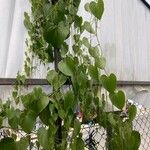
Dioscorea mexicana
Mexican yam
Description
Source: leafsnapDioscorea mexicana, Mexican yam or cabeza de negro is a species of yam in the genus Dioscorea.Dioscorea mexicana is a caudiciform dioscorea having either a partly to completely above-ground dome-shaped caudex with a thick, woody outer layer up to 3 feet (90 cm) in diameter and 8–10 inches (20 to 25 cm) in height. The caudex of D. mexicana is divided into regular polygonal plates that become protuberant with age, and separated by deep fissures. The vigorous annual vines which may reach 30 feet (9 m) long before dying back in winter, that grow up from the caudex, bear heart-shaped leaves.Dioscorea mexicana ranges from the state of San Luis Potosí in northeastern Mexico south to Panama. It is notable for its production of diosgenin, which is a precursor for the synthesis of hormones such as progesterone. Russell Marker developed the extraction and manufacture of hormones from D. mexicana at Syntex. Later the Mexican barbasco trade focused instead on Dioscorea composita instead, as this variety has a higher diosgenin content.
Care Guide
💧 Water Every 7 days
The first and the most important thing about watering the plant is that its soil should not be soaked. These plants have low to medium watering requirements, and there's no set schedule for watering the plant. Like most succulents, it does not do well with overwatering. The excess water can damage the entire root system of the plant. Watering the plant depends on many factors, including the climate and other growing conditions. Figure out a schedule by watering the plant only when its soil seems to be completely dry.
☀️ Light Partial sun
Mexican yam is native to habitats with filtered light, such as the understory of forests or rocky locations that provide natural shade. It prefers partial sunlight but can also tolerate full sun.
🌡️ Temperature 20–37.8°C
Mexican yam does best in warm conditions and needs relatively high temperatures during the growing season to encourage growth and metabolic processes. It prefers plenty of sunlight, proper moisture, and good air circulation. It can be harmed by very low temperatures and by too much watering. A balance is necessary, so extremely high heat and excessively dry conditions should also be avoided.
💨 Humidity normal (40-60%)
This plant will thrive in moderate humidity, which is probably the level in your home. However, misting it a few times a week can be very beneficial. Make sure the room has good ventilation.
🪴 Soil 6-7
🌱 Fertilizer
Mexican yam plants only need light fertilizer applications once or twice a year during the growing season. Do not fertilize in winter or summer when the plant is dormant. Cut back on feeding for repotted specimens and wait a couple of months after repotting before applying fertilizer. Regular fertilization supports healthy growth and encourages flowering.
🪴 Pot & Repot
✂️ Pruning
The plant generally does not require much pruning, but the plant can always be pruned for health, presentable look, and for size/spread maintenance.
🌿 Propagating
🐛 Diseases & pets
☠️ Toxicity
The plant is considered toxic to humans and pets.
Characteristics
- Plant Type
- Vine, Succulent
- Life Cycle
- Perennial
- Genus
- Dioscorea
- Family
- Dioscoreaceae
- Hardiness Zone
- 9-11
- Mature Height
- 3.05 m to 4.88 m
- Mature Spread
- 0.91 m to 2.13 m
- Leaf Color
- Green, Dark Green
- Leaf Type
- Deciduous
- Flower Size
- 0.25 cm to 0.51 cm
- Bloom Time
- Early summer, Mid summer
- Planting Time
- Spring, Summer, Autumn
- Harvest Time
- Late summer, Early fall, Mid fall
- Native Area
- Colombia, Belize, Honduras, Mexico, Guatemala, El Salvador, Nicaragua, Costa Rica, Panama