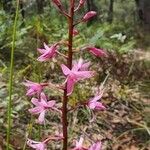
Dipodium roseum
Rosy hyacinth-orchid
Description
Source: leafsnapDipodium roseum, commonly known as rosy hyacinth-orchid or pink hyacinth-orchid, is a leafless saprophytic orchid found in east and south-eastern Australia. In summer it produces a tall flowering stem with up to fifty pale pink flowers with small, dark red spots. A widespread and common species it is often confused with D. punctatum but has darker, less heavily spotted flowers.
Care Guide
💧 Water
The rosy hyacinth-orchid thrives in consistently moist environments, needing soil that stays evenly damp and weekly watering to maintain the right level of moisture. Being an epiphytic plant, it benefits greatly from rainwater, which encourages healthier growth and flowering. This watering method mimics the rainfall patterns of its natural habitat.
What do I do if I give too much or too little water to my Rosy hyacinth-orchid?
To keep your Rosy hyacinth-orchid healthy, it's important to balance its watering needs. While it needs regular watering during growth, it also requires well-draining soil. Overwatering can cause root rot, which can be treated by removing affected roots using sterile pruning shears. Afterward, repot the plant in a container with proper drainage and fast-draining potting mix. Avoid excessive repotting as it may not be well-received by the plant. On the other hand, underwatering can cause the plant to shrivel and feel dry. If this happens, increase your watering frequency to ensure the soil remains adequately moist.
How frequently should I water my Rosy hyacinth-orchid?
To properly care for your Rosy hyacinth-orchid during its active growth stage in spring and summer, water it once or twice a week. If it's hot and dry, increase the watering to three times a week or more. In winter, water the plant, but not as frequently. Two to three times a month should suffice during the coldest months. However, if you keep the plant indoors during winter, be aware that indoor conditions may dry out the soil faster, so you might need to increase the number of monthly waterings. Use the fall season as an opportunity to gradually reduce watering from multiple times per week to the reduced winter schedule.
What do I need to think about when watering my Rosy hyacinth-orchid during different seasons and periods of growth?
When planning the watering schedule for your Rosy hyacinth-orchid, it's important to consider two growth phases. The first phase is the active growth period in spring and summer. During this time, you should water the plant multiple times per week. The second phase is the rest period in winter, which lasts about two to three months. During this period, the plant requires less water and fertilization. Watering once or twice per month is sufficient. In the fall, gradually reduce the watering frequency from multiple times per week to once or twice per month to prepare for the winter rest period.
How should I water my Rosy hyacinth-orchid if I grow it indoors?
The Rosy hyacinth-orchid needs a relatively humid growing environment, which may be lacking in most indoor locations. As a result, the plant and its soil may dry out faster compared to outdoor growth. To address this, adding a humidifier in the room can help maintain the desired air moisture level. It may also be necessary to water the plant more frequently. However, it is important to note that while the Rosy hyacinth-orchid appreciates humidity, it also requires proper air circulation to avoid excess moisture and potential diseases. To ensure good air flow, consider having a fan in the room where you grow the plant.
How should I water my Rosy hyacinth-orchid?
-The watering method for your Rosy hyacinth-orchid depends on its growth phase. -During active growth, water the soil and occasionally water the plant from above if it's warm. -In winter or cool, wet weather, stick to watering the soil directly. -Look for signs of needing water or too much water, such as dry roots and leaves or mushiness. -Plant the Rosy hyacinth-orchid in a well-draining potting mix. -During the growing season, water multiple times per week with quick drainage. -Adjust the amount of water based on pot size, larger pots need less frequent watering. -Use rainwater or distilled water that matches the air temperature as closely as possible.
☀️ Light Partial sun
Rosy hyacinth-orchid is native to the understory of tropical forests or to rocky areas, where natural shade is available. It prefers partial sun but can tolerate full sun, adapting well to varying light conditions.
How much sunlight does Rosy hyacinth-orchid need to grow?
Epiphytic Orchids that thrive in partial sun require 3-6 hours of direct sunlight daily. To prevent overheating, they should be positioned in a spot with morning sun and afternoon shade. Orchids exposed to excessive sun may develop sunburned leaves and dry out if not provided with sufficient humidity to withstand the heat.
What will happen if the Rosy hyacinth-orchid doesn't get enough sunlight?
Epiphytic Orchids that prefer partial sun may not bloom as much if they don't get enough sunlight. In addition, their leaves may become darker green than usual. To prevent damage to the leaves and flowers, gardeners should make sure these plants get enough indirect light and shade.
What happens if Rosy hyacinth-orchid gets too much sunlight?
If Epiphytic Orchids that prefer partial sun are exposed to too much direct sunlight, their leaves can become sunburned and dry out. To prevent this damage, gardeners should make sure their plants receive adequate shade and indirect light. Additionally, maintaining proper humidity levels is crucial in hot climates. A good strategy is to place the orchids in a location that receives morning sun and some afternoon shade, while also using sheer curtains or blinds to create indirect light and shade. Regular watering is important for these orchids to maintain the right humidity levels and promote healthy leaves and flowers. By providing the right balance of sunlight, humidity, and shade, gardeners can enjoy beautiful blooms from their Epiphytic Orchids throughout the year.
🌡️ Temperature 20–37.8°C
The rosy hyacinth-orchid is grown at temperatures ranging from 68 to 100.4 °F (20 to 38 ℃), matching its native climate. Seasonal adjustments should be made as necessary to maintain this temperature preference.
What temperature is best for Rosy hyacinth-orchid?
Both Rosy hyacinth-orchid and Rosy hyacinth-orchid have different maintenance requirements, but they both thrive in the same temperature range. For optimal growth, it is recommended to keep these warm-weather plants in temperatures between 75-90℉ (25-32℃). Although Rosy hyacinth-orchid can tolerate some temperature variations, it is best to maintain a few degrees within this range. The lowest temperature limit that Rosy hyacinth-orchid can withstand is 50℉ (15℃), while the highest limit is 95℉(35℃). Since Rosy hyacinth-orchid prefers warm weather and is typically grown in the summer when planted outdoors, it is crucial to avoid temperatures below 70℉ (25℃). If the temperature drops below 50℉ (15℃), it will cause damage or even death to the plants.
Does the Rosy hyacinth-orchid need different temperatures during different stages of growth?
To ensure that the Rosy hyacinth-orchid blooms to its fullest potential, it is important to maintain a consistent temperature range. Fluctuations in temperature can be harmful at any stage of growth. Temperatures below 70℉ (25℃) and above 90℉ (32℃) can slow down and impede growth, while prolonged periods below 50℉ (15℃) can prevent flowering altogether. Since the Rosy hyacinth-orchid is not hardy, it requires a well-regulated environment for proper growth. It is recommended to have control over the temperature as much as possible. Additionally, the Rosy hyacinth-orchid also needs a cool period, which will be discussed further below.
Here are three tips for maintaining the right temperature for Rosy hyacinth-orchid.
1. Cooling Period
Does the Rosy hyacinth-orchid require varying temperatures throughout the year?
If you don't plan on growing Rosy hyacinth-orchid outside, you don't need to worry about varying temperatures throughout the seasons. However, if you have no space in your home or a greenhouse and must use an outdoor area, it's crucial to grow them during the summer. Make sure the temperature in your area falls between 75-90℉ (25-32℃), without exceeding it. Controlling outdoor weather is difficult, so it's usually best to use an indoor space or greenhouse. Rosy hyacinth-orchid thrives in sunlight, so choose an area with ample natural light. A greenhouse is ideal as it allows the plant to receive direct sunlight while maintaining the required high temperatures.
How can I keep the Rosy hyacinth-orchid at the right temperature?
To maintain the right temperature for Rosy hyacinth-orchid, the best option is to place them in a climate controlled environment like a room in your home. If you have A/C or fans, they can help keep the temperature within the optimal range. In colder regions, a quality heating system is necessary to ensure the temperature remains hot enough. Ideally, the room should be heated up to temperatures as high as 75℉ (25℃). If heating a room to these temperatures is not feasible, placing the plants in a greenhouse is another option. A greenhouse naturally heats up when sunlight passes through its glass panels, saving you money on heating. This ensures that the Rosy hyacinth-orchid is growing in the best possible environment.
💨 Humidity
🪴 Soil 5-7
🌱 Fertilizer
Proper fertilization is essential for the Rosy hyacinth-orchid's health and appearance. Fertilize the Rosy hyacinth-orchid in summer, repeating the treatment monthly throughout the season. Nutrients fuel growth and support the plant's tissues. Fertilization improves the Rosy hyacinth-orchid's flower display, ensuring the best blooms.
🪴 Pot & Repot
✂️ Pruning
The rosy hyacinth-orchid flourishes with minimal pruning, which is best done from early to late spring. Concentrate on removing any dead or diseased parts to encourage healthy growth. Avoid heavy pruning to prevent stressing the plant. With proper care and maintenance, you can promote robust flowering and reduce pest problems.
🌿 Propagating
🐛 Diseases & pets
☠️ Toxicity
Characteristics
- Plant Type
- Herb
- Life Cycle
- Perennial
- Genus
- Dipodium
- Family
- Orchidaceae
- Hardiness Zone
- 9-11
- Mature Height
- 30 cm to 91 cm
- Mature Spread
- 2 cm to 3 cm
- Leaf Type
- Semi-evergreen
- Flower Color
- Pink
- Flower Size
- 2.03 cm to 3.05 cm
- Bloom Time
- Early summer, Mid summer
- Planting Time
- Spring, Summer
- Harvest Time
- Late summer, Early fall