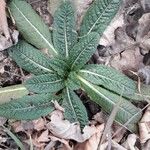
Dipsacus fullonum
Common Teasel · Teasel · Wild teasel · Fuller's Teasel · Venuscup Teasle
Description
Source: leafsnapDipsacus fullonum, commonly known as Fuller's teasel, is a biennial plant in the Dipsacaceae family. Native to Europe and Asia, it has been introduced to many other parts of the world. The plant can grow up to 2 meters tall and features a stout stem with opposite, lance-shaped, and toothed leaves. One of the most distinctive features of Dipsacus fullonum is its inflorescence, which consists of cylindrical flower heads surrounded by spiny bracts. The flowers, which bloom from July to September, are pinkish-purple. Throughout history, Fuller's teasel has been used for various purposes. Its spiny flower heads were traditionally used by textile workers for raising the nap on woolen cloth, giving it the name "Fuller's teasel." Additionally, it was believed to have medicinal properties and was used as a diuretic, tonic, and treatment for rheumatism. Beyond its practical applications, Dipsacus fullonum is also an important food source for various insects, including bees and butterflies. Its seeds are consumed by birds such as goldfinches. Overall, Dipsacus fullonum is a fascinating plant with unique features that have made it valuable and useful throughout history.
🌳 Wild teasel isn't widely recognized for many practical uses, but one lesser-known role is its popularity within the floral industry. The plant's dried heads are frequently used in flower arrangements for their characteristic spiky look and lasting quality. These traits provide a rustic, textural contrast in bouquets, especially in the dried-flower market where durability and visual appeal are valued.
🎭 Hatred of humanity
Care Guide
💧 Water Every 7 days
Water teasel plants regularly until fully established. Average water needs,watering when the top 3 cm(1,18") of soil has dried out.
☀️ Light Full sun
Wild teasel does best in places with plenty of sunlight, tolerating strong rays throughout the day. If it is healthy, it can also manage fairly well in moderate light. However, excessive shade can upset its energy balance and may lead to stunted growth or weakness.
🌡️ Temperature 0–32.2°C
Wild teasel is native to areas with a temperate climate and prefers temperatures of 68 to 95 °F (20 to 35 °C). Depending on the season, adjustments may be needed to reproduce those natural conditions.
💨 Humidity
🪴 Soil 6-7
🌱 Fertilizer
Wild teasel are regarded as heavy nutrient feeders. They require frequent, small doses of nitrogen and potassium fertilizers and periodic applications of phosphorus, micronutrients, sulfur, and magnesium to maintain good growth and bright coloration. Continuous fertilization throughout the growing season is needed to prevent deficiency symptoms and maintain optimal growth.
🪴 Pot & Repot
✂️ Pruning
🌿 Propagating
🐛 Diseases & pets
☠️ Toxicity
Dipsacus fullonum has no toxic effects reported. No reported toxicity to: birds, cats, dogs, horses, livestock or people.
Characteristics
- Plant Type
- Herb
- Life Cycle
- Biennial, Annual, Perennial
- Genus
- Dipsacus
- Family
- Caprifoliaceae
- Hardiness Zone
- 3-8
- Mature Height
- 0.91 m to 2.44 m
- Mature Spread
- 30 cm
- Leaf Color
- Green, Brown
- Leaf Type
- Deciduous
- Flower Color
- Lavender
- Flower Size
- 3.05 cm to 5.08 cm
- Bloom Time
- Early summer, Mid summer
- Planting Time
- Spring
- Harvest Time
- Mid summer