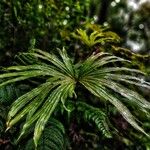
Dipteris conjugata
Description
Source: leafsnapDipteris conjugata is a species of fern. It has a rhizome, and 2-3 tall stems with mid green or dark green fronds, which have several divisions to toothed lobes. It is grows in clearings, mountain ridges and in forest margins, from tropical and temperate Asia, northern Queensland in Australia and some islands in the Pacific Ocean. It has limited native medicinal uses.
Care Guide
💧 Water
The Broad-Leaf Fern thrives in environments with high humidity, similar to its native tropical rainforests. Since it is not drought-tolerant, it requires watering twice a week to maintain the necessary moisture. As an evergreen plant, the Broad-Leaf Fern keeps its leaves throughout the year, so it's important to provide enough indoor humidity to replicate its preferred conditions.
☀️ Light Full shade
Broad-Leaf Fern is native to habitats such as forest understories and rocky areas that provide natural shade. It prefers Full Shade but can tolerate Partial Sun.
What are the sunlight requirements for plants?
Plants have varying sunlight requirements. Partial sun plants need about 3-6 hours of sunlight, while full sun plants require more than 6 hours of sunlight. It's essential to watch how sunlight moves through your garden and choose spots that offer the proper balance of light and shade for your plants, ensuring they thrive.
What are the essentials for growing Broad-Leaf Fern?
Broad-Leaf Fern, botanically known as Dipteris conjugata, typically grows in forest understories or rocky areas which provide natural shade. It thrives best in Full Shade but can tolerate Partial Sun conditions. Inadequate sunlight, especially in winter or less sunny spaces indoors, can be supplemented with artificial lighting for optimal growth. LED lights are advantageous because they can be adjusted to provide specific wavelengths needed by the plants. For full sun plants, it's recommended to provide 30-50W/sq ft of artificial light, partial sun plants need 20-30W/sq ft, and full shade plants require 10-20W/sq ft. Placement of the light source should be 12-36 inches above the plant, mimicking natural sunlight conditions for about 8-12 hours per day.
What are the symptoms of inadequate light for Broad-Leaf Fern?
Broad-Leaf Fern can show several symptoms due to insufficient lighting, including smaller new leaves, leggy or sparse growth, faster leaf drop, slower or no new growth, lighter-colored new leaves, chlorosis, sunscald, leaf curling, wilting, and leaf scorching. These symptoms indicate the plant is struggling with the light conditions it's in. Providing optimal light condition is crucial for its health and growth.
How can I solve lighting issues for my Broad-Leaf Fern?
To optimize growth for Broad-Leaf Fern facing lighting issues, gradually adapt them to better light conditions. Indoors, transition them to sunnier spots or use artificial lighting, ensuring they receive 3-6 hours of direct sunlight or equivalent artificial light daily. Outdoor plants should be moved gradually to avoid sunburn. Removing obstacles that block sunlight and carefully transplanting smaller plants during their dormant period can also help improve sunlight exposure. Note that parts of the plant damaged by insufficient light might not recover, but new growth should be healthy with improved light conditions.
🌡️ Temperature 20–37.8°C
Broad-Leaf Fern comes from tropical areas, where the climate is generally warm and humid. Consequently, it is well suited to high temperatures and humidity. It is sensitive to rapid temperature changes and prefers consistent temperatures, so indoor temperature swings should be avoided. It is generally intolerant of cold and needs warmer conditions to grow. If the surrounding temperature falls too low, the plant’s growth may stop or it may die.
💨 Humidity
🪴 Soil 6-7
🌱 Fertilizer
🪴 Pot & Repot
✂️ Pruning
The Broad-Leaf Fern has large, lobed fronds and benefits from annual pruning in early spring for optimal health. To enhance air circulation and reduce the risk of disease, remove any damaged fronds. Pruning back overgrown fronds can also encourage bushier growth. Be sure to use clean, sharp tools to prevent infection.
🌿 Propagating
🐛 Diseases & pets
☠️ Toxicity
Characteristics
- Plant Type
- Fern
- Life Cycle
- Perennial
- Genus
- Dipteris
- Family
- Dipteridaceae
- Hardiness Zone
- 10-12
- Mature Height
- 2.13 m
- Mature Spread
- 91 cm
- Leaf Color
- Green
- Leaf Type
- Evergreen
- Planting Time
- Spring, Summer, Autumn
- Native Area
- Malaysia, Indonesia, Cambodia, Vietnam, Japan, Vanuatu, Philippines, Singapore, Fiji, Thailand, China