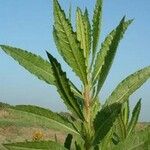
Dittrichia viscosa
مڨرمان · False yellowhead · Woody-fleabane · Aromatic inula · Sticky aster
Description
Source: leafsnapDittrichia viscosa, commonly known as sticky fleabane or woody fleabane, is a perennial herbaceous plant in the Asteraceae family. Native to the Mediterranean region, it has spread to other parts of the world, including North America and Australia. The plant can grow up to 1 meter in height and has a woody stem with sticky leaves covered in glandular hairs. Dittrichia viscosa produces small yellow flowers with five petals arranged in a daisy-like shape, which bloom from July through October. These flowers attract bees, butterflies, and other pollinators. For centuries, this plant has been used for medicinal purposes due to its anti-inflammatory properties, traditionally serving as a remedy for respiratory issues such as coughs and bronchitis. Known for its drought tolerance, Dittrichia viscosa is an ideal choice for xeriscaping gardens or landscapes with limited water availability. However, it can be considered an invasive species due to its rapid spread through self-seeding or vegetative propagation. Therefore, it should be monitored carefully when planted outside its native range. Overall, Dittrichia viscosa is an interesting plant, offering both medicinal benefits and an attractive appearance in gardens or landscapes where water is scarce.
Care Guide
💧 Water Every 7 days
False yellowhead is native to the Mediterranean region and thrives in dry climates due to its remarkable drought tolerance. When cultivated, it needs weekly watering and grows best in well-draining soil. This hardy outdoor plant is also resistant to salt spray, making it an excellent choice for seaside gardens where fresh water is scarce.
How should I water my False yellowhead plant?
To properly water the False yellowhead, it is recommended to use filtered water at room temperature. Tap water may have harmful particles, so using filtered water is preferable. The water should be at room temperature or slightly warmer since the False yellowhead is accustomed to a warm environment and can be sensitive to cold water. It is also advised to avoid overhead watering to prevent foliage complications. Instead, apply filtered room temperature water directly to the soil until it is completely soaked. This helps moisten the roots and allows them to spread through the soil and absorb the necessary nutrients.
What should I do if I give my False yellowhead too much or too little water?
Overwatering is a common issue for False yellowhead plants and can cause wilting, yellowing leaves, and diseases like root rot. Underwatering is less common but can lead to brittle, brown leaves. It is important to identify signs of overwatering early and reduce watering immediately. If the soil doesn't drain well, replace it with a well-draining potting mix. If there are signs of underwatering, simply water more regularly until the signs disappear.
How frequently do I need to water my False yellowhead?
If your False yellowhead plant is in a pot, you can check if it needs water by putting your finger in the soil. If the top two to three inches of soil feel dry, it's time to water it. If you have your False yellowhead planted outside in the ground, you can use the same method. When the top few inches of soil are dry, it needs watering. In the spring and early fall, you'll usually need to water it once a week using this method. In extremely hot weather, you might need to water it twice or more per week. However, mature and well-established False yellowhead plants have the ability to tolerate drought.
How much water does my False yellowhead bird need?
To properly water your False yellowhead, don't hold back on the amount of water you give. Wait until the top two to three inches of soil are dry, then give the plant a thorough watering. Make sure the soil is completely soaked. You should add enough water so that it drains out of the bottom of the pot. If you don't see any excess water draining, it means you haven't watered enough. However, be careful not to let water accumulate in the soil, as that can harm the plant. On the other hand, if water doesn't drain through the pot, it could mean the soil doesn't drain well, which is bad for the plant's health. If the plant is outdoors, one inch of rain per week should be sufficient.
How should I water my False yellowhead as it grows?
The water needs of the False yellowhead can vary depending on its growth stages. Specifically, when the plant is in its early years or has just been transplanted, it requires more water than usual. This is because during these stages, a lot of energy is dedicated to developing new roots, which will support future growth. These roots perform best with slightly higher moisture levels compared to later stages of maturity. As the False yellowhead matures over a few seasons, its water requirements decrease. Another stage where the plant may require additional water is during the bloom period. Flower development utilizes a significant amount of moisture, so it's important to provide extra water during this time.
☀️ Light Full sun
False yellowhead performs best with ample light throughout the day. In its natural environment it grows in the sunniest locations. Insufficient light can hinder its growth, while too much can cause dryness. The plant’s sunlight requirements remain the same at all stages of growth.
What are the sunlight requirements for False Yellowhead?
False Yellowhead requires full sun, meaning it should receive above 6 hours of sunlight daily. Observing how sunlight moves through your garden allows you to choose spots that offer a balance of light and shade, ensuring the plants' happiness. False Yellowhead thrives with abundant light throughout the day, but too little or too much light can stunt growth or cause dryness. The plant's sunlight needs remain consistent through different growth stages.
How can artificial lighting benefit False Yellowhead indoors?
Indoor plants, including False Yellowhead, require adequate lighting for optimal growth, especially when natural sunlight is insufficient, like during winter or in less sunny spaces. Artificial lights, such as LEDs which can be customized to specific wavelengths, provide a vital solution. For full sun plants, 30-50W/sq ft is recommended, partial sun plants need 20-30W/sq ft, and full shade plants require 10-20W/sq ft. The light source should be placed 12-36 inches above the plant, mimicking natural sunlight for 8-12 hours per day.
What are common symptoms of light deficiency in False Yellowhead?
Symptoms of light deficiency in False Yellowhead include smaller new leaves, leggy or sparse growth, faster leaf drop, slower or halted new growth, and lighter-colored or yellowing leaves (chlorosis). Excessive sunlight can cause sunscald, leaf curling, wilting, and leaf scorching. These symptoms indicate the plant's struggle with inadequate light conditions, affecting its growth and overall health.
What solutions can address light deficiency or excessive sunlight for False Yellowhead?
To address light deficiency in False Yellowhead, gradually move the plants to sunnier locations, ensuring at least 6 hours of sunlight daily. For indoors, use south-facing windows or artificial light for at least 8 hours a day. For outdoor plants, avoid sudden changes in light to prevent sunburn. Reducing obstructions and transplanting to sunnier locations can also help. Note that parts of the plant damaged by insufficient sunlight may not recover, but new growth should be healthy once light conditions improve.
🌡️ Temperature 20–37.8°C
False yellowhead occurs naturally in habitats where temperatures are usually between 68 and 100 °F (20 to 38 °C). It prefers temperate climates and shows considerable adaptability to seasonal variations. Care should be taken to keep temperatures within its preferred range.
What is the native environment of False yellowhead?
False yellowhead, botanically known as Dittrichia viscosa, thrives in environments where temperatures range from 68°F to 100°F (20°C to 38°C). It is best suited to temperate climates and exhibits a strong adaptability to seasonal changes. The plant is extremely heat-loving, sensitive to cold temperatures, and requires specific care to flourish, especially regarding maintaining the appropriate temperature range.
How should False yellowhead be cared for in autumn and winter?
As autumn approaches and temperatures begin to drop, it is advisable to bring outdoor-grown False yellowhead indoors to protect it from the cold. Placing it near a bright window ensures it receives sufficient light; however, it should not be placed too close to heaters to avoid damage. Maintaining indoor temperatures above 20°C during the winter months is pivotal for the health of the plant. Exposing it to temperatures near or below 0°C can be detrimental and should be avoided.
What are the symptoms of low temperature exposure in False yellowhead?
When exposed to temperatures below its preference, False yellowhead may exhibit several symptoms indicative of distress. These include lightening of leaf color when temperatures fall below -5°C, which after frost damage can progress to browning or blackening of the leaves. Wilting and drooping are also common symptoms. To mitigate such damage, it is recommended to trim off frost-damaged parts and move the plant to a warmer, ideally sunlit indoor location, while avoiding placing the plant too close to heaters or air conditioning vents to prevent the air from becoming excessively dry.
How can high temperatures affect False yellowhead and what are the solutions?
False yellowhead should ideally be kept under 38°C during the summer. Exposure to temperatures above 43°C can result in the lightening of leaf colors and increased susceptibility to sunburn. In such cases, it is advisable to trim away the sunburned and dried parts of the plant, move it to a shaded location especially during the midday and afternoon sun, and ensure the soil remains moist by watering in the morning and evening.
💨 Humidity
🪴 Soil 6-7
🌱 Fertilizer
Proper fertilization is essential for False yellowhead's health and looks. Fertilize False yellowhead in summer, repeating the application monthly throughout the season. Nutrients provide the energy for growth and help maintain the plant's structures. Fertilization improves False yellowhead's floral display, promoting the best blooms.
Why do I need to add fertilizer to my False yellowhead plant?
All plants, including the False yellowhead, need soil nutrients to grow. However, it's not always guaranteed that the soil in your garden will have all the necessary nutrients. To make sure your plants have what they need, fertilization and soil amendments are important. This ensures that your garden plants not only receive the basic nutrients but also the specific ones they require. For the False yellowhead, fertilizer is vital to support healthy root and stem development throughout the growing season. Additionally, fertilization helps the False yellowhead produce beautiful leaves, which are especially important for this plant's ornamental appeal.
When should I fertilize my False yellowhead plant?
To help your False yellowhead thrive, give it the most fertilizer when it's actively growing, which is usually during spring, summer, and early fall. Once winter is over, feed it every two to four weeks until fall. As fall approaches, gradually decrease the amount of fertilizer given until you stop completely in preparation for the slower growth during winter.
When should I not add fertilizer to my False yellowhead plant?
For most of the year, including spring, summer, and fall, it is recommended to regularly feed your False yellowhead. However, if you notice that it has received too much fertilizer or if you have fertilized it incorrectly, causing fertilizer burn or other issues, you will need to address these before resuming a regular feeding schedule. The only exception to fertilizing your False yellowhead is during winter. If you grow it indoors in a cold winter area, it will enter a dormant phase. Feeding the plant during this phase is not necessary or beneficial for its growth, and it is likely to result in fertilizer burn.
Which type of fertilizer does my False yellowhead plant need?
When fertilizing a False yellowhead, it is important to use a fertilizer that has a specific blend of nutrients in relatively low amounts. An ideal fertilizer will have an N-P-K ratio of 3-1-2, but a general-purpose fertilizer with an even blend can also be effective. Regardless of the type of fertilizer used, the ratio number representing the volume of each nutrient should be at 10 or lower. If you choose to use a liquid-based fertilizer, it is recommended to dilute the strength by half. While granular fertilizer has its benefits, using liquid fertilizer is generally more practical, especially if you provide water while feeding your False yellowhead.
How do I make my False yellowhead plant grow better?
When purchasing fertilizer for your False yellowhead, it is important to read and follow the application instructions. To prevent the fertilizer from damaging the plant's roots, it is recommended to fertilize just before or during watering the soil. If you are using a slow-release granular fertilizer, sprinkle it onto the soil and then water immediately. For liquid-based fertilizers, dilute it with water and apply to the soil, followed by supplying a bit more water. During spring and fall, when the plant's growth is increasing or slowing down, it is especially important to dilute the fertilizer by at least half.
🪴 Pot & Repot
✂️ Pruning
The False Yellowhead plant boasts bright yellow flowers and a bushy growth habit. To keep it healthy, regular pruning is important. Essential pruning techniques include removing dead stems and thinning out branches to improve air circulation. Pruning should be done from early to late spring to encourage healthier growth. Making clean cuts during pruning also enhances the plant's overall vigor and appearance.
🌿 Propagating
🐛 Diseases & pets
☠️ Toxicity
Dittrichia viscosa can cause health problems in humans and animals. The oil on the leaves and stems causes contact dermatitis, resulting in itching and blistering skin.
Characteristics
- Plant Type
- Herb, Shrub
- Life Cycle
- Perennial
- Genus
- Dittrichia
- Family
- Asteraceae
- Hardiness Zone
- 9-11
- Mature Height
- 0.4 m to 1.22 m
- Mature Spread
- 91 cm
- Leaf Color
- Green, Blue
- Leaf Type
- Semi-evergreen
- Flower Color
- Yellow
- Flower Size
- 2.03 cm to 2.29 cm
- Bloom Time
- Mid summer, Late summer
- Planting Time
- Spring, Autumn
- Harvest Time
- Mid summer, Late summer, Early fall