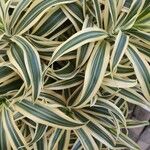
Dracaena reflexa
دراسينا هندي · Song-of-India · It IS NOT a Song of India. This is a Tri-Colored Dracaena · Tri-colored Dracaena · Song of India
Description
Source: leafsnapDracaena reflexa, commonly known as the Song of India or Pleomele, is a popular ornamental plant that belongs to the Asparagaceae family. Native to Madagascar and other Indian Ocean islands, it has become a favorite houseplant worldwide due to its attractive foliage and ease of care. The plant features long, narrow leaves that are dark green with yellow stripes running down the center. These leaves grow in clusters at the end of each stem, giving the plant a bushy appearance. The stems are woody and can reach up to six feet tall under ideal conditions. Dracaena reflexa thrives in bright but indirect light and can also tolerate low light conditions. It requires well-draining soil with regular watering, though it can endure periods of drought. The plant is sensitive to fluoride in water, so it’s best to use distilled or filtered water for watering. The Song of India is renowned for its air-purifying properties, effectively removing harmful toxins such as formaldehyde, benzene, and trichloroethylene from indoor air. This makes it an ideal choice for indoor spaces like homes and offices. Overall, Dracaena reflexa is an excellent option for those seeking an attractive, low-maintenance houseplant that not only enhances interior beauty but also improves indoor air quality.
💡 Some fascinating animal species rely on the Song of India plant for their survival in their natural habitat. Its fruits are a crucial part of the diet of the critically endangered black-and-white ruffed lemur. Additionally, the giant frigate beetle, the largest darkling beetle in the world, is also associated with this plant.
🌳 Many people don't realize that the Song of India was identified by NASA's Clean Air Study as a highly effective air purifier. Its capability to remove harmful chemicals like benzene, formaldehyde, trichloroethylene, and xylene from indoor air is a notable yet often neglected attribute. Thus, the Song of India functions not only as decorative greenery but also as a practical contributor to healthier indoor environments.
🎭 Personal power, spiritual awareness, cleansing, ardor, fortitude
Care Guide
💧 Water Every 7 days
The Song of India plant thrives in moderate to high humidity and requires consistent moisture, although it can tolerate occasional dryness. It should be watered every two weeks using well-draining soil to prevent root rot. This plant is commonly grown indoors for its ornamental value, reflecting the conditions of its tropical native environment.
When should I water my Song of India?
Watering your Song of India is crucial for its health, requiring a perfect balance as it's sensitive to both overwatering and underwatering. To determine the right time to water, check the top 2-3 inches of soil; if it's dry, the plant needs watering. Look out for signs of water stress such as leaf curling, changes in color to yellow or brown, especially at the tips, or soft and droopy texture, which indicate the plant needs water. Adequate watering is essential to avoid conditions like root rot from overwatering or dehydration from under-watering, and neglecting these signs can lead to severe stress and even death of the plant.
How should I water my Song of India?
Your Song of India, or Dracaena reflexa, thrives on infrequent but deep watering to keep the soil lightly moist without being waterlogged. Use a watering can with a long spout to direct water to the base and roots, avoiding the leaves to reduce the risk of fungal diseases. A moisture meter can be a valuable tool to check if the topsoil is dry, indicating it's time for watering. It's essential to focus on wetting the soil, not the foliage, and ensure the pot has good drainage to prevent diseases from overly wet conditions.
How much water does Song of India really need?
The Song of India prefers its soil to be evenly moist but never waterlogged. The amount of water needed varies with factors like pot size and the plant's size. A good rule of thumb is to allow the soil to dry out slightly between watering, with an ideal volume ranging from 1 to 2 cups (236 to 473 ml) per session. Proper hydration results in green, lush leaves and a healthy growth habit, while over or under-watering can lead to yellowing leaves, root rot, and even plant death. For optimal health, use well-draining soil and provide a humid environment, emulating the plant's natural habitat.
What kind of water is best for Song of India?
The Song of India plant does well when watered with rainwater or distilled water, as these are free from chemicals and have a balanced pH. Tap water can be used if necessary but may contain chlorine, fluoride, and other minerals to which the plant is sensitive. To minimize these risks, let tap water sit for 24 hours before use to evaporate the chlorine, or use a filter to remove contaminants. The water should be at room temperature to avoid shocking the plant.
How do Song of India's watering needs change with the seasons?
The watering needs of Song of India vary across seasons. In spring, water when the soil feels dry to support the new growth phase, being mindful of the risk of late frosts. During summer's active growth phase, maintain consistent soil moisture due to higher temperatures and sunlight exposure. In autumn, reduce watering as the weather cools and growth slows. Winter requires further reduced watering, allowing the soil to dry out more between sessions and being cautious of indoor heating's drying effects. These seasonal adjustments help maintain the plant's health year-round.
☀️ Light Partial sun
Song of india favors locations where sunlight is filtered, yet it can withstand spots that receive full sun. Originating from such habitats, the plant is adapted to these light conditions. However, too much exposure can cause leaf burn, while too little light may hinder the plant's healthy growth.
What are the sunlight requirements for plants?
Plants have varying sunlight requirements to thrive. Partial sun refers to areas that receive about 3-6 hours of sunlight per day, while full sun areas receive more than 6 hours of sunlight. It's important to watch how sunlight moves through your garden, choosing spots that offer a balanced mix of light and shade, to ensure your plants remain happy and healthy.
What are the essential lighting conditions for Song of India?
Song of India prefers locations where sunlight is filtered, but it can also tolerate full sun. Originating from environments with similar light conditions, it has adapted well, but overexposure may cause leaf burn, and insufficient light can affect the plant's growth negatively. During periods of low natural light, such as winter or in less sunny indoor spaces, artificial lighting can be a crucial solution for maintaining optimal growth. LED lights are recommended for their ability to provide specific wavelengths required by plants, with varying wattage recommendations based on the plant's sunlight needs.
What are the symptoms of insufficient light in Song of India?
Symptoms of insufficient light in Song of India include faster leaf drop, as the plant sheds older leaves to conserve resources; lighter-colored new leaves, indicating a lack of chlorophyll and nutrients; loss of variegation, with some leaves possibly turning completely green; leggy or sparse growth, making the plant appear thin and weak; chlorosis, where leaves lose their green color and turn yellow; sunscald, with damage from intense sunlight exposure; leaf curling, a defense mechanism to reduce surface area exposed to sunlight; wilting, due to excessive water loss; and leaf scorching, characterized by brown, dry patches on leaves due to overexposure.
How can I address lighting issues for my Song of India?
To optimize growth for Song of India, gradually acclimate it to increasing sunlight by relocating it to sunnier spots each week until it gets 3-6 hours of direct sunlight a day. For large or immovable plants, supplement with artificial light, using a desk or ceiling lamp for at least 8 hours daily, or invest in professional grow lights. Outdoors, move plants gradually to prevent sunburn. To increase sunlight exposure, reduce obstructions such as branches from trees or consider transplanting to a brighter location during the plant's dormant period.
🌡️ Temperature 20–37.8°C
For song of india, its native growth environment requires temperatures between 68℉ and 100℉ (20℃ and 38℃). It prefers temperatures in the 68℉ to 80℉ (20℃ to 27℃) range. During colder seasons, it is recommended to adjust the temperature around the plant to 60℉ to 75℉ (16℃ to 24℃).
What are the ideal temperature conditions for a Song of India plant?
The Song of India, or Dracaena reflexa, thrives in temperatures ranging from 68°F to 100°F (20°C to 38°C), with a preference for the 68°F to 80°F (20°C to 27°C) range. During the colder seasons, it's suggested to keep the surrounding temperature between 60°F to 75°F (16°C to 24°C). This plant loves heat, and exposure to cold can be harmful. In autumn, if grown outdoors, it's recommended to bring it inside and place it near a bright window while keeping it away from heaters. Ensuring the temperature remains above the minimum suitable growth temperature during winter benefits its growth, while exposure to temperatures nearing the minimum tolerable growing temperature can be detrimental.
What should I do if my Song of India is exposed to low temperatures?
If your Song of India experiences low temperatures, it may exhibit lighter leaf coloration and, after frost damage, leaves can turn brown or black, accompanied by wilting and drooping. To address this, trim off the frost-damaged parts and immediately move the plant to a warmer, indoor location. Placing it near a south-facing window is ideal to ensure it gets enough sunlight. However, make sure it's not too close to heaters or air conditioning vents, as they can cause the air to become excessively dry, further stressing the plant.
How should I care for my Song of India during high temperatures?
During the summer, it's crucial to ensure the Song of India doesn't surpass the maximum suitable growth temperature. Exceeding the tolerable growing temperature maximum can cause the leaves to lighten and increase susceptibility to sunburn. To mitigate this, trim away the sunburned and dried parts of the plant. Move it to a spot that's shaded during the midday and afternoon sun. Watering the plant in the morning and evening will help maintain moisture in the soil, helping the plant better cope with the heat.
💨 Humidity high (>60%)
This plant needs special care because it loves high humidity levels of 60-80% or more. The best way to achieve this is by placing a humidifier near the plant. Daily misting is also essential! Make sure the room has good ventilation.
🪴 Soil 6-7
🌱 Fertilizer Every 90 days
Fertilizing is essential for the care of Song of India. Regular feeding during the growing season supplies the energy required for its showy leaves and supports overall growth. Failure to fertilize can lead to unhealthy leaves, reduced ornamental appeal, and stunted or weak growth that is prone to breaking.
Why is it necessary to give fertilizer to my Song of India plant?
Song of India requires regular fertilization due to its energy-consuming showy leaves. It must allocate sufficient energy for leaf maintenance and growth of stems, branches, roots, and other essential structures. Neglecting fertilization can lead to two likely outcomes. Firstly, the leaves may lose their natural color and texture, appearing unhealthy and diminishing its ornamental appeal. Secondly, overall growth may slow down or result in weak growth that is prone to breakage.
When should I fertilize my Song of India plant?
Song of India plants will benefit from occasional feedings, so there is no need for a set feeding schedule when you plant one. A simple way to fertilize your Song of India is to apply fertilizer when you water the plant occasionally. Additionally, during the growing season, this plant requires a good amount of water. You can feed it once every two to three weeks, consistently throughout its period of producing new growth.
When is the best time to not add fertilizer to my Song of India plant?
For most of the year, you can stick to a regular fertilization schedule for your Song of India plant. This includes the active growing season of spring, summer, and early fall. However, during winter, it is important to refrain from fertilizing the plant. This is because Song of India enters a dormant growth phase during this time, meaning it either produces no or very little new growth. Since the plant is using less energy during this period, fertilization is unnecessary.
What kind of plant food does my Song of India plant need?
To properly fertilize a Song of India plant, it is important to use a specific blend of nutrients in relatively low amounts. The ideal ratio for these nutrients is 3 parts nitrogen, 1 part phosphorus, and 2 parts potassium (N-P-K ratio of 3-1-2). However, in some cases, a general-purpose fertilizer with an even blend of nutrients can also work well. Regardless of the type of fertilizer used, it is important to ensure that the ratio number representing the volume of each nutrient is 3 or lower. There are two options for fertilizer: granular or liquid-based. If you choose to use a liquid-based fertilizer, it is recommended to dilute its strength by half. While granular fertilizer doesn't have many downsides, using liquid fertilizer is often the preferred choice, especially if you plan to water your Song of India plant while feeding it.
How do I give plant food to my Song of India plant?
One of the easiest methods to fertilize a Song of India plant is to feed it every time you water it. To do this, gather your fertilizer and a water container, such as a watering can. Mix the fertilizer with water to weaken its strength, then pour the diluted mixture onto the soil and let it soak down to the roots. Another option is to use a granular fertilizer. Simply sprinkle the fertilizer on the soil where your Song of India plant is located. Granular fertilizers usually release their nutrients slowly, so you won't need to fertilize as frequently as you would with a liquid fertilizer. Regardless of the method you choose, it's a good idea to water the plant while you feed it.
🪴 Pot & Repot 2-3 years
When repotting Song of india, select a pot 1-2 inches (2.5–5.1 cm) larger with ample drainage. Use a well-draining potting mix. Repot in spring or fall, making sure the root ball sits slightly below the rim of the flower pot. Water thoroughly after repotting and place it in a warm spot with indirect sunlight.
✂️ Pruning
To ensure the Song of India remains vibrant and healthy, regular pruning during its dormant period—from early to late winter—is essential. Key practices include removing dead leaves, trimming overgrown areas, and shaping the plant. This process encourages new growth, improves airflow, and helps prevent pests and diseases.
🌿 Propagating
🐛 Diseases & pets
☠️ Toxicity
Characteristics
- Plant Type
- Shrub
- Life Cycle
- Perennial
- Genus
- Dracaena
- Family
- Asparagaceae
- Hardiness Zone
- 10-12
- Mature Height
- 4 m to 6 m
- Mature Spread
- 0.91 m to 2.44 m
- Leaf Color
- Green
- Leaf Type
- Evergreen
- Flower Color
- White, Yellow, Purple
- Flower Size
- 0.51 cm to 0.76 cm
- Bloom Time
- Mid spring, Late spring, Summer
- Planting Time
- Spring, Summer, Autumn, Winter
- Harvest Time
- Late summer, Fall
- Native Area
- Madagascar, Mozambique